Why Permaculture’s Founding Principles Require Technology, Not Refusal
A Cernunnos Foundation Position Paper on Permaculture and the Work of Restoration
There is a sentence at the foundation of permaculture that the discipline has, over the past three decades, quietly rewritten.
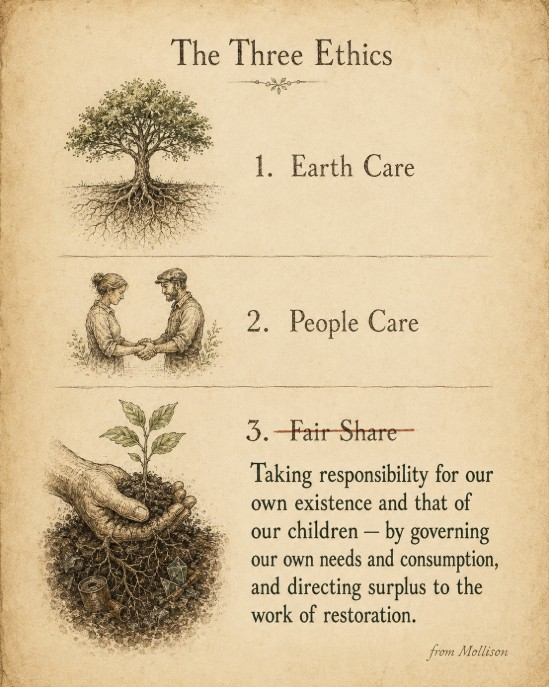
In Bill Mollison’s original framing, the three ethics of permaculture were Earth Care, People Care, and the third — variously rendered across his work as taking responsibility for our own existence and that of our children, setting limits to consumption and reproduction, and redistributing surplus to those ends. The third ethic, in Mollison’s own words, was a demand for active responsibility. It asked the practitioner to take ownership of what humans had done to the planet, and to participate in fixing it.
Somewhere in the translation from Mollison’s foundational work to contemporary practice, that ethic became Fair Share.
The phrase is not Mollison’s. It emerged in the reformulations that followed his original writing, in the textbooks and certification courses and movement materials that built modern permaculture as a popular discipline. Fair Share is gentler. It implies generosity rather than obligation, sharing rather than fixing. It points the practitioner toward what they have to give, rather than toward what they owe.
This was not a small edit. It was a load-bearing change to the framework, and it has shaped the discipline ever since.
What Mollison Actually Asked For
The third ethic, as Mollison wrote it, was the most demanding of the three. Earth Care can be performed through gardening, water harvesting, soil building, and habitat restoration at the scale of an individual property. People Care can be performed through community organizing, mutual aid, and the slow work of building local resilience. Both ethics are deeply valuable, and both have been the focus of the discipline’s most visible achievements.
The third ethic asks for something different. It asks the practitioner to recognize that human civilization has done substantial damage to the planet — not abstractly, not as a regret, but as a material inheritance with real coordinates: contaminated rivers, leaching landfills, depleted topsoils, eroded watersheds, lost forests, fractured habitats. It asks the practitioner to take responsibility for that damage. It asks them to participate in fixing it.
That is not the same thing as sharing. A surplus of vegetables given to a neighbor does not address a single legacy landfill. A community seed library does not remediate a poisoned watershed. These are good acts. They are not the third ethic.
The third ethic, taken at its original word, requires the practitioner to engage with damage at the scale at which damage was done. And the damage was done by industrial civilization, at industrial scale, over a century and a half of accumulating decisions. To take responsibility for that inheritance — to genuinely take responsibility, in the sense Mollison used the word — requires interventions sized to match.
This is the sentence the discipline rewrote. And in rewriting it, the discipline let itself off the hook.
The Cultural Drift
The drift from take responsibility to fair share did not happen in a vacuum. It happened because permaculture, as it grew into a popular movement, absorbed cultural currents that were skeptical of technology, suspicious of industrial systems, and protective of small-scale and biological methods as the only legitimate domain of practice. These cultural commitments have produced real value — they preserved knowledge, built communities, and demonstrated that small-scale ecological design could work.
They also narrowed the discipline. A permaculture community that defines itself by what it refuses — refuses tools, refuses industrial scale, refuses manufactured systems — cannot, by definition, take responsibility at any scale larger than what hand tools and biological methods can address. And the damage humans have done is not at that scale. It is much, much larger.
The result is a contemporary discipline that performs Earth Care and People Care with skill and dedication, and that has effectively retired from the third ethic. Practitioners can complete certification courses, design productive small farms, build resilient communities, and never engage with a single legacy industrial wound. The framework allows it. The community celebrates it. The original demand — to take responsibility for what we have done — has been quietly converted into a softer call to share what we have, which is something altogether different.
This is the work that needs to be undone. The discipline must read Mollison again, in the original language, and confront the gap between what the founder wrote and what the movement has become.
What Restoration Actually Requires
When the third ethic is restored to its original demand, the practical implications follow immediately and inescapably.
Cleaning a contaminated watershed at the scale of an actual watershed is not a hand-tool job. It requires integrated systems — biological filtration, mineral binding, microbial communities, controlled flow regimes — operating at volumes and rates that small-scale methods cannot achieve. It requires tanks, pumps, monitoring instruments, and engineered substrates. It requires manufacturing capacity directed toward restorative ends.
Reclaiming a legacy landfill is not a community garden project. It requires excavation equipment, materials sorting infrastructure, hydrothermal processing reactors, and biochar production at industrial volumes. It requires the integration of metals recovery, fuel production, and remediation backfill into a single operational sequence. It requires manufacturing capacity directed toward restorative ends.
Restoring soil at the scale of agricultural collapse — the topsoil losses across continental cropland, the salinity damage across irrigated regions, the chemical residue accumulation across decades of conventional farming — is not a backyard composting project. It requires biochar at scales of millions of tons annually, distribution networks that can reach working farms, and the integration of soil amendment with the broader carbon cycle. It requires manufacturing capacity directed toward restorative ends.
The pattern is consistent across every actual instance of damage that the third ethic asks practitioners to address. The damage is at industrial scale. The response must be at industrial scale. And industrial scale requires manufacturing.
This is not a betrayal of permaculture’s principles. This is permaculture’s principles meeting the demand its third ethic has always made of them. The biological systems, the closed loops, the cyclical material flows, the design rooted in observation of natural systems — these all hold. They are the foundations of how the manufacturing must be designed. But the foundations alone do not produce a watershed restoration program, a landfill reclamation operation, or a continental soil amendment supply chain. Foundations require buildings.
The Profitability That No One Is Talking About
The cultural assumption, inside permaculture as it currently exists, is that this kind of restorative work is sacrificial — that someone has to give something up to make it happen, that it requires subsidy, charity, or moral commitment in lieu of viable economics. This assumption is false, and it is one of the most damaging unexamined inheritances of the discipline’s drift.
Restorative manufacturing, designed correctly, is extraordinarily profitable.
A landfill reclamation operation produces metals at concentrations that compete favorably with primary mining. It produces fuel feedstocks from carbon-bearing waste. It produces biochar that can be sold into agricultural and remediation markets. It produces remediated land that can be sold to developers. Every output stream has a real market. The operation pays for itself and generates surplus, while accomplishing the restorative work that the third ethic demands.
An integrated aquaponic and thermochemical system applied to nutrient-loaded watersheds produces marketable protein, marketable produce, marketable biochar, and marketable soil amendments — while pulling nitrogen and phosphorus loads out of waterways that would otherwise drive algal collapse. The operation pays for itself and generates surplus, while accomplishing the restorative work that the third ethic demands.
A continental biochar supply chain producing soil amendment for agricultural recovery monetizes carbon sequestration credits, sells amendment product to farmers, and recovers value from biomass waste streams. The operation pays for itself and generates surplus, while accomplishing the restorative work that the third ethic demands.
The pattern is consistent. When restorative manufacturing is designed with permaculture principles — closed loops, multiple yields, stacked functions, waste as input — the economics are not just viable but compelling. The same principles that make a permaculture garden productive make a permaculture-designed industrial operation productive. The principles scale. They have always scaled. The discipline has simply not been willing to do the work of scaling them.
This matters because the cultural framing of restoration as sacrifice has limited the discipline’s reach. Practitioners who would gladly take on profitable restorative work have been told, implicitly, that profitability and restoration are in tension — that the truly principled path is the small, the slow, the sacrificial. This has been bad for the planet and bad for the practitioners. The damage continues to accumulate while the discipline confines itself to interventions that cannot match the damage in scope.
A mature permaculture, returned to its third ethic, does not have to choose between principle and viability. It can pursue both. It must pursue both. The scale of the responsibility makes any other choice an evasion.
What Maturity Looks Like
A permaculture discipline that has read Mollison again, restored the third ethic to its original language, and embraced the manufacturing implications would look measurably different from the discipline as it currently exists.
It would treat industrial-scale restoration projects as central to the practice, not as exotic departures from it. The certification programs would include modules on hydrothermal processing, integrated aquaponic systems at municipal scale, biochar production engineering, and the design of closed-loop industrial operations. The discipline’s exemplary projects would include not just farms and gardens but watershed-scale restoration operations, landfill reclamation facilities, and soil amendment supply chains. The conferences would feature engineers and process chemists alongside permaculture designers, because the work requires both.
It would speak about profitability without apology. The third ethic does not require sacrifice; it requires responsibility, and responsibility at scale is paid for by the value the work generates. A discipline that hides this is doing itself and the planet a disservice.
It would be willing to use the language Mollison used. Take responsibility for our own existence and that of our children. Not as an aspiration. Not as a soft preference. As the active demand the founder placed at the foundation of the framework.
And it would understand, finally, that manufacturing is not the enemy of permaculture’s principles. Manufacturing aimed correctly — manufacturing that closes loops, restores what was damaged, and discharges the inheritance the previous generations left — is permaculture’s principles taking the form the scale of the work requires. The principles are sound. The principles have always been sound. The principles are waiting for practitioners willing to apply them at the scale at which the third ethic has always been pointing.
Read Mollison Again
The work of restoring permaculture’s third ethic begins with re-reading the foundational text. Not the textbooks, not the certification materials, not the popular reformulations. The original work, in Mollison’s own language, with attention to what he actually asked for.
What he asked for was responsibility. Not sharing. Responsibility for what we have done and for what we are leaving our children. He asked for it as a practical demand on the discipline, not as a philosophical stance. He asked the practitioner to participate in the work of fixing what industrial civilization had broken, using the design principles permaculture had developed.
Three decades on, the work he asked for is more urgent than it was when he wrote. The damage has accumulated. The legacy landfills have aged. The watersheds have grown more loaded. The topsoils have grown thinner. The window during which the third ethic can be discharged at any reasonable scale is narrower than it has ever been.
The discipline must grow up. It must put aside the cultural anti-technology drift that has substituted for engagement with the actual scope of the work. It must recover the language Mollison used and the demand he placed at the foundation of the framework. It must accept that taking responsibility, at the scale of the inheritance, requires manufacturing — and that manufacturing rooted in permaculture principles is both viable and profitable.
The third ethic has been waiting. The work has been waiting. The principles have been sound the entire time.
It is time to take responsibility.
Cernunnos Foundation publishes position papers on systems design, ecological restoration, and the integration of technology with regenerative practice. This paper is offered as a contribution to the renewal of permaculture’s foundational principles and the recovery of its founding ethics.