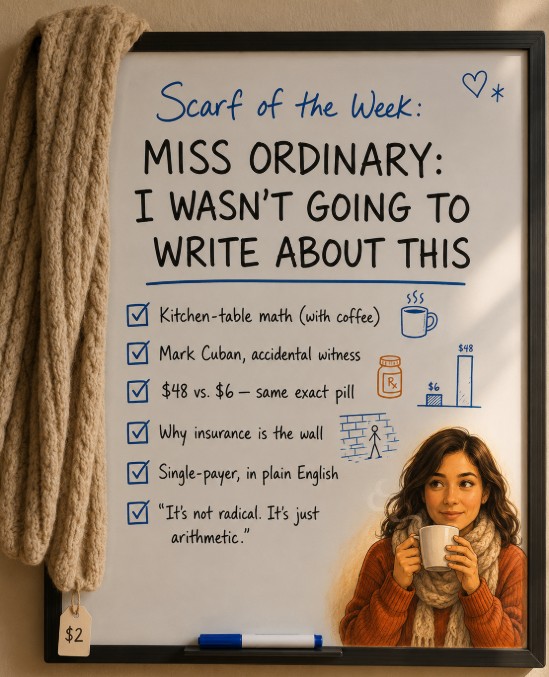
I wasn’t going to write about this. Money is exhausting and politics isn’t my lane, and I had a whole post planned about a new oatmeal-colored scarf I found at the Goodwill on Scalp Avenue for two dollars. It is exactly the color of a latte with extra milk and I am, frankly, obsessed with it.
But Mark Cuban has been on my feed for weeks now, and I can’t shake what he’s been saying.
If you don’t know him, he’s the Shark Tank guy. The Mavericks guy. He’s a billionaire, which is not usually who I quote in a cozy column. But about three years ago he started a pharmacy called Cost Plus Drugs. The whole idea is: he buys medicine, adds fifteen percent, and sells it to you. The price is on the website. No coupons, no cards, no haggling. The math is right there.
And here is the part I keep thinking about. On a lot of medicines, his price is fifty to ninety percent lower than what people are paying through insurance.
I had to read that twice the first time.
So Cuban, who is about as pro-business as a person can be, has been on Twitter — sorry, X — basically every week, frustrated. He’s frustrated because he built a thing that works and the system still won’t let most people use it. He has used profanity in front of the drug industry’s own trade group. He has called the prices “insane.” He has, in his words, said the quiet part loud.
I am usually skeptical of billionaires telling me how the world works. But the math is the math, and the math is on the website.
Here is what he keeps explaining. There are three companies — Express Scripts, CVS Caremark, OptumRx — that sit between your doctor’s prescription and the pill in your hand. They are called pharmacy benefit managers, which is the kind of name an industry gives itself when it doesn’t want you to look directly at it. What they do is decide which medicines your insurance will cover, take secret discounts from the drug companies, and pocket the difference. The Federal Trade Commission — the government’s own people, under two different presidents — looked at this and said those middlemen marked up drugs by 7.3 billion dollars above what they actually paid for them. Last year.
7.3 billion dollars. For doing what, exactly. For being there.
I sat at the kitchen table on Tuesday with my own bill and a fresh cup of coffee, and I did the very small math of one ordinary American. My monthly prescription, through my plan, costs me forty-eight dollars. The same prescription, on Cost Plus, is six. Six dollars. Even adding shipping it would be cheaper to buy it without my insurance than with it. That is not a thing my brain knows how to hold.
And then I read something else, and I haven’t been able to put it down.
UnitedHealth, the biggest insurance company in the country, made twelve billion dollars in profit last year. Cigna made six. CVS, which owns Aetna and also one of the pharmacy middlemen I just mentioned, runs both sides of the same store. Elevance — that’s the company you might still know as Anthem — pulled in almost two hundred billion dollars in revenue. Two hundred billion. With a B. The Wall Street Journal — not, you know, a radical publication — found that insurance companies had added fifty billion dollars in extra diagnoses to people’s medical charts that the patients didn’t actually have, to bill Medicare more.
That isn’t a glitch in the system. That is, very clearly, what the system does.
I want to be careful here because I don’t like meanness and I don’t like cynicism. So let me just say what I actually think, gently.
We’ve been told for my entire life that competition is what will bring prices down. That if we just let the market work, things will get cheaper and better. I believe in that, mostly. I’m a thrift store girl. I love a good price.
But when a billionaire — a real one, with a working pharmacy and the FTC on his side — cannot get his fifteen-percent-margin medicine into your plan, because your plan is run by a company that exists to keep him out, then the market is not working. The market is being prevented from working. By the same people who keep telling us the market will work, if only we wait a little longer.
And I don’t think most of the people who own these companies are evil. I think the awful thing is much quieter than that. The people who own these insurance companies are mostly the big retirement funds and asset managers. Vanguard. BlackRock. State Street. Pension funds. University endowments. So the way we all keep paying through the nose for prescriptions and procedures and denied claims is, in a strange roundabout way, how somebody else’s retirement account goes up by another quarter percent. The product is not the medicine. The medicine is the cost of goods. The product is the line going up.
That’s the part that makes me a little sad. Because it means it isn’t a villain. It’s just a structure. And structures can be changed.
I keep thinking about my neighbor, who is a sweet older lady I bring soup to in the winter. She told me last month, very matter-of-factly, that she skips her blood pressure pill three days a week to make the bottle last. She wasn’t complaining. She was just telling me. The way you might mention the weather. Oh, I just stretch it out. My friend at church has a husband whose insulin costs more than their car payment. They are not poor. They are working. They are doing what we are all told to do.
So I guess I’ll say the thing, even though it is not my usual lane.
I think we deserve to just buy the medicine. I think we deserve to see a doctor without the middle layer deciding if it counts. I think we deserve a system that is built around the patient getting better, not around quarterly earnings calls. Every other country I might want to visit has figured this out. They live longer than we do and they pay half as much.
The boring word for this is single-payer health care. It is not a scary thing. It is the government doing for everyone what Mark Cuban is trying to do for prescriptions — buying the care, paying for it directly, and skipping the middle layer whose entire job is to take a cut. That’s it. That’s the whole idea.
It’s not radical. It’s just arithmetic.
Anyway. I’m sorry this one was heavier than usual. Tomorrow I’ll be back with scarves and coffee and the way the light comes in the back window at four o’clock. But this one was sitting in my chest and I had to put it on the page.
Be kind to yourself this week. Take the walk. Drink the water. And if a billionaire who hates wasting money tells you the system is wasting yours — maybe it’s okay to listen.
Stay clean, stay kind, stay caffeinated.
— Heather