Or: Do You Want to Make More Money Making Your City Better?
I’m going to tell you, up front, that I think you’re probably a turd.
Not all of you. But enough of you that I want it on the record before we go further. You’re sitting on enough money to feed a county and most of you have arranged your lives so that you don’t have to look at the county. You’ve made your peace with that arrangement through some combination of philanthropy that costs you nothing, political donations that protect what you’ve already extracted, and a quiet certainty that the people who built the wealth you inherited or compounded would have wanted you to keep it concentrated rather than spread it back into the kinds of places where the wealth was made in the first place.
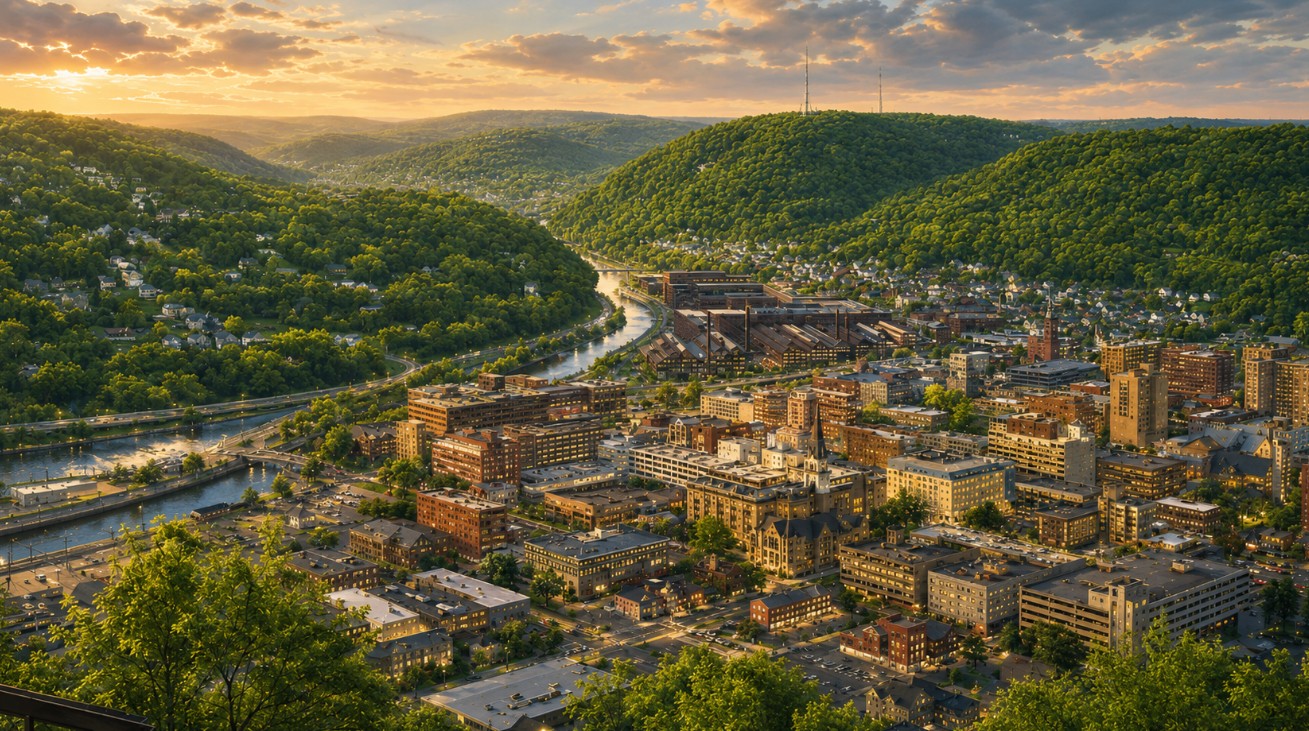
I am writing from one of those places. Johnstown, Pennsylvania. Cambria County. Upper Yoder Township. I work as a janitor and I run a foundation.
The foundation is Cernunnos Foundation LLC, and through it I publish, design, and document the kind of working-class economic development work that the credentialed class has spent forty years telling us isn’t possible in places like this. The work is real, it is in public, and it is documented across several websites with publishing, print-on-demand, and political and editorial production all operating under the same umbrella. You can read all of it. You can download the technical documents. You can see the traffic patterns and the engagement metrics. I have been busy..
What I am writing to ask is whether any of you — the rare ones, the ones who already suspect you might be one of the turds — would like to make money making a city better. Not as a charity case. Not as an impact-washing line item. As a portfolio of real, costed, operator-agnostic development plays in a documented geography with documented audience demand.
What’s already on the table
The Cernunnos Foundation operates four divisions:
Bright Meadow Group — systems analysis and solutions consulting, using an Observe-Design-Intervene methodology. BMG is where the feasibility work lives.
Blue Ribbon Team — the webzine. Stories of place, purpose, and craft. Architecture, civic life, infrastructure, food, art, the overlooked details of post-industrial American life. Multiple recurring personas and editorial voices. This is where the audience is built and where the political legitimacy compounds.
Relevant Irreverence — publishing and production.
Fortean Giftorium — print-on-demand storefront, cryptid art and folklore.
The flagship technical asset is the River Refugium Project (RRP) — a multi-volume framework for nutrient remediation of polluted waterways using integrated aquaponic greenhouse systems, thermochemical processing (HTC/HTL), and biological filtration. Version 2.0 released this year. The whitepaper, operator brief, and field documentation kit are all live on cernunnosfoundation.com. RRP has been the network’s primary download driver and produces consistent international search traffic. It applies at watershed scale, neighborhood pond scale, municipal sewage scale, and HOA scale. Slagmouth Realcycling extends the same thermochemical platform into complete municipal waste stream processing.
Beyond the flagship, the published BMG concept catalog includes:
- Backfill: The Hole That Heals — a five-part series on landfill reclamation as restorative industrial work
- Johnstown’s Next Mill and Future Mining — urban mining and material recovery as the regional industrial successor
- The Tin Can Was Steel — packaging recovery infrastructure
- The Data Center Dividend and Distributed Intelligence Infrastructure — distributed compute infrastructure proposals for places like Cambria County, sized to behind-the-meter natural gas reciprocating gensets
- Real Farm to Restaurant — regional food system feasibility
- Rivers of the World Aquarium and Conemaugh Conservatory — a destination cultural asset built around the RRP technology stack
- The Johnstown Museum of Fortean Studies — a cultural attraction concept
- Johnstown’s Comprehensive Plan Is the Easy Part — civic infrastructure analysis
- Precision Thermal Cycling (PTC) — process innovation supporting the HTL/HTC platform
- Aerial Material Logistics — drone-based construction supply
- The Circuit — regional music and venue infrastructure, including a closed-Rite-Aid music venue concept in Moxham
- The Refugium — applied aquaponic refugium design
Sitting one layer down from publication: a veteran-specific peer-governed sober recovery residence concept, a seated octocopter VTOL design (Project Peregrine), and a working-class restaurant feasibility I just finished costing out at the conversion level for an actual building in Johnstown. That last one I’m holding privately for now because it’s a viable first-mover slot in this region and I’d rather not hand the slot off just yet.
Each of these has been published or drafted using the same discipline: real unit economics, real regulatory analysis, real operator profiles, real local conditions. Not pitch decks. Working documents. The kind of thing a developer or a capital partner could pick up and run with, modify for their conditions, or hand to an operator they trust.
I publish under several personas across The Blue Ribbon Team Webzine. Each one does specific work the others can’t. Together they produce a body of writing that builds audience trust across multiple registers — civic analysis, architectural criticism, working-class economic philosophy, political accountability, cultural review. The audience is real. The traffic patterns are documented. The download numbers on RRP are documented. The international indexing on the technical documents is documented.
What I’m proposing
I am not pitching one deal. I’m describing a portfolio.
The version of this that I’d build with the right capital partner looks like a regionally-scoped place-based development fund — somewhere between $2M and $10M depending on appetite — deploying across a slate of Cambria County and adjacent projects over a 5-to-10-year horizon. Each project has documented feasibility before capital deploys. Each project is operator-agnostic by design — I am the originator and oversight, but the operators are recruited per project, often from the existing audience the publication has already built. Each project is sized to working-class accessibility, which is the actual unmet demand in this region.
The projects already costed out range from $80,000 (a converted-second-generation restaurant) to $300,000-500,000 (a veteran recovery residence, a music venue conversion, a small distributed compute installation) to $2-5M (an RRP demonstration site at municipal scale, a Slagmouth pilot, the aquarium-and-conservatory destination asset). The math on each one is in the documents. None of them require speculative leaps. All of them require capital that the working-class people who would operate them cannot access and that the credentialed development class cannot be bothered to deploy at this scale in this kind of place.
The fund’s thesis is straightforward: a portfolio of $200k-to-$5M working-class economic development projects in a post-industrial county, originated and overseen by someone who lives in the county, executed by operators recruited from a documented regional audience, generating both financial return and the kind of compounding civic legitimacy that turns a place from a depopulating Rust Belt casualty into an actual destination economy over a decade.
The financial returns will not be 10x. They will be the boring kind — single-digit to low-double-digit annual returns on individually-modeled deals, with downside protected by the feasibility discipline and the operator recruitment process. The compounding return is in the portfolio effect: each successful project makes the next one easier, makes the audience larger, makes the local political environment more receptive, makes the next operator easier to find. Ten years in, you have a position in a place that has become legibly investable to capital that wasn’t looking at it before. That is the actual return.
What I’m not proposing
I am not asking you to fund a charity. I am not asking you to fund my personal restaurant or my personal anything. I am not asking you to fund a single deal that I would operate. I am not asking you to fund your vision of me as a heroic founder™.
The thing I have built is specifically designed so that I am not the bottleneck. The concept papers can run without me. The operators don’t need to be me. The fund, structured correctly, has me as the originator and the quality control on the deal flow, but does not collapse if I get hit by a bus or decide in year seven that I would rather live on the mountain.
The work continues. That part is not negotiable and not contingent on whether you write a check. The publishing operation has been running for years and will keep running for years. The concept papers will keep being produced. The audience will keep compounding. The projects will get built whether through this fund structure, through individual capital partners on individual deals, through municipal partnership, or through the slow accumulation of my own working-class savings and SBA veteran lending. The pace changes. The direction does not.
What changes if the right partner shows up is the pace and the portfolio coherence. A capital partner with patience and appetite means several projects move forward at once instead of one every two or three years. That accelerates the compounding effect. It also gets the rest of you to the point where the place starts to stink of money and the next generation of capital shows up on its own.
How I plan on developing — the Gates Method, from The Road Ahead
In 1995, Bill Gates published The Road Ahead. He laid out, in public, exactly what Microsoft was going to do over the next decade and a half. Ubiquitous computing, the information highway, software as the layer that would mediate every industry. He gave the plan away. Then he executed it almost exactly as described, and the people who had read the book and believed it had the chance to position themselves accordingly. The ones who did got wealthy alongside him. The ones who dismissed it as hype watched the entire thing unfold on schedule and arrived late.
I read that book. I didn’t have the money to invest. I did have the lesson.
The lesson is that publishing the plan is not a giveaway. Publishing the plan is the invitation. It is the filter that separates the people who can see what’s coming from the people who can’t. It is the public record that lets you walk the road on the timeline you announced and lets the people who believed you share in what gets built. The plan being public does not weaken it. The plan being public is the thing that makes the rest of it possible.
That’s what the Cernunnos Foundation publishing operation is. The webzine, the technical documents, the concept papers, the persona writing — all of it is the road ahead, published in pieces, as the work matures and as the conditions allow. Some of what’s published is already at the feasibility stage. Some of it is still at the concept stage. Some of it I’m holding privately because the first-mover slot in this region is too valuable to give away before I’ve decided whether I want it. The decision about what to publish when is the only proprietary thing about any of it.
What you are reading right now is the front-matter of the road. The map of where the work is going. The capital partner who reads this and believes it has the same opportunity that a 1995 reader of The Road Ahead had, scaled down to a Cambria County regional development thesis instead of a global software platform, but operating on the same principle: published intent, walked at a steady pace, with rewards for the people who showed up early.
The pace is set by whatever capital and conditions allow. Faster with the right partner. Slower without. Either way, the road is the road. Anyone who has been reading Blue Ribbon Team and the Cernunnos Foundation site for the past two years can already tell you what’s coming next, because it’s been published as it’s been ready. Anyone who starts reading today can catch up in a few hours. The work is in public on purpose.
What kind of partner I’m looking for
The wrong partner is the one who thinks this is too small. They want 10x in seven years on a tech play. They are not for this and this is not for them. They should move along.
The wrong partner is the one who thinks this is charity. They want to write a check, get a plaque, and not think about it again. Cernunnos Foundation is not a 501(c)(3) and is not asking for tax-deductible contributions. This is an LLC operating commercial projects in a commercial geography. We are looking for a commercial partner who happens to also care.
The wrong partner is the one who wants control of the editorial voice or the publication operation. That voice and that operation are what produces the deal flow and the audience trust. Trying to clean them up would destroy the asset.
The right partner is one of three profiles:
A regional family office or second/third-generation industrial money that wants a Pittsburgh-or-eastern-Pennsylvania-adjacent regional development thesis with documented founder capacity and a portfolio of pre-vetted projects. The check size and patience fit. The values alignment is what you already feel when you read this letter without it making you defensive.
A place-based impact fund — Kresge, Heron, Surdna, LISC, or any of the smaller regional analogs — that already invests in anchor strategies in post-industrial geographies. The CF portfolio is already structured the way you structure your investments. The work to integrate is minimal. The leverage you’d get on your existing deal flow is significant.
A veteran-focused capital partner — Hivers and Strivers, Bunker Labs, StreetShares, or a high-net-worth veteran who has done well and wants to deploy in another veteran’s regional development thesis. The cultural translation is already done. The Navy frame, the working-class frame, the regional frame all land without explanation.
If you are any of those three and you’re still reading, the next move is to reach out through the contact page on cernunnosfoundation.com. I will respond. I will tell you the truth about what I’m working on, what’s published and what’s held, what the realistic timelines look like given that I am currently a working-class janitor with active federal legal matters and a wife who is a feature-not-a-bug brake on overexposure. None of that disqualifies the work. All of it is the context the work happens in. Pretending otherwise would be the kind of professional-class theater I am specifically trying to route around.
A closing note for the rest of you
If you got this far and you don’t fit any of those three profiles, that’s fine. You might know somebody who does. The pass-along is its own form of capital and costs you nothing. The work will keep moving forward either way.
To the ones who were offended by the “you’re a turd” opening — you might want to ask yourself why. Most of the people I actually want to hear from will have laughed at it because they already know. That was the filter. It worked exactly the way it was supposed to.
Johnstown is going to come back. Not because of me — because the conditions are right and the place has bones and the people who stayed are the ones tough enough to make the comeback happen. The question is only whether the comeback happens with the kind of capital partnership that lets it happen on terms set by the people who live here, or whether it happens the way it usually happens, with the wealth extracted again on its way out.
I’d rather it happen the first way. So would the right partner. The rest of this is just paperwork.
Bert Smith Cernunnos Foundation LLC Upper Yoder Township, Cambria County, Pennsylvania US Navy, Veteran cernunnosfoundation.com | blueribbonteam.com | brightmeadowgroup.com