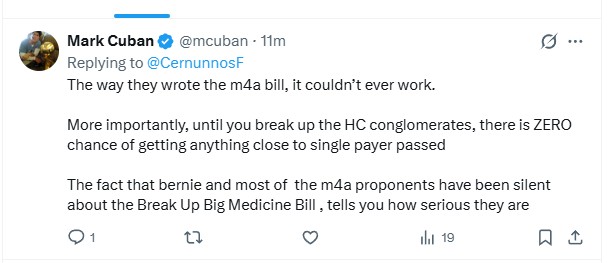
Mark Cuban took the bait. I’ll give him that — most billionaires don’t bother. His response was sharper than the usual swing at M4A too. He didn’t say single payer was socialism or that it would destroy innovation. He said the bill is badly written, and that until somebody breaks up the healthcare conglomerates, single payer has zero chance of passing. He pointed out that Bernie and most M4A proponents have stayed quiet on the Break Up Big Medicine Bill, and took that silence as evidence they aren’t serious.
It’s a fair shot. The political read is probably right. But it skips the question I actually care about, which is what the thing should look like if we ever do get to build it. And I think the answer is simpler than the bill people are arguing about.
We only need to nationalize one layer. The insurance layer. That’s it.
Think about what insurance actually is. It’s a risk pool. You put money in, and when something bad happens, money comes out. The bigger the pool, the more predictable the math, and the cheaper it gets per person. That’s not ideology. That’s actuarial science — the same math the insurance companies themselves run on every day.
Right now in this country we have hundreds of risk pools. Every employer plan, every state Medicaid program, every Medicare Advantage carrier, every individual marketplace plan — each one a little island doing its own math, hiring its own claims adjusters, negotiating its own contracts, paying its own executives, and skimming its own margin off the top. The administrative overhead alone is somewhere north of a quarter of every healthcare dollar spent in America. That money doesn’t treat a single patient. It just shuffles paper between offices that exist because we decided to have hundreds of insurance companies instead of one.
Collapse those pools into one. 370 million people. One risk pool. The math gets very friendly very fast — not because of some socialist miracle but because that’s how insurance works. Bigger pools are cheaper pools. Ask any actuary who isn’t on the payroll of a carrier.
Now here’s where Cuban’s conglomerate point actually folds into the argument instead of against it.
You don’t have to break up the hospitals first. You don’t have to break up the drug companies first. You don’t have to break up the imaging manufacturers or the device makers. Leave all of that private. Let them compete. Let them stay as consolidated as they want to be.
Because now they’re negotiating with one buyer. One. And that buyer represents every patient in the United States.
You know what happens to a pharmaceutical company’s pricing power when there is exactly one customer in the country and that customer covers 370 million lives? It collapses. You know what happens to a hospital chain’s chargemaster nonsense — the $40 aspirin, the $9,000 saline bag — when the single payer says “no, we’re paying you what the procedure actually costs plus a reasonable margin”? It collapses. You know what happens to an MRI manufacturer’s ability to charge American hospitals three times what they charge German hospitals for the exact same machine? It collapses.
You don’t need to break up Big Medicine to bring it to heel. You need to consolidate the buyer’s side of the table so it stops being a turkey shoot. Right now the supply side has consolidated into a handful of giants while the demand side is fragmented into hundreds of weak little pools. That’s not a free market. That’s a rigged one, and we’re the marks.
A single national risk pool puts a single national negotiator across from the drug companies and the hospital systems and the device makers. And that negotiator doesn’t have to be cruel about it. Doesn’t have to nationalize anything. Just has to say: here’s what we’ll pay. Take it or don’t sell to America. Watch how fast “we need these prices to innovate” turns into “actually we can do it for less.”
So Cuban’s wrong about the order of operations, but he’s right that the current bill is a mess. You don’t have to break up the conglomerates first. You just have to put one buyer across from them. The conglomerate problem gets a lot smaller when the conglomerate is no longer the bigger party in the negotiation.
And on the silence — he’s not wrong that the M4A coalition has been quiet on the antitrust side. Maybe that’s a strategic miss. Or maybe they understand that you don’t need the antitrust hammer if you’ve got the monopsony hammer, and a single national risk pool is the monopsony hammer. One layer. That’s the whole fight.
We don’t need to overthrow the system. We don’t need to break it up first either. We just need to stop letting it overcharge us.