Race and Nationality in Johnstown: A Real History
Prologue
I don’t usually open this heavy, but the rest of this piece needs it. So here goes.
Race relations are fear relations. Every place that has ever had them has had them for the same reason — the people already there were afraid of what the people arriving might take. That fear is real, and it has been used, over and over, by people who profit from us looking at each other instead of at them.
Cambria County is a good place to look at this, because our geography makes it visible. We live in a narrow valley between steep ridges, with a population that has been shrinking for a century, and a bounty — three rivers, deep soil, dense forest, abundant water — that has been here longer than any of us. The lines we drew are still here to see. The neighborhoods are still named. The churches still stand. The cemeteries still hold the people who carried the script and the people who got hit by it.
I want to tell you the ending up front so you can read the middle without bracing too hard. The lesson of Cambria County’s long struggle with hate is not that hate wins here. It is that hate has never won here, not finally. Every group the script was used against is still in this valley. The floods of 1889, 1936, and 1977 took every group’s homes together. The mill closures laid off every group together. The relief efforts fed every group together. The togetherness isn’t aspirational. It’s documentary.
The history is the evidence.
Part One: The Original Sort (1850s–1880s)
Joseph Schantz — Joseph Johns — founded Johnstown in 1800 as a Pennsylvania German settlement. By the 1830s it was a small German-dominated town. When Cambria Iron Company arrived in 1852, the economic and political power consolidated in what historians call the Anglo-Protestant elite: English, Scots-Irish, and assimilated German Protestants who ran the company, the banks, the churches, and city hall.
The first wave of industrial immigrants — Welsh into the coal mines, Irish into rail-building and then the mills — slotted in below them. The hierarchy was clear: WASP, then German, then Welsh, then Irish, with religion (Protestant or Catholic) as a major axis alongside ethnicity.
Cambria Iron was a textbook company town. It owned the houses, the store, the school, the library, and the hospital. The Anglo-Protestant elite ran a non-unionized, ethnically fragmented town with about two-thirds of its male population working in mills and mines. The fragmentation wasn’t an accident. It was the management strategy. If everyone could talk to everyone else, the bosses couldn’t keep wages low.
Part Two: The New Immigration (1880s–1914)
Starting around 1880, the demographics flipped. Slavs, Magyars, Poles, Slovaks, Croatians, Serbs, Slovenes, Rusyns, Italians, and Eastern European Jews came in waves to fill the bottom rungs of the steel mills.
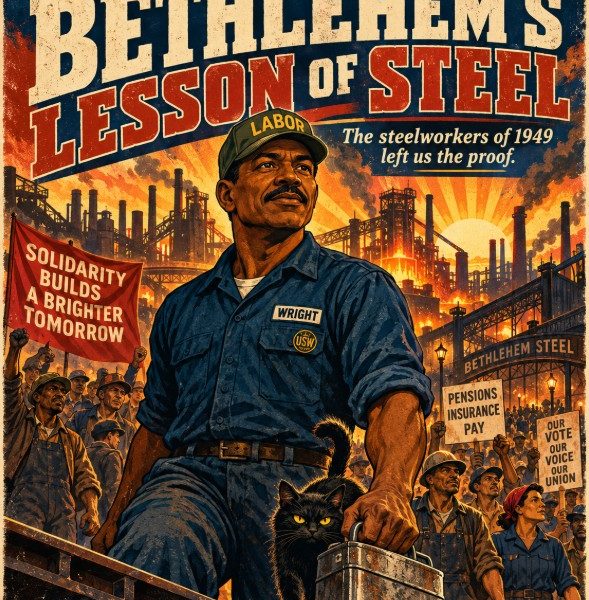
Management deliberately sorted these immigrants into work crews by language group, so a Polish crew couldn’t easily talk to a Slovak crew couldn’t easily talk to an Italian crew. The stated reason was communication. The real reason was the opposite — to prevent it. Unionization didn’t reach Bethlehem Steel’s Johnstown plant until 1942, and the language-crew sorting is a big part of why.
New arrivals weren’t welcome in old Johnstown proper, so they settled in Cambria City and Minersville, the bottoms next to the mills. The density of nationality churches in those few blocks — Slovak, Polish, Croatian, German, Irish — wasn’t quaint heritage. It was the architecture of mutual non-integration, encouraged from above.
The slurs were everywhere. “Hunky” was the catch-all for any Slavic or Hungarian worker. “Bohunk,” “Polack,” “Dago,” “Wop,” “Kike” all in active use, by every layer above the newest arrivals, including by management. The German and Irish workers who had been the bottom one generation earlier became enthusiastic enforcers of the new bottom. That’s the part of this history that breaks my heart the most — how quickly the people who had just survived the script started using it on someone else.
Part Three: The 1889 Flood and Its Scapegoats
The South Fork Fishing and Hunting Club — Andrew Carnegie, Henry Clay Frick, Andrew Mellon, and about fifty other Pittsburgh industrialists — owned the dam that killed 2,209 people. They had lowered the dam to widen the carriage road across the top, removed the discharge pipes, and put fish screens across the spillway. Engineers had warned about it for years. The club members were largely silent after the disaster, and they were never held legally liable.
Within days, newspapers ran sensational stories about Hungarian immigrants caught looting bodies and being lynched by survivors. There was no truth to this. None. The story spread because it served a function: it moved the moral outrage away from the wealthy club members who had actually killed the town and onto the most recently arrived, least powerful, least defended group in the valley.
That’s the pattern. The wealthy break something. The frightened blame the newcomer. The wealthy walk away clean.
But the rebuilding was cross-ethnic and instant. The Cambria Iron Works reopened on June 6, days after the flood. Welsh and German and Irish and Hungarian families dug each other out of the mud. Within five years the city showed no visible signs of the disaster. Whatever the newspapers invented, the people on the ground saved each other.
Part Four: The 1920s and the Klan
The Second Klan revival hit Pennsylvania harder than almost any other state. At its mid-1920s peak, the Klan had about 250,000 members in Pennsylvania, with roughly a quarter living in the counties around Pittsburgh. Altoona may have had the highest Klan membership per capita of any city in the United States. Johnstown was close behind.
In Pennsylvania, the 1920s Klan was primarily anti-Catholic and anti-immigrant before it was anti-Black. The “Catholic immigrant” enemy meant Irish, Italian, Polish, Slovak, Hungarian — the working-class population that built Cambria County.
In April 1924, four hundred hooded Klansmen took a train to Lilly, twenty miles east of Johnstown, to intimidate the town for hiring Catholic immigrants. The townspeople didn’t cower. The Klansmen were jeered, pelted, and chased back to the trains. Gunfire broke out. Three Lilly residents — Philip Conrad, Cloyd Paul, and Frank Miesko — died from gunshot wounds defending their town. Their resistance is widely credited as the beginning of the end of the Klan’s advance in the northeastern United States.
The Catholic mining-town immigrants of Cambria County broke the second Klan in the Northeast. They died together, of different backgrounds, in defense of the same valley.
Part Five: The Rosedale Banishment (1923)
This is the moment Johnstown’s racial story shifts decisively from European-on-European to anti-Black.
Black workers, recruited from the South by Bethlehem Steel during the Great Migration, lived in Minersville, Rosedale, Franklin, and Conemaugh — neighborhoods close to the mills. Rosedale was the predominantly Black neighborhood.
Mayor Joseph Cauffiel held the office of mayor and primary magistrate simultaneously — two of the most powerful positions in the city, in the hands of one man. He had a record of brutality toward Black defendants, and on September 7, 1923, after a Black steelworker fatally shot four police officers, he ordered all Black and Mexican people who had lived in the city less than seven years to leave. The Klan, which controlled thousands of Johnstown votes and which Cauffiel was courting for re-election, supported the order and burned crosses on the hills above Rosedale to enforce it. An estimated 500 to 2,000 people left, terrified and largely without money.
The pushback was real, and it’s worth remembering. The NAACP, led nationally by James Weldon Johnson, demanded an investigation. The ACLU was contacted by Johnstown Democrat editor Warren Bailey, who was disgusted by the edict. Governor Gifford Pinchot investigated and pledged the full power of the commonwealth to protect constitutional rights. State police concluded the policy was unlawful and racially motivated. Cauffiel lost the election.
The damage was done. But so was the precedent that resistance worked. A Welsh-American newspaper editor, a Black national civil rights organization, and a Republican governor stopped a mayor who was backed by the Klan. That happened here. That’s part of our story too.
Part Six: 1937 and the Little Steel Strike
By the 1930s, the European immigrant groups had been in Johnstown for two or three generations and were starting to assimilate into a more unified ethnic white working class. The 1937 Little Steel Strike at Bethlehem’s Cambria Works was the test.
Bethlehem Steel responded with textbook divide-and-conquer aimed at ethnic fault lines the company itself had built. Mayor Daniel J. Shields — previously convicted and jailed for attempted bribery of a federal official — led the back-to-work drive, financed by $31,456 from Bethlehem Steel. That’s roughly $700,000 in today’s money, paid by the company to the mayor to break the strike.
The company tried to pit “American” workers against “foreign” Slavic and Magyar organizers. It worked less than they wanted. By 1937, a Slovak miner’s son and a Polish steelworker’s son had grown up in the same neighborhood and gone to the same parochial school. The strike was lost, but the cross-ethnic solidarity that had been impossible in 1892 was visibly real by 1937. The script had started to fail.
Part Seven: The 1940s–60s — Consolidation and Containment
Wartime labor shortages brought a second Great Migration wave of Black workers to Johnstown. Restrictive covenants on housing and informal redlining by Johnstown banks kept Black families out of Westmont, Southmont, Geistown, and the new postwar suburbs. The 1923 banishment didn’t need to be repeated. The city had built the boundaries into the deed records.
The Catholic ethnic groups consolidated upward. Union wages at Bethlehem made it possible. GI Bill loans made it possible. A Slovak millworker’s son could become a teacher. A Polish family could buy in Moxham. The hierarchy didn’t disappear — it moved up one rung, with Black families now occupying the position the Slavs had held fifty years earlier.
Urban renewal demolished half of Cambria City in the 1950s. The targeted neighborhoods were exactly the ones where the polyglot immigrant working class had built its parallel society. “Blight” was the technical reason. The result was the dismantling of immigrant community infrastructure. Black neighborhoods got similar treatment in the same era.
Part Eight: The 1970s and the Bottom Dropping Out
This is the period people don’t talk about much, and it’s where everything before turns into the Johnstown of right now.
The 1977 flood — July 19–20, eleven-plus inches of rain in less than ten hours, 84 dead, six dams failed — was the third thousand-year flood in Johnstown’s recorded history. It happened on top of an already-collapsing economy and broke the back of the city’s confidence in its own future.
Bethlehem Steel had begun cutting back in the late 1960s. The 1977 flood took out portions of the Cambria Works, and Bethlehem used the damage as cover to accelerate closures. By 1982, massive permanent layoffs. By 1992, the Johnstown plants shut forever. Tens of thousands of jobs evaporated in a decade.
This is where the modern enemy comes into focus, and it’s the part of the story that needs to be said clearly.
The mills didn’t close because of the workers. They didn’t close because of the unions. They didn’t close because of the Black families in Rosedale or the recent immigrants in Cambria City. They closed because the people who owned them decided that more money could be made by extracting whatever value remained and walking away. Bethlehem Steel had cash. Bethlehem Steel had contracts. Bethlehem Steel had skilled labor. What Bethlehem Steel didn’t have, by the 1980s, was a leadership class that lived here, raised children here, or had any reason to care what happened to a small Pennsylvania city when the books could be balanced more profitably somewhere else.
That pattern — extract the value, leave the consequences — has only accelerated since. The hospitals consolidated under out-of-state ownership. The newspapers sold to chains. The local banks merged into national conglomerates. The pharmacies got bought by private equity, leveraged into debt, and closed when the debt service ran ahead of the profits. Rite Aid in Moxham didn’t close because Moxham failed it. It closed because a private equity firm in New York loaded it with debt to extract dividends and then walked away from the wreckage.
That is the actual enemy. Not the newcomer. Not the family on the next block whose last name is new. Not whichever group the loud and frightened are pointing at this season. The actual enemy is a small class of people who do not live here, do not know us, do not intend to know us, and who treat this valley — and every valley like it — as something to be drained and abandoned.
Part Nine: The 1980s–2020s — The Slow Decline and the Real Pattern
Population: 1950: 63,232. 1970: 42,476. 2000: 23,906. 2020: under 18,000. The city lost more than half its population in fifty years. As the white population fled to the townships, the Black share of the city’s population grew — not because the Black population was growing in absolute terms, but because it was shrinking slower than the white population. The city is increasingly diverse only because the city is increasingly poor.
The crack era hit Johnstown like every other deindustrialized small city, and the same Black neighborhoods that had been targeted in 1923 and hemmed in by redlining in 1950 became the focus of heavy policing in the 1990s. Incarceration rates for Black men in Cambria County climbed steeply.
The opioid epidemic devastated Cambria County starting around 2010, with overdose deaths among the highest per capita in Pennsylvania. This hit the white working-class population disproportionately — the children and grandchildren of the steel and mining families. The opioid crisis wasn’t an accident either. It was manufactured. Purdue Pharma, owned by the Sackler family, marketed OxyContin aggressively to communities exactly like ours, knowing the addiction profile, knowing the death toll. The Sacklers extracted billions of dollars and went to court to protect their wealth. The funerals happened here.
The pattern is consistent. The extraction class causes the harm. The local victims look for someone to blame, and the script tells them to blame each other. The wealth keeps leaving.
In 2023, the 100th anniversary of the Rosedale banishment, JAHA organized a public remembrance. Cody McDevitt’s Banished From Johnstown had brought the story to a much wider audience. A historical marker was unveiled. The Tribune-Democrat ran a multi-part series. It took a hundred years for our city to officially say out loud what had been done in our name. That’s slow, but it happened. That counts.
Today, Johnstown is about 18,000 people. Roughly 70% white, 12% Black, smaller Hispanic and Asian populations. The Bethlehem mills are mostly gone. Cambria City is a National Historic District and hosts an annual Ethnic Festival that draws tens of thousands. The diocese has consolidated most of the parishes. The visible legacy of the immigrant hierarchy is mostly cultural now — pierogi sales, polka festivals, the names on the headstones in St. Mary’s and Grandview cemeteries.
Epilogue: Together
Here’s what the history shows when you read it whole.
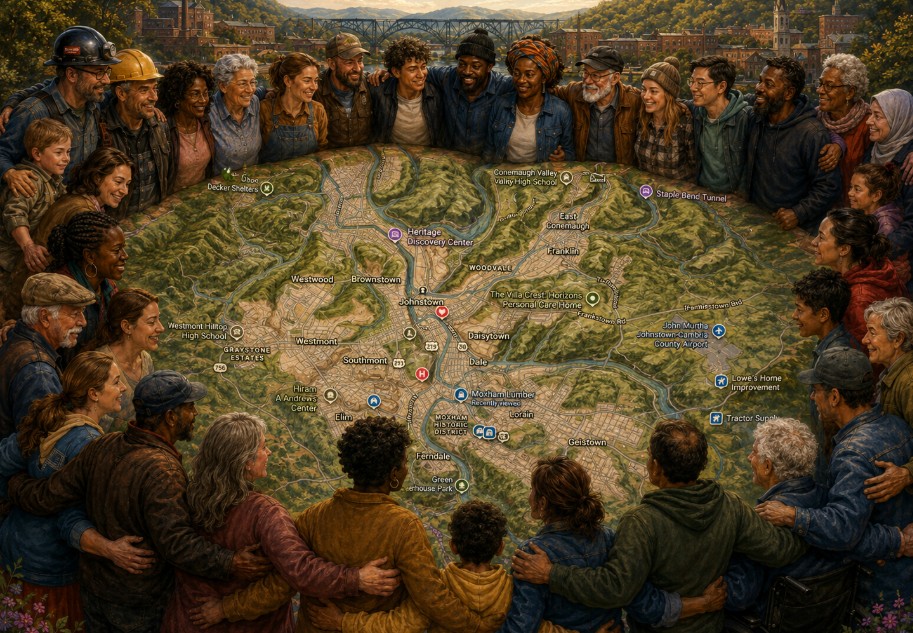
Every group that arrived in this valley was told it didn’t belong. Every group outlasted the telling. Every flood took the homes of every group without checking surnames first. Every mill closure laid off every group together. Every relief effort fed every group together. Every opioid funeral has been attended by every group together. The togetherness isn’t a wish. It’s documentary. It’s what has actually happened here, every time the valley has been tested, regardless of what the loud minority of the moment was saying.
The fear that drives the script is real, and it’s worth naming with kindness. People in this valley have watched a century of leaving. They have watched the mills close, the churches consolidate, the schools shrink, the storefronts go dark. They are not wrong to feel that something has been taken from them. Something has been taken from them.
The mistake is in identifying the thief.
The thief was never the newcomer. The Hungarians didn’t break the dam. The Slavs didn’t break the union. The Black migrants didn’t close the mills. The current immigrants are not closing the hospitals. The wealth that left this valley left up the rail line to Pittsburgh and from there to Wall Street, and it left in the pockets of people whose grandchildren have never set foot in Cambria County and never will. The script that tells the frightened to blame the newcomer is the same script that has always covered for the actual extraction. It works because it’s easier to be angry at a face you can see than at a balance sheet you can’t.
So let me say the harder version, plainly.
The people taking from us right now are not our neighbors. They are private equity firms that buy our pharmacies and close them. They are healthcare conglomerates that buy our hospitals and gut them. They are pharmaceutical billionaires who flooded our county with opioids and went to court to keep their fortunes. They are the extracting class — the people who have never lived here, never will live here, and who treat every place like ours as a balance sheet to be cleared. The wealth our great-grandparents built with their hands, the wealth our parents built with their backs, the wealth we ourselves are still building with whatever’s left — that wealth has been siphoned out of this valley for a hundred and seventy years by people who have never come here and never intend to.
That is the fight. Not against each other. Against the small class of people who have always benefited from us fighting each other.
And we outgrow them by staying together. We outgrow them by refusing to hand our children and grandchildren a valley that has been hollowed out further than we found it. We outgrow them by tending the bounty that is still here — three rivers, four seasons, deep soil, dense forest, water cleaner than the gossip about it, festivals in seven different ethnic registers that all happen in the same six blocks — and by making sure that bounty belongs to the people who live here, not to the people who keep finding new ways to drain it.
We have survived 1889 together. We have survived 1936 together. We have survived 1977 together. We have survived the mills closing together. We are still surviving the opioid crisis together. We have done the hard thing already, repeatedly. The question now is whether we do it on purpose this time, with our eyes open, against the people who have actually been doing this to us.
The river is going to keep moving. The mountain is going to keep standing. The bounty is going to keep growing for whoever shows up to tend it. The hate is going to keep getting louder for a while, because it always does when the count is against it, and then it’s going to keep losing, because it always does, because this valley has been tested too many times by too many actual disasters to take the manufactured ones seriously for long.
Our grandchildren are going to inherit this valley. The only question is whether they inherit it from us — the people who live here, who love it, who tend it together — or from a hedge fund in Manhattan that bought up what was left when we weren’t looking.
Together isn’t a slogan. It’s the only thing that has ever worked here.
Small joys are big deals. Stay clean, stay kind, stay caffeinated.
And stay together. That part has always been the only one that mattered.
Sources for this piece include Ewa Morawska’s For Bread with Butter (1985) and Insecure Prosperity (1996), Cody McDevitt’s Banished From Johnstown (2021), David McCullough’s The Johnstown Flood (1968), John M. Craig’s The Ku Klux Klan in Western Pennsylvania, 1921–1928 (2014), Pennsylvania Heritage Magazine, the Tribune-Democrat’s 2023 Rosedale centennial series, the Johnstown Area Heritage Association archives, and the Pennsylvania Historical and Museum Commission marker series.