On open thinking, the collision theory of creativity, and why a $12,000 flying machine is too fun not to talk about.
Off Book
One of the things we believe at Bright Meadow—and practice in the open, loudly, on purpose—is that intellectual property hoarding kills more good ideas than it protects. We are not against ownership. We are not against getting paid. We are against the premise that locking a thought in a drawer makes it more valuable than throwing it into a room full of other thoughts and seeing what happens.
Because here is what actually happens when you do that: the thoughts collide, and the collisions produce things nobody planned.
The Collision Theory of Getting Somewhere
Go find your favorite actor. Look at their filmography. Within two or three projects you will find them working with someone else you recognize, who is working with a third person you recognize, and suddenly you are looking at a web of collaborators who kept finding each other across decades. This is not networking. It is not branding. It is pattern recognition at scale. Creative people seek out other creative people because exposure to a different angle on the same problem is how the problem actually gets solved.
Musicians figured this out early. The supergroups of the 1960s were not an accident. Cream, Blind Faith, Crosby Stills Nash & Young—these were not commercial gimmicks. They were what happened when people who had already pushed their own craft to its edges went looking for edges they hadn’t found yet. The collaboration was the product. The music was the byproduct of proximity and friction.
Engineers in a room together do not add ideas. They multiply them. One person’s throwaway sketch becomes another person’s structural insight, and the third person in the corner says “what if we just flip it upside down” and suddenly the problem is solved.
Science works exactly the same way. Every major breakthrough has a room behind it. Relativity had the Olympia Academy. The transistor had Bell Labs. The internet had DARPA, but more importantly it had the culture of open publication and shared standards that let every subsequent idea build on the last one without asking permission first.
This is what we mean when we say we oppose intellectual property as a reflex. Not as a legal structure—as a reflex. The instinct to hide your work before it is finished, to wall off your thinking until you have extracted its commercial value, is an instinct that kills the collision. And the collision is where the value actually lives.
Now Add Technology to the Room
Everything described above was already true when the room was physical and the collisions happened over coffee and chalkboards. Technology—the internet, open-source repositories, AI as a translation and acceleration layer—has made the room infinite and the collisions continuous. Ideas that used to take a generation to propagate across disciplines now propagate in hours. An aerospace concept shows up in a robotics forum, gets riffed on by a drone hobbyist, gets refined by someone with fabrication experience, and inside a week there are build plans that did not exist on Monday.
We are living in the fastest idea-collision environment in human history. Which brings us, inevitably, to the fun part.
The Point Where Responsible Meets Irresistible
I have been promised flying cars since birth. Every science magazine cover of my childhood had one. And I am still not convinced the average human can manage one, because we have ample evidence that the average human struggles with roads, trails, parking lots, and four-way stops. Giving that same population a vertical axis of freedom is a thought that should concern any responsible adult.
I am a responsible adult.
And I am telling you: we have reached a point where a personal vertical takeoff and landing aircraft is not only possible, it is affordable. Not next-decade affordable. Not venture-capital affordable. Less than your car cost affordable. Simple design. Commercially available parts. A competent fabricator with a TIG welder, a flight controller from the drone shelf, and about $12,000–15,000 in materials can build a human-carrying VTOL octocopter in a garage over a few months.
That sentence is true and I verified it with engineering data before writing it.
The responsible part: This should absolutely not be your weekend project. This belongs in controlled conditions—tethered testing, instrumented ground runs, incremental altitude expansion, ballistic parachute systems, experienced observers, and a test program that would bore you to tears before it ever lets you leave the ground untethered. Lab-like testing grounds. The whole deal. We are not kidding about this part. Do not build one and fly it over your neighbor’s fence. We will not help you with that conversation.
Still. It is too fun not to talk about.
Introducing Project Peregrine
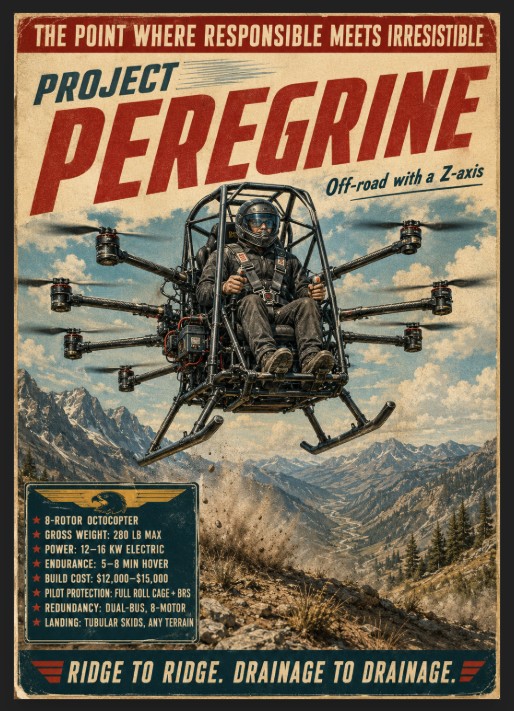
Eight rotors. A roll cage you could flip an ATV into and walk away from. A bucket seat rated for forces that would rearrange your internal organs in anything less. Two independent battery buses so redundant that losing an entire power rail still leaves you with diagonal thrust pairs and enough authority to set down on your own terms.
You sit inside the cage. Five-point harness locks you to a seat that sits right at the center of gravity—low, stable, planted. Left hand on the throttle stick. Right hand on the directional. Your feet are on pegs and the world is about to get very, very small beneath them.
Throttle up. The eight carbon-fiber props bite air simultaneously and the skids unweight from the dirt. Not a lurch. Not a leap. A lift—smooth, insistent, like the ground just decided to let go of you. The flight controller is making a thousand corrections per second and the only thing you feel is the low hum of brushless motors doing exactly what they were designed to do: turn electricity into defiance of gravity.
At ten feet you can see the ridgeline you spent forty-five minutes driving around last weekend. At fifteen you can see the valley on the other side. The air is different up here—cleaner, colder, moving. You press the right stick forward and the Peregrine tilts its nose two degrees and begins translating across the drainage, skids clearing the scrub oak by a comfortable margin, the GPS logging your track in case you want to do it again.
This is not a helicopter. Helicopters are machines that actively try to kill you and only don’t because of extraordinarily complex mechanical systems. This is a scaled-up drone with you inside it. The physics are the same physics that keep a $200 quadcopter hovering in your living room. The flight controller is the same open-source firmware. The motors are the same architecture, just bigger. The difference is that this time the payload is you, and the view is the Alleghenies in early morning light, and the sound is a low electric whisper instead of a combustion scream, and the thing you are sitting in cost less than a mid-trim side-by-side.
Configuration: 8-rotor octocopter | Gross weight: 280 lb max | Power: 12–16 kW electric | Endurance: 5–8 minutes hover
Build cost: $12,000–$15,000 | Pilot protection: Full roll cage + BRS | Redundancy: Dual-bus, 8-motor | Landing: Tubular skids, any terrain
Ridge to ridge. Drainage to drainage. Over the deadfall that blocked the trail, past the washout that ate the fire road, across the creek that flooded last Tuesday. Five minutes of flight replaces an hour of crawling in low range. Set it down on a rock shelf, unclip, glass the valley with your binos, clip back in, and hop to the next ridge. This is not aviation. This is off-road with a Z-axis.
And when you are done—when the battery monitor says it is time and the responsible voice in your head agrees—you bring it down onto whatever flat-ish patch the mountain offers, the skid rockers absorbing the terrain, the props spooling down to silence, and you sit there for a second in the cage with the harness still buckled and the helmet visor still down, looking at a view that took you ninety seconds to reach and would have taken all morning on wheels.
You will not stop thinking about it for the rest of the day.
Why We Published This
Because this is what happens when ideas collide in the open. A conversation about a 1950s military prototype became a conversation about quadcopter physics, which became a seated roll cage concept, which became a full engineering spec with a bill of materials. In a closed environment, that sequence does not happen. In an IP-protected silo, the Hiller Rotorcycle data stays in an archive, the drone motor specs stay on a manufacturer’s datasheet, the flight controller firmware stays in a developer’s repository, and nobody connects the dots because nobody is allowed to see enough dots at once.
We connected them in the open. We are publishing the result in the open. Not because we think you should build one tomorrow—please reread the disclaimer—but because we think the collision between these ideas is more valuable shared than hoarded. Someone with composite materials experience will read this and see weight savings we missed. Someone with flight controller expertise will see control law improvements we did not consider. Someone with regulatory knowledge will see a certification pathway we could not.
That is the thesis. Ideas in isolation are worth what you paid for them. Ideas in collision are worth what they become. And what they become is always, always more interesting than what they started as.
This is a Bright Meadow Group “Off Book” publication—exploratory thinking shared publicly as part of our commitment to open ideation. Project Peregrine is a conceptual engineering exercise, not a product offering.