Let me tell you something they hope you never figure out.
That man cannot tie his own boat to a dock. He cannot pump his own fuel. He cannot weld a cracked fitting, splice a line, scrub a hull, or cook his own dinner forty miles offshore. He cannot do one single useful thing with his own two hands that keeps that floating palace from becoming a very expensive reef. Not one. He has never had to. That’s the whole point of being him.
You can. That’s the whole point of being you.
So get this straight, because it is the most important fact in the harbor and they have spent a hundred years and a billion dollars hoping you’d forget it: he needs us. We do not need him. That isn’t a slogan. It isn’t a feeling. It’s a load-bearing fact, true as gravity, true as the tide. Strip away the deckhands and the welders and the tug crews and the fuel men and the provisioners and the divers and the dock workers, and what is he? A man standing on a dead machine in the middle of the water, hollering for help that isn’t coming.
Fifteen hundred families in this region got the letter. Bellevue gutted — six hundred ninety-nine. Seattle, Redmond, the spare bedrooms where the remote folks worked. Effective July. And the same company that signed those letters is turning around to spend a hundred and forty-five billion dollars on machines to do the work those people used to do. Read that again until it makes you angry, because anger is the correct response and numbness is the trap. They didn’t run out of money. They ran out of use for you. That’s worse. A man who’s broke can’t help it. A man this rich looked at fifteen hundred of his neighbors and decided a server rack was a better investment than a human being.
And then — then — he goes to sea.
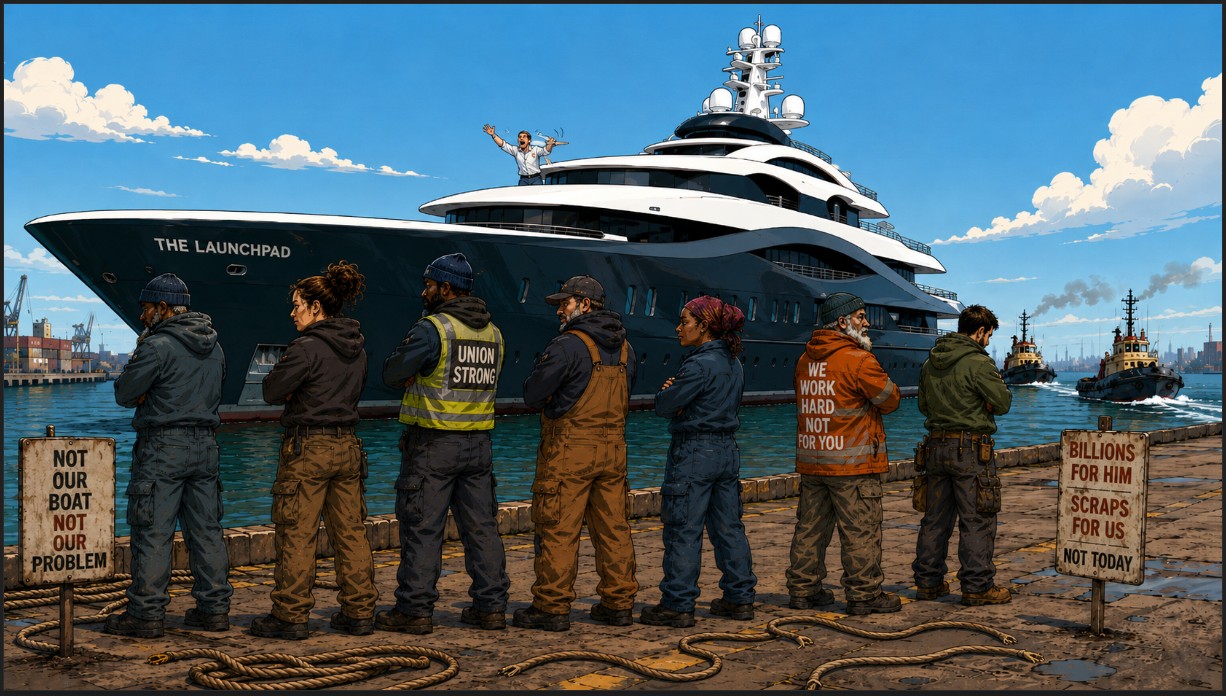
Now hear me, because here’s where the soft people get nervous and the hard truth comes out clean: you don’t have to touch a thing. You don’t lay a hand on his property. You don’t break a window or board a deck or untie a single rope that isn’t yours to untie. That’s their game — they’d love it if you swung first, because then the story’s about you instead of about the thousand families he put on the street. Don’t give it to them.
You do the one thing that’s stronger than any fist ever thrown, and it is yours, it has always been yours, it is the thing they cannot lay off and cannot automate and cannot buy back once you decide to keep it:
You fold your arms.
The tug operator looks at his book and finds he’s busy. The fuel barge can’t seem to find a window. The marina’s full up, sorry, try next season. The provisioner’s truck breaks down on the way. The welder’s got a backlog. The diver’s knee is acting up. The pilot’s schedule is a mess. Every one of them, lawfully, freely, on their own good conscience, discovering the same thing at the same time: I just don’t have it in me to help that man this year.
And the whole monstrous thing grinds to a stop. Not because anybody attacked it. Because nobody showed up to keep it alive.
That’s the secret they’ve been sitting on. A yacht is the neediest object ever built by the hand of man. It floats on a thousand small yeses, and every one of those yeses belongs to somebody who punches a clock. Take back the yeses. Just take them back. Let him sit out there on his hundred-million-dollar machine and discover that all the money in Menlo Park can’t buy a single willing pair of hands in a harbor that’s decided it’s had enough.
Let him shame himself. Let the whole world watch the richest man on the water find out he can’t get a tank of diesel because the people he threw away aren’t in a helping mood. Let him drift back to whatever cave he came out of and count his pennies in the dark, alone, with no one to admire the pile.
That’s not piracy. That’s not a mob. That’s labor remembering the one thing labor’s not supposed to remember:
The harbor was always ours. We just let him park here.
Turn him away. Keep your hands in your pockets. And watch — watch how fast a king turns back into a man the second nobody agrees to row.
Enough.
Editorial note. It is my personal position that it would be within the rights of Seattle to seize the vessel as reparations for the recent surge in unemployment this will cause downstream in the city of Seattle. That said, the editor is not a judge, lawyer, or anyone with the right to make that decision. It is just an opinion.