Increasing Production in a 2-Acre Fish Pond Using a Greenhouse Wetland Loop
A Bright Meadow Group Systems Example
Most pond operations are not limited by land. They are limited by water quality.
Feed goes in, fish grow, nutrients accumulate. At some point oxygen drops, ammonia rises, sludge builds, and the operator is left with two options: slow down production or change water. Neither is profitable.
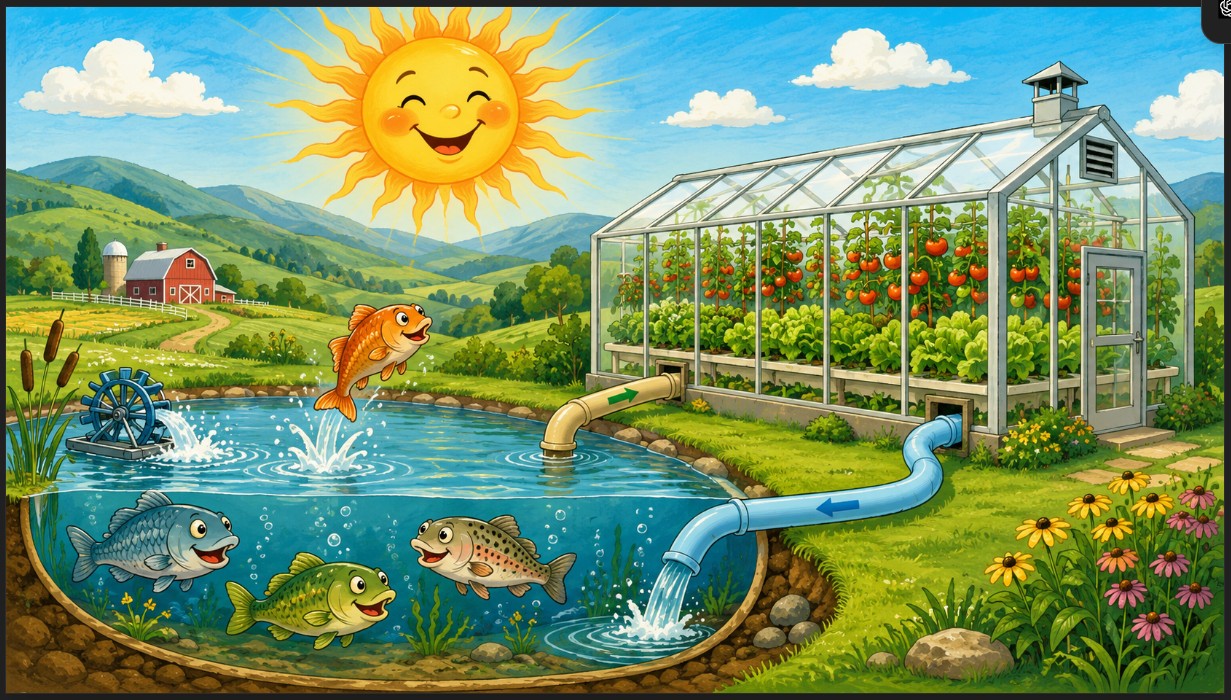
There is a third option. Add a greenhouse aquaponic wetland loop that removes nutrients, stabilizes water, and generates secondary income on the same site, using the same fish feed already paid for.
On a typical 2-acre pond, that addition can mean an extra $10,000 to $15,000 in fish revenue per cycle, plus another $5,000 to $20,000 per year in crops, with no additional pond area.
This is how.
The Baseline
A representative pond operation:
- Surface area: 2 acres
- Average depth: 6 ft
- Volume: roughly 3.9 million gallons
- Species: mixed warm-water fish — catfish, tilapia, hybrid striped bass, or similar
- Feeding: commercial pellet feed
- Aeration: standard paddlewheel or diffused air
- Harvest cycle: seasonal
Typical production for a pond this size runs 4,000 to 6,000 lbs per acre per season, or roughly 8,000 to 12,000 lbs per cycle. Typical limitations: ammonia spikes during heavy feeding, low oxygen in warm weather, sludge accumulation in feeding zones, algae blooms, and the constant pressure to reduce stocking density to avoid losses.
The operator has room to grow fish. They do not have room to grow problems.
The Addition
A greenhouse filtration and crop system connected to the pond.
Example build:
- Greenhouse footprint: 30 × 96 ft (2,880 sq ft)
- Grow beds — raft, media, or hybrid — inside the greenhouse
- Solids settling tank
- Pump loop: pond → greenhouse → pond
- Continuous circulation at 50 to 150 gallons per minute
Full pond turnover is not required. Continuous partial filtration is enough.
The greenhouse functions as biofilter, solids separator, plant nutrient sink, oxygenation loop, and temperature buffer at the return point. Water returns cleaner than it left.
Water Quality Effects
With continuous circulation through plant beds:
- Ammonia reduced through bacterial conversion
- Nitrate absorbed by crops
- Suspended solids captured before they reach sludge
- Oxygen increased during return flow
- pH swings dampened
- Algae pressure reduced
The pond becomes more stable under higher feeding rates. Stability is what allows higher production.
The Throughput Math
Baseline: 2 acres × 5,000 lbs/acre = 10,000 lbs per cycle.
With improved water quality, the operator can run higher feed rates, higher stocking density, lower mortality, and faster growth. A conservative new rate of 7,000 to 8,000 lbs per acre brings the total to 14,000 to 16,000 lbs per cycle.
That is an additional 4,000 to 6,000 lbs per season without adding a square foot of pond.
At $2.50/lb live weight equivalent, that is $10,000 to $15,000 in added revenue per cycle. The fish side of the system pays for itself before the greenhouse produces a single head of lettuce.
The Greenhouse Side
The greenhouse is not just filtration. It produces crops using nutrients the operator already paid for in fish feed.
For a 30 × 96 footprint:
- Leaf greens — lettuce, spinach, herbs — 150 to 300 heads per week year-round with heat, or seasonal production without
- Fruiting crops — tomatoes, cucumbers, peppers
- Feed crops — duckweed, azolla, fodder greens — usable as fish feed supplement, poultry feed, or local sale
- Specialty crops — microgreens, medicinal plants, nursery starts, native wetland plants
Even modest production adds $5,000 to $20,000 per year on top of the fish revenue. Same water. Same nutrients. Second income stream.
Sludge as Product
Solids captured by the greenhouse system are not waste. Fish waste plus plant waste is excellent compost — usable as soil amendment, potting mix, garden retail, or recycled back into greenhouse beds.
Instead of sludge building up in the pond, nutrients become saleable material.
Oxygenation
Return water from the greenhouse can do double duty as aeration. Cascade returns, spray returns, venturi injection, waterfall returns, and air-lift systems all add dissolved oxygen at the point of reentry.
This reduces stress on the pond during hot weather. Higher oxygen allows higher feed rates. Higher feed rates allow faster growth.
Why a Greenhouse Instead of an Outdoor Wetland
Outdoor wetlands work. Greenhouses do more:
- Year-round operation
- Higher plant density per square foot
- Controlled temperature
- Predictable filtration through winter
- Income stream the wetland cannot produce
- Protection from weather extremes
- Faster bacterial activity in warm conditions
The greenhouse turns filtration into production.
Designed for the Operator
Every pond is different. Design depends on pond size, fish species, feed rate, climate, labor availability, market access, budget, and existing equipment. Systems can run low-tech gravity flow or pump-driven, seasonal or year-round, hobby scale or commercial scale.
The goal is always the same: increase throughput without increasing risk.
Bright Meadow Group designs integrated pond and greenhouse systems for fish farms, aquaculture operations, farm ponds, hatcheries, regenerative agriculture projects, municipal water systems, and educational facilities. Consulting follows our standard model: one-day site visit at no fee (travel excluded), system analysis, and build-ready design if requested. Each system is built for the site, not from a catalog.
Bright Meadow Group — Systems Analysis and Solutions Consulting — www.brightmeadowgroup.com