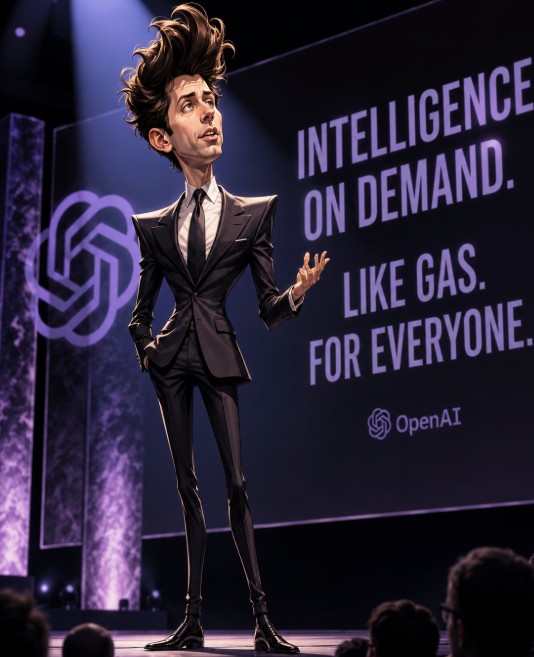
There’s a picture of Sam Altman going around. He’s onstage somewhere, in a suit cut a half-inch tighter than a suit needs to be cut, calmly explaining that he’d like to sell you intelligence the way the gas company sells you gas. The internet has already pointed out that nobody has ever said anything like that in a movie and been the good guy. True. But look at the picture itself. The lighting. The posture. And the hair — a peculiar leaning tower of carefully tousled architecture that somebody, possibly him, possibly a guy on payroll, put real time into building this morning.
He looks like a villain. Not because the suit is too sharp. Because the whole thing is orchestrated, and your animal brain knows what that means.
Stay with me, because once you see this pattern you can’t unsee it, and once you can’t unsee it you stop getting fooled, which is a hell of a return on a five-minute read.
The Look-Book
Fiction first, because fiction is where we agreed on the shorthand. Every Bond villain you’ve ever seen. Blofeld stroking a cat in a chair that costs more than your house. Goldfinger in his absurd gold-tinted everything, a man who looked at the periodic table and chose poorly. The modern ones in mock turtlenecks and architectural eyewear, perched in lairs designed by someone who studied at the Bauhaus and then went to work for Satan. The look is always expensive, intentional, and just slightly off. A silhouette engineered to be photographed from the angle the photographer was told to use.
Gordon Gekko in his slicked hair and suspenders, the suspenders functioning as a statement: I do not require a belt, because gravity itself works for me. Patrick Bateman, whose entire personality is a skincare routine. Anton Chigurh, whose haircut is so deliberate it becomes a weapon before he picks up the cattle gun. The Emperor in Star Wars in a hooded robe that cost the Galactic Empire’s GDP. Hans Gruber in a suit so well-cut Alan Rickman appears computer-generated. Loki in horns. Sauron in a helmet that has spikes on its spikes, because one layer of spikes was insufficiently spiky.
Now compare. Indiana Jones in a beat-up jacket and a hat he’s clearly had since college. Atticus Finch in the same plain suit every day. Columbo in a coat that looks like he found it behind a diner. Frodo barefoot. Aragorn dressed like a guy who slept in a ditch, because he did. Luke Skywalker in farmer pajamas. Mr. Rogers in a cardigan his actual mother actually knit, which is the most un-villainous reason to wear anything that has ever been recorded.
The heroes look like they have somewhere to be. The villains look like they have somewhere to be seen.
Real People, Same Rule
History holds the line, almost embarrassingly well.
Lincoln looked like he was assembled from spare fence posts and given the day off. MLK wore the same dark suit, white shirt, skinny tie, every photograph. Gandhi wore a sheet. A sheet. He went to meet the King of England in a sheet, and the King of England is the one who came out of that exchange looking overdressed. Mother Teresa wore the cheapest cloth available in Calcutta on purpose. The Dalai Lama wears a robe and glasses he probably got at a clinic. None of these people were photographed from a flattering angle, ever, because none of them gave a single thought to which angle was flattering.
Now the other column. Mussolini, who personally consulted on the Fascist uniform and posed shirtless in fields because he understood image before he understood economics, which is to say he never understood economics. Hitler, whose regime hired actual Hugo Boss — the fashion house — to dress them, because if you are going to do crimes against humanity, you might as well do them with a strong shoulder line. Stalin in a tailored tunic with no rank insignia, because he was beyond rank. Kim Jong-un, whose haircut is enforced by law in his country, which is the single most villain thing a haircut can do. Gaddafi in robes that changed daily and looked like a costume department had a stroke.
Then the robber barons, sitting for portraits in waistcoats and watch chains designed to communicate that they were a different species than the workers dying in their factories. Their modern descendants wear the mock turtleneck or the four-thousand-dollar hoodie, and the message is identical: I am performing simplicity at you, from a great distance, while costing more than your car to do it.
The Altman photo is in this lineage. The hair is a confession.
What Flags Tell You
Same logic at state scale, and it’s the part nobody wants to look at.
Countries that want to grow food and trade fish put a tree on the flag. Lebanon’s cedar. Canada’s maple leaf. Countries that want to be left alone put a star or a sun. Costa Rica abolished its army and put coffee plants and ships on its seal, because what they value is what they grow and where they trade. The UN went with olive branches. None of these people are subtle, they just chose to be obvious about peace instead of obvious about violence.
Then there’s the other team. Mozambique has an actual AK-47 on its national flag, in case you weren’t sure where they stood. Saudi Arabia put a sword on theirs. Eagles clutching arrows, lightning bolts, snakes, anything with a beak and an attitude — these show up on the seals of empires that want you to remember they can kill you. The Roman fasces was literally a bundle of rods wrapped around an axe, the magistrate’s authority to beat you and then behead you, in that order, and Mussolini grabbed it off the shelf two thousand years later because it still worked.
Aggressive symbols are not decoration. They are an announcement of values. When a government covers itself in eagles and swords and lightning, it is telling you, at full volume, that it values dominance. It is not hiding. We just keep agreeing not to see it.
And it cross-applies. When a person covers themselves in aggressive aesthetic symbols — the orchestrated silhouette, the architectural hair, the engineered photograph — they are running the same announcement at smaller scale. The flag tells on the country. The hair tells on the man.
Why It Works This Way
There’s a mechanism, and saying it out loud helps.
To curate yourself to that degree requires placing self-presentation above almost everything else you could be doing. Every hour at the mirror is an hour not spent on the work, on other people, on the world outside your own outline. Vanity at that scale doesn’t correlate with selfishness. It is selfishness, expressed in a visible medium. It is selfishness you can photograph.
And selfishness, scaled up and handed power, is the thing every wisdom tradition on earth has named as the root of evil. Greed is selfishness about stuff. Cruelty is selfishness about other people’s suffering. Tyranny is selfishness about other people’s freedom. Same root, different branches. The orchestrated look isn’t the villain’s costume. It’s the villain’s symptom. The same root that grew the hair will, given enough soil and water, grow the policy.
The Useful Part
We keep getting fooled by charisma-as-product. We keep handing power — political, economic, and now technological power over the entire information environment — to people whose presentation is already telling on them, if we’d just look.
The pattern is free. It’s sitting in every movie and every history book. Heroes got dressed in the dark because they had bigger things on their mind. Villains got dressed by committee because being seen was the thing on their mind.
You do not need a political science degree to apply this. One question: does this person look like they spent more time on themselves this morning than I spent on my entire family this week? If yes, and they’re asking you to trust them with something that affects your life, they told on themselves before they opened their mouth.
Look at the Altman picture again. Look at the hair. Then look at Mr. Rogers in his cardigan, and ask which of these two you’d hand the future of the species to.
Run around with those scissors. Try not to put your eye out.