From Escape Pod to Launch Pad: What the Freedom Ship Gets Wrong — and What It Could Get Right
Collin Rugg at ThePeoplesAdvertiser.com broke the story. Derrick Bell Sr. amplified it. Rinor Restelica reposted it and added his own frame: sovereign tech-states at sea, international law rewritten, the ultimate playground for the ultra-wealthy escaping traditional jurisdictions. He asked what we thought.
Here is what I thought.
Observe
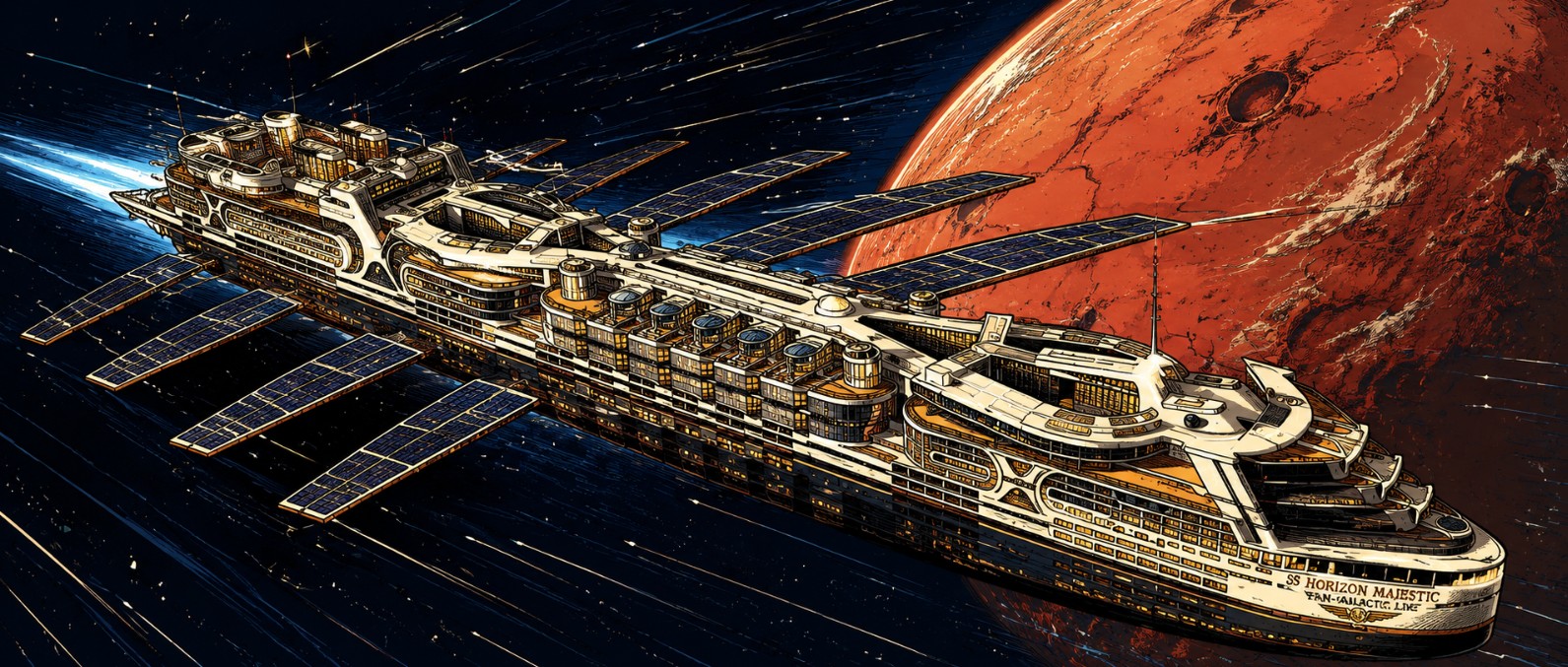
The Freedom Ship as reported is a staggering engineering proposition. A mile-long, nuclear-powered vessel. Home to 50,000 permanent residents, with space for 10,000 tourists and 20,000 crew. Eight times the size of Royal Caribbean’s Icon of the Seas. A 15,000-seat stadium. Schools, colleges, museums, a water park, a music hall. Nuclear-powered, too large to dock anywhere on Earth, circling the globe every two to three years in international waters.
Freedom Cruise International describes it as a permanently mobile city designed for long-term residence rather than short-term travel.
That framing is honest as far as it goes. But a city needs more than infrastructure. It needs a reason to exist that outlasts its founders.
The Freedom Ship as pitched is built around escape. Escape taxation. Escape jurisdiction. Escape the complications of terrestrial governance. That is a legitimate grievance dressed up as a civilization. And it will not survive its second generation.
Every large intentional community faces the same fracture point. The founders carry the culture in their bodies — they know what the thing cost, what the tradeoffs mean, why the rules are what they are. The second generation inherits the institution without inheriting the understanding. Paul Wheaton’s work in permaculture community design documents this failure pattern obsessively. Robert Heinlein spent a career fictionalizing it across a dozen worlds. The pattern holds: organizations built around escape rather than purpose tend not to outlive their founders.
80,000 people on a comfort vessel with no shared mission is a very expensive social experiment with a predictable result.
Design
Now invert it.
Keep the ship. Lose the escape premise entirely. Take ten thousand volunteers — purpose-selected, skill-diverse, unified in a single long-horizon intention — and give them the vessel as their world. Not a cruise. Not a resort. A civilization in construction.
The ship never docks. That is not a limitation — it is the founding constraint, the one that makes everything else meaningful. The world can come to them; they can go to the world. But the vessel is home, permanently and without exception, and running it is the work.
The ship follows the planet’s logic rather than fighting it. It reads weather systems weeks out and repositions accordingly — tracking storm corridors to collect fresh water from tropical rains, moving north and south with the seasons to maintain solar exposure for energy and agriculture, riding the great ocean currents that have directed human movement for ten thousand years. The vessel is not conquering the sea. It is in conversation with it.
Food comes from the sea and from the ship simultaneously. Aquaponic systems running through the interior decks cycle fish and vegetables in closed loops, maximizing nutrition per square foot. Sea harvesting operations — managed, rotational, ecologically calibrated — supplement from the surrounding water column. The community understands its food supply at every level, from biology to harvest to table, because survival literacy requires it.
Intervene
Here is where the concept becomes something genuinely new.
The children born on this ship learn the ship. Not as passengers. Not as tourists. As inheritors.
Every system, every trade, every discipline that keeps the vessel alive is taught with the seriousness of a guild. Navigation and meteorology. Marine engineering and nuclear systems maintenance. Aquaponic biology and sea harvest management. Medical practice, governance, conflict resolution, education itself. A child grows up moving through the ship’s functions the way an apprentice moves through a workshop — observing, assisting, practicing, mastering. By the time they reach adulthood they can run any system they choose, and the community has the redundancy that survival requires.
This is not schooling for the world outside. This is cultural transmission with a purpose. The founders chose the constraint. The children inherit fluency in it. The third generation will have never known anything else — and that is the point.
Because this is not ultimately a ship project. It is a colony culture project.
Mars does not need astronauts. It needs people who grew up in a closed-loop system, who learned resource scarcity as design rather than deprivation, who inherited their competencies from parents who chose this life deliberately, who have already navigated second-generation succession and come out with the culture intact. We are spending hundreds of billions of dollars engineering the rocket and almost nothing engineering the civilization that has to survive after it lands.
The families who stay — who raise children on the vessel, who commit to the multi-generational mission — those families earn priority placement on the first colony manifest. That is the reward. Not luxury. Not escape. First families off Earth.
The Larger Vision
This concept has particular legs for island nations.
A small sovereign state with limited landmass, climate exposure, and resource constraints is already running a version of this experiment. The ship offers such a nation something extraordinary: a mobile sovereign extension, a second territory that follows optimal conditions rather than enduring fixed geography, a platform for economic activity, scientific research, and cultural projection that no fixed island can match.
Imagine a Pacific island nation operating a vessel of this kind — not as a tourist attraction but as a legitimate arm of national life. Citizens who choose the ship. Trade relationships conducted from international waters. A living demonstration of closed-loop resource management that the world’s development institutions would pay to study. The diplomatic and economic leverage of a nation that is literally everywhere at once.
The Freedom Ship is a $16 billion escape pod. With a different founding premise, the same vessel becomes a $16 billion civilization incubator. The engineering is identical. The mission is everything.
Rinor asked what we thought. Derrick shared the news. Collin reported it. This is what happened when I let it run.
I will be writing more about colony culture design, second-generation organizational succession, and the systems framework for intentional communities. The aquaponics framework alone deserves its own treatment — and it will get one.
This is why thinking in public matters.
— Bright Meadow Group