Observe → Design → Intervene
I went looking at how Japan handles algal blooms and nutrient loading in its coastal waters. What I came back with was mostly not about algal blooms. It was three things I did not know, one of which I should have, and all of which change how I will build.
That is how it usually goes. Everything is a teacher once you open yourself to learning.
For the engineers
There are engineers reading the River Refugium Project work, and I know some of you have been patient with me. I am not an engineer. I do not use your language efficiently and I have been reconstructing from first principles things that already have part numbers.
Here is the useful finding: there is no need to reengineer a bacterial refugium.
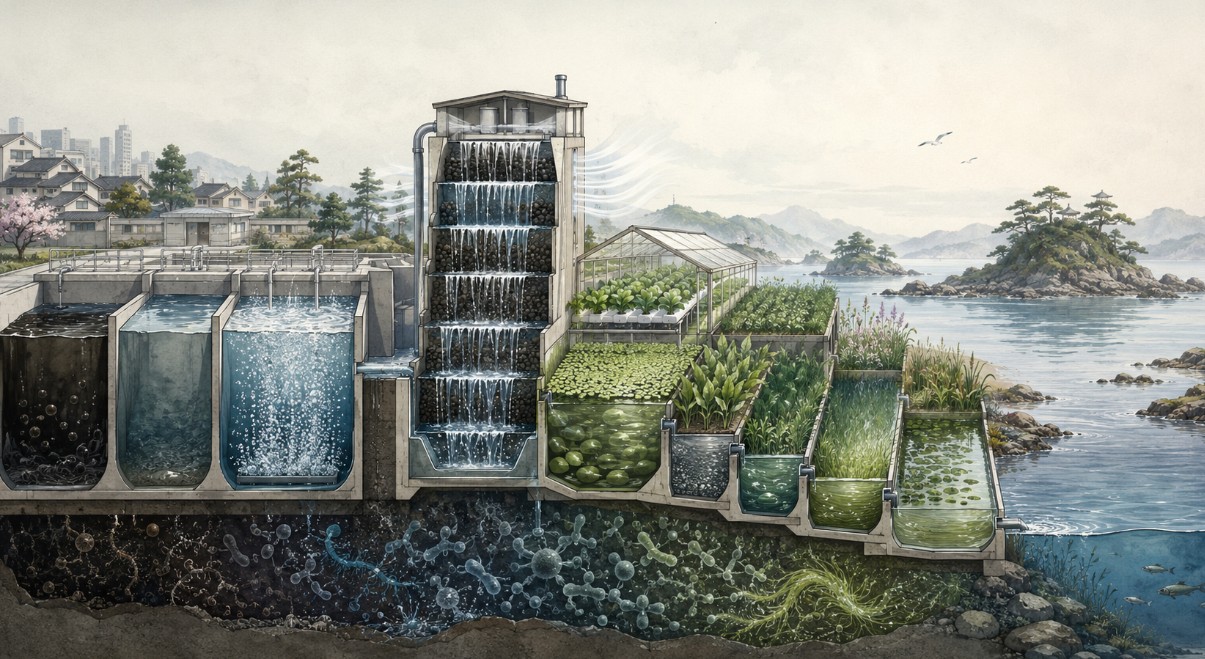
Japanese municipal wastewater treatment runs a process called kōdo shori — advanced treatment. It is not filtration and it is not chemistry. It is bacteria, arranged in sequence by oxygen state. An anaerobic zone with no dissolved oxygen and no nitrate. An anoxic zone with no dissolved oxygen but oxygen available as nitrate. An aerobic zone under aeration. Water moves through them in order, and which zone it is standing in determines which metabolism runs.
There are three canonical arrangements. AO for phosphorus. A2O for nitrogen and phosphorus together. Recirculating nitrification-denitrification for nitrogen. All three are built from the same tank shell, and the retrofits are cheap enough that Japanese plants routinely divide an existing reaction tank into four cells and get advanced treatment out of a standard basin.
They have been running this at national scale for forty years. The design guidelines are published. The failure envelope is documented by operators who hit it: recirculated nitrate above roughly 70 mg/L collapses denitrification; solids retention time below four days kills nitrification; long retention stabilizes nitrogen removal but degrades phosphorus removal, with 18 to 20 days cited as the working compromise. Sustained rain stops denitrification, and the operator’s fix is to reduce air to the back of the tank so nitrification does not run to completion.
None of that needed inventing and none of it needs inventing again.
What it needs is selection. Choose the arrangement by desired product and source water parameters. If you want nitrate, run the aerobic stage and skip the recirculation. If you want phosphorus in tissue rather than sludge, you are working against their optimization and you need to know where. If you want both, you are managing a documented tension rather than discovering one.
The RRP is not a treatment technology. It is a decision about what happens to the biomass, sitting on top of a treatment biology that is a solved problem. I should have said that earlier and more plainly.
The embarrassing one
I have worked with aquaponics for close to twenty years. I am also a student of Japanese culture. And until this month I thought the Bakki Shower sitting above half the serious koi ponds in the world was a water feature.
Which is silly. This is Japan. Nothing in that culture does one job when it could do three.
It is a bacterial refugium. Water is showered over stacked trays of open lava rock rather than pumped through a submerged bed. The rock is media — enormous colonizable surface. The falling water picks up oxygen through the air gaps without a blower. And the counter-current air moving up through the tower strips carbon dioxide out of the water, which raises pH, which partially offsets the acid that nitrification produces.
That last part is the elegant piece. Nitrification consumes about 7.14 grams of alkalinity for every gram of ammonia nitrogen it converts. In a soft-water system that is what eventually stalls the whole biology — the buffer runs out, pH falls, and the nitrifiers quit. The tower answers that passively, by geometry, using head instead of electricity.
Aeration, colonization, and pH stabilization out of one structure with no moving parts. It also happens to be beautiful, which in that design tradition is not a separate consideration.
I do parts of this without intending to, the way anyone running a media bed does. But doing it on purpose, with the tower sized as its own stage, is a different thing. I guess this is the price of not being that interested in koi. This set of efficiencies is going into future designs.
Considerations for the RRP
I am not a biologist either, and some of my worst thinking has been in plant uptake chemistry. Here is where I have been wrong.
I have been treating full nitrification as the goal — convert everything to nitrate, deliver nitrate, done. That is what fish require, and I came up through fish. But plants do not want a pure nitrate feed. Most crops do better on a mixed nitrogen source, and the figures I have seen put the preferred ammonium fraction somewhere around ten percent of total nitrogen. Ammonium is also cheaper for the plant to use, since it skips the reduction step nitrate requires.
News to me. Twenty years in and I did not know it.
It changes something structural. The RRP train has greenhouses in sequence, and they do not all do the same job. The early houses are production — the point is yield. The late houses are polishing, where the concern is nutrient reduction and toxin uptake before discharge.
Those two jobs want different water speed.
For the production end, we may move water faster through the refugium and let more ammonia through. Faster water means less complete conversion, which means a mixed feed closer to what the plants actually want. It also means more total volume through the same hardware, and less alkalinity consumed, which opens up soft source water that a full-conversion design could not handle.
The polishing end stays slow. Contact time is the whole point there.
That is a fork in the framework rather than a parameter, and it is going into Version 3.
Three findings. One I should have found by reading, one I should have found by looking up at a koi pond, and one I should have found by asking a grower instead of a fish keeper.
Where we learn, we apply and develop.
Same terms as always. No patents, no proprietary claims, no gatekeeping.
Robert Smith
robert@brightmeadowgroup.com
Where the rest of it is
The RRP archive: cernunnosfoundation.com/rrp
- River Refugium Project — Five New Appendices, and the Close of Version 2
- The Refugium
- Lessons from the Aquarium — The Nitrogen Cycle
- The Loop That Feeds You
- Currents in Aquaponics
- The River Is the Supply Chain
Argue with it: r/Cernunnos_Foundation