A Labor History Museum Belongs in Johnstown
Johnstown has a flood museum, an immigration exhibit at the Heritage Discovery Center, an inclined plane with a small interpretive area, and a scatter of markers and modest collections across the region. What it doesn’t have yet is the one institution the valley is most suited for: a museum that puts working people at the center of the story rather than in the background of someone else’s.
That’s less a complaint than an opening. The material for it is already here, and there’s more of it, and better, than almost anywhere else in the country. Consider what a serious labor museum in Johnstown would have to work with.
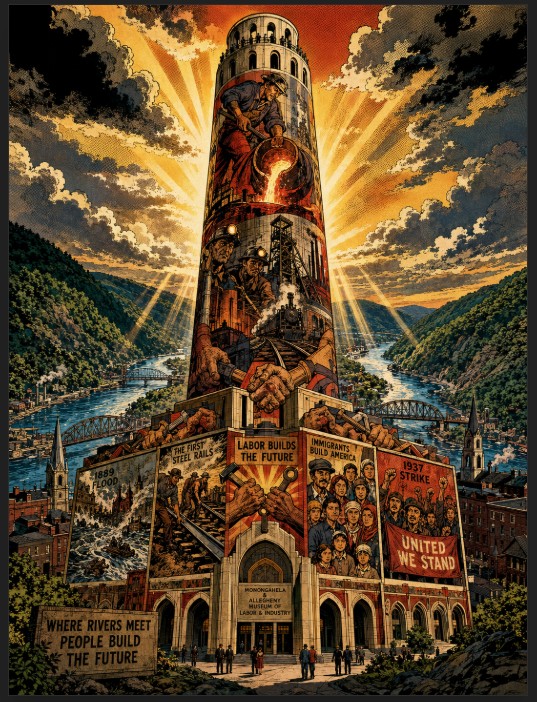
Cambria Iron and the company town. For much of the nineteenth century the Cambria Iron Company was the largest and most advanced steelworks in the United States. The Bessemer process was refined here; the first commercially viable steel rails in America were rolled here. The company owned the housing, the stores, sometimes the churches, and effectively the politics of the borough. Workers were paid in scrip good at company stores. The ethnic ladder on the shop floor — Anglo and German skilled men at the top, Irish below, Slavs, Hungarians, and Italians at the bottom doing the hardest work for the least pay — was a management strategy meant to keep solidarity from forming. That alone is a wing.
The 1889 flood as a labor story. The flood is usually told as a disaster of weather and engineering. It is also a story about class. The South Fork Fishing and Hunting Club was an elite retreat sitting on a dam its members declined to maintain properly. When the dam failed, 2,209 people died, overwhelmingly working-class immigrants in the mill neighborhoods downstream, and no member of the club was ever held to account. In the aftermath, the press blamed Hungarian immigrants for supposedly looting the dead — a claim that was largely invented but hardened ethnic suspicion for a generation. A labor museum can tell the flood from the valley floor looking up, which is a version most visitors have never heard.
The 1892 Homestead resonance. Homestead is forty miles west, and the men who fought the Pinkertons there had brothers and union brothers in the Cambria mills. The defeat of the Amalgamated Association at Homestead set steel labor back a generation across the whole industry, and this valley felt every year of it. That makes Homestead a regional story, not only a Pittsburgh one.
The coal patches. Cambria and Somerset counties are dotted with the bones of company coal towns — Revloc, Colver, Nanty Glo, Vintondale, and dozens more. The patch town was a specific American institution: company housing, company store, company police, company church, company school, all built around a single mine that closed when the seam ran out. The United Mine Workers organized those patches at real cost, often against the Coal and Iron Police, a private armed force the Commonwealth had authorized. The Ghost Town Trail runs straight through what amounts to an open-air record of that era, and a museum could make it legible to anyone walking it.
1937 and the Little Steel Strike. One of the most consequential labor confrontations of the twentieth century happened here, and most residents under sixty have never heard of it. Bethlehem Steel, by then the valley’s dominant employer, was among the “Little Steel” firms that refused to recognize the Steel Workers Organizing Committee after U.S. Steel gave in. The mayor deputized hundreds of men and brought in strikebreakers, and ethnic and racial divisions were worked deliberately to keep the strike from holding. The union eventually prevailed at the labor board years later, but the events themselves have never been gathered into local memory.
The Knights of the Flaming Circle. Founded in this region in 1923 to stand against the second Klan, the Knights pulled together Catholics, Jews, Black Americans, and immigrant workers across Pennsylvania and West Virginia. Three Cambria County Catholics died defending their community against Klan violence. It is one of the more genuinely cross-ethnic working-class stories in American history, and it has no permanent home anywhere.
The end of the mills. Bethlehem closed, the population fell from 67,000 to under 19,000, and whole neighborhoods emptied out. The people who had built the region’s postwar prosperity watched the work disappear and the pensions and benefits get pared back. That chapter is still living memory for a lot of families here, and it deserves to be told with care while the people who lived it can still tell it.
The content, in other words, is overwhelming, and it’s already in the valley. The reason it hasn’t been gathered into one place isn’t anyone’s failure so much as how heritage tends to grow: one institution at a time, each forming around a single story — the flood here, immigration there, the canal up the mountain. No one has yet stepped back and put the working story, which underlies all the others, at the center of its own building.
That’s the opportunity. A labor museum wouldn’t compete with the Flood Museum, the Heritage Discovery Center, the Path of the Flood, the Ghost Town Trail, or the Portage Railroad site. It would complete them — the connective story the others orbit. And it would draw its own audience: union retirees, labor historians, school groups, researchers, and the many people who come through tracing family who passed through the mills and the patches. It would also give the visitors already here for the flood a reason to stay longer, which is the thing Johnstown most needs if it wants to become a place people come to rather than pass through.
The encouraging part is how much of the hard work is already done. The buildings exist — downtown has more than one vacant structure with the square footage and the character for it. The artifacts exist, scattered through union halls, private collections, attics, and the back rooms of museums that have no space to show them. The scholarship exists; Ewa Morawska’s For Bread with Butter alone is a foundation, and there’s plenty more.
It’s the unusual civic project where the difficult parts — the story, the artifacts, the buildings, the audience — are already in hand. What’s left is the decision to assemble them. For a city named Johnstown, in a county named Cambria, in a valley built by what working people made here, it would be hard to think of a better fit.