A Hundred Thousand Dollars and a Robot That Can Jump
A Bright Meadow Group concept brief on making Johnstown a robotics destination
Johnstown has heard enough economic-development language to last a generation. The word “innovate” has been said over it so many times it has stopped meaning anything, and every few years a new committee rediscovers that young people are the future. What the city has never been handed is a single concrete machine — an idea simple enough for a kid to grasp on sight and hard enough for the wider world to take seriously.
Here is that machine.
Once a year, Johnstown hosts a small robotics competition with a large prize. First place takes $50,000, second place $30,000, third place $20,000 — a clean $100,000 purse.
FIRST and VEX have already proven the part that matters most: the audience is real and it is enormous. VEX lists more than 17,000 teams across 54 countries. The FIRST Championship draws upward of 50,000 people to Houston every year — an event the city values enough that it just locked in a hosting deal projected past $500 million in economic impact across 2028 through 2034. Those are deep institutional ecosystems built around elaborate, months-long student engineering challenges, and they do that work well. Johnstown’s opening sits in the space those championships leave open: one elegant, self-contained challenge a spectator understands in a single glance, run in one city, every year, until the city’s name and the event become the same word.
The reference design already exists, and it is decades old. Micromouse — a small autonomous robot solving a maze against the clock — works because the public grasps the task instantly while the engineering underneath runs deep: sensing, mapping, motion control, planning, acceleration, traction. The robot either clears the maze or it doesn’t, faster than the others or not. That legibility is the model worth borrowing. The maze itself is optional. What Johnstown should take is the shape: one task, one rule set, one field, one winner the crowd can read without a translator.
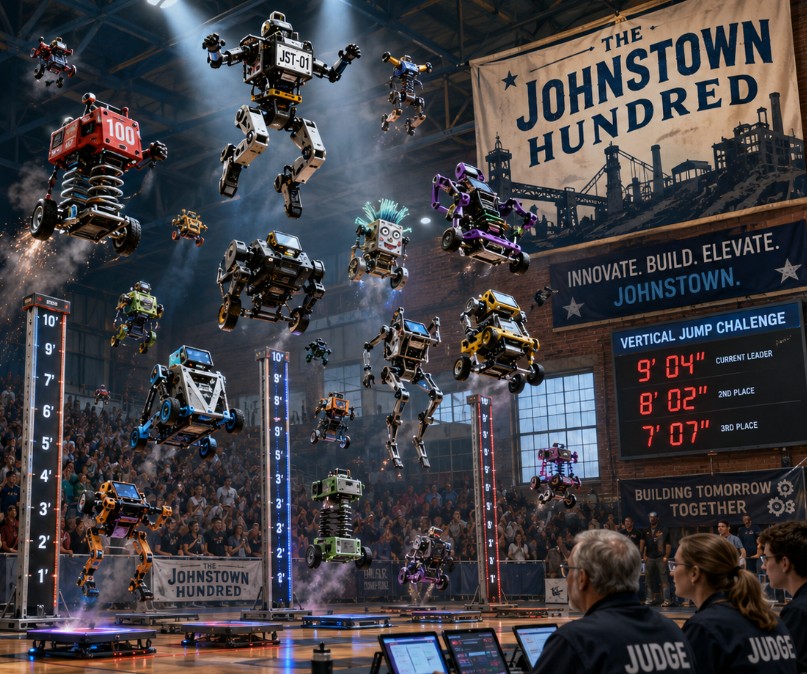
Call it the Johnstown Hundred. The prize is a hundred thousand dollars, the format is compact, and the name carries a little of the old steel-town wager — bring your best machine, put it on the mark, and let everyone watch what it can do.
The first year’s task should be almost insultingly simple. Build a robot under a fixed weight limit that performs a standing vertical jump and lands under control inside its own launch zone. No ramp, no tether, no combustion, no thrown parts, no external guidance, no human correction after launch. The machine sits on a marked pad, takes one signal, jumps, and lands. Highest controlled jump wins, with penalties for leaving the square, tipping, shedding parts, or damaging the surface. A third grader can follow it; an engineer will lose sleep over it. That gap is exactly where the event lives.
A jumping robot becomes a real problem the moment you start designing one. Weight against stored energy. Springs against motors. Power against control. Actuation against landing gear. Sensors against simplicity. The machine has to produce a violent force and then survive the force it produced — brave on the way up, civilized on the way down. That is most of robotics compressed into a single motion, and a crowd understands the question before the announcer finishes asking it: can it jump higher than the last one and still land where it started? That reads on a livestream, on YouTube, in a clip. It is the kind of thing a twelve-year-old watches once and starts sketching in a notebook.
The Johnstown Hundred should never settle into one solved machine repeated forever, so the task changes every year — announced far enough ahead that serious builders can prepare, simple enough that a high-school shop class, a community-college lab, a garage tinkerer, or a university club can all take a real swing. A compact robot crossing a broken surface without touching the rails. A climber that scales a vertical standard using no wheels. A machine that finds and retrieves one object from a field of decoys, or crosses a narrow beam, turns, and comes back, or launches and relaunches itself under stored power, or solves a physical task with no camera at all, only touch and sound. One clean problem a year, a different slice of machine intelligence each time, in the same city every time. That sameness of place is the lever.
Which is why the venue matters as much as the rules. Host it at Greater Johnstown High School, on purpose. A school gym is probably not the easiest room to run this in and almost certainly not the largest in the region, and that is beside the point. The reason is the story. Johnstown High needs a hero story and so does the city, and staging the future inside a public high school lets local students stand next to it without a bus trip, a scholarship, or an invitation from somewhere richer.
Put the pits in the school. Put the field where a crowd can gather and the finalists under lights. Let the students run the event — robotics kids, shop kids, art kids, media kids, business kids, marching-band kids, and the quiet back-row kids who haven’t found their thing yet. Make the school the visible center of the weekend. That single choice reverses the usual order of operations, where adults design a project, raise the money, hold the meetings, cut the ribbon, and only then ask how to “engage youth.” Here the youth facility is the center from day one, and the city’s public high school becomes the annual landing pad for the most interesting small robots in the world.
The prize purse earns the attention. A real operating budget makes the attention usable, and the numbers are not exotic. A serious first year:
$100,000 — prize purse
$100,000 — field design, fabrication, scoring systems, insurance, safety, technical administration
$100,000 — media production: livestream, photography, editing, documentary shorts, archive
$150,000 — advertising, sponsor development, team recruitment, travel outreach, public relations
$50,000 — local programming, student workshops, school support, hospitality, signage, volunteers
$100,000 — reserve, contingency, year-two development
Six hundred thousand dollars a year. Split across a city, a county, a regional foundation, a few industry sponsors, a state economic-development office, and a tourism bureau, that is a disciplined annual bet rather than a moonshot. It is also the right size. Too small and no one believes it; too large and the machinery starts eating the idea. Six hundred thousand is enough to be real without turning into a bureaucratic monument to itself.
The direct return is easy to picture. Teams arrive. Families arrive. Mentors, sponsors, and the whole traveling apparatus of a build weekend arrive, and they all need rooms, food, coffee, gas, hardware, an emergency 3D print at eleven at night, spare bolts, pizza, and somewhere to sit down after their machine has either flown beautifully or come apart in front of everyone. That spending is useful, and it is the smallest part of the prize.
The real prize is repetition. Year one is an event. By year three it is a fixed date on the robotics calendar. By year five it is a pilgrimage, and by year ten it is part of the city’s identity — and that is where the economic math actually turns over. A city does not get rich because a few hundred people booked hotel rooms one weekend. It gets rich when that weekend becomes the reason for workshops, suppliers, machine shops, classroom programs, university partnerships, sponsor relationships, startups, summer camps, fabrication labs, media channels, and a thousand small acts of technical confidence. The robots are the visible object. The system they pull into being is the actual product.
Johnstown is unusually well-suited to host this, whether the city frames it that way or not. This is a place built around making hard things. The old economy was never only “steel”; it was heat, force, logistics, labor, timing, material flow, maintenance, repair, and applied intelligence under pressure. Robotics is the same inheritance with servos bolted on. A small robotics prize lets the city treat its industrial past as a working platform instead of a museum — shop culture, repair culture, and the plain pride of making a physical object do a difficult thing all belong here. The city does not have to ask the future to notice it. It can issue a challenge and wait for the future to show up.
The challenge should be wide enough to matter. Run a student division, so the budget never crushes the kids. Run an open division, so the rest of the world is allowed in. Add a local prize, so Johnstown and Cambria County teams have something specific to chase. Add a documentation award, because the engineering notebook is part of the public value. Add a beautiful-failure award, because a machine that almost works teaches more than one that merely wins.
Build a public archive from day one. Every finalist gets photographed, filmed, measured, and documented, and every year becomes a permanent record of what the machines taught the people who built them. That archive is what turns a weekend into a growing technical library: material for teachers, proof for builders, something concrete for sponsors to point at, and a civic story that accumulates instead of evaporating.
The event also has to read to people who don’t care about robots yet, which makes the look of it a real design problem. The field should be genuinely good to look at, and that is a matter of design discipline more than budget. A clean black-and-white launch pad. A bright measurement tower. A scoring display anyone can read. A visible countdown. A camera angle from the floor and a slow-motion replay. A judge with a hand on the flag, and a crowd that knows exactly what just happened — no clutter, no insider fog, no forty-minute explanation standing between a newcomer and the thing itself.
Run it with the rhythm of a county-fair event from the future. Bring the machine to the line. Make the attempt. Take the measurement. Next machine. That cadence is ancient — horses pulling weight, tractors dragging sleds, soapbox cars rolling downhill, pole vaulters going over the bar, the old plain pleasure of watching a built thing get tested in public. The only difference now is that the built thing has sensors.
This is how Johnstown becomes a destination without pretending “destination” has to mean luxury. A destination can be a challenge, and people travel for a challenge when it is clean, prestigious, repeatable, and worth winning. A $50,000 first prize makes serious builders pay attention. A $30,000 second keeps the field deep. A $20,000 third tells teams that excellence below the top still counts. The purse is the city saying out loud that it respects the work.
That matters more than it sounds. A lot of maker culture runs on applause and underfunded enthusiasm. Applause is pleasant; cash changes behavior. Cash makes a team justify the trip, makes a sponsor return the call, makes a garage builder think twice before writing the event off as a school hobby. Cash is how the city says: we are serious, bring the good machine.
Serious is the right register — serious, with room to be fun. Food trucks, local music, school media teams, shop tours, maker booths, downtown tie-ins, library displays, a Saturday-night finals atmosphere with real stakes. The surrounding weekend can be a party. The competition at its center stays clean and unforgiving, because the machine either performs or it doesn’t, and that unforgiving line is how prestige gets built.
Keep the rules public, stable, and short — the first-year rulebook should fit in ten pages. The robot starts inside a defined box, under the weight limit, untethered, from rest. It has to stay intact, land under control, and leave the field undamaged. Highest verified jump wins. That is the whole sport. Resist the urge to overdesign the first year, to bolt on side quests, or to make it “educational” by making it boring. The educational value is already inside the problem. Let the problem do the teaching.
If Johnstown wants to become a robotics destination, the wrong opening question is “how do we attract robotics?” The right one is: what is the smallest annual challenge that could make the robotics world remember our name? That is the Bright Meadow answer, and it falls out cleanly along the lines we work in.
Observe: robotics already has a large, committed global audience, but most of what serves that audience is big, expensive, complex, or institutionally crowded.
Design: a compact annual prize built around one elegant physical task — enough money to pull in serious builders, enough simplicity to pull in everyone else.
Intervene: host it at Greater Johnstown High School, put the city’s own students at the center of it, document everything, repeat it every year, and let the identity compound.
The city does not need to build a billion-dollar attraction. It needs to build a six-hundred-thousand-dollar annual machine that could plausibly grow into one — slowly, across many seasons, by becoming the place where a certain kind of builder comes to test himself. The city where a strange little robot jumps under the lights, lands on its own feet, and makes a kid in the bleachers think: I could build that. And then, a second later, the better thought: I could build something better.
That is how a destination gets made — by giving people a reason to come back.