My father was a porter. Rode the rails for the Pullman Company, and I’ll tell you something about that job — the whole country set its watch by it. Before the railroads, every town kept its own noon, whatever the sun said over the courthouse. It was the timetable that made America agree on what time it was. My father’s trade built the shared clock. And then he worked every hour of it — making up berths at midnight, shining shoes at three in the morning, gone four days at a stretch so that other men could sleep their way to Chicago in comfort. He carried other folks’ rest the way he carried their baggage.
The man I’m named for changed that. A. Philip Randolph and the Brotherhood took on Pullman when porters were working four hundred hours a month — read that number again — and the first great thing that union ever won wasn’t a dollar figure. It was hours. A human month. Time enough to be a father in your own house. My old man used to say the Brotherhood gave him back his Sundays, and my mother would add that Sundays were the only reason I turned out at all.
So understand that when I talk about time, I’m talking about the family business.
Now look at what they’ve done to the clock.
Your daughter stocks shelves from ten at night to six in the morning. Her husband drives a route that starts at four. Your neighbor gets his schedule Thursday evening for a week that starts Sunday, and it matches nothing — his wife’s hours run opposite, his kids’ school runs opposite, his own hours last week ran opposite. He is never off when anyone he loves is off. Ask him when he last sat down to supper with his whole family at one table and watch him do the math. Watch his face while he does it.
They’ll tell you this is efficiency. They’ll tell you the modern economy runs around the clock and we all have to be flexible. And I want you to notice something about that word flexible, because in a hundred years of labor struggle I have never once heard it used to describe anything the company gives up. Flexible always means you bend. Flexible means your Tuesday belongs to a scheduling algorithm in an office park six hundred miles away, and your Sunday too, and the algorithm doesn’t know your boy has a game and wouldn’t care if it did.
The neighborhood I grew up in ran on mill whistles. When the shift turned, the whole street turned with it — the taverns filled at the same hour, the church suppers and the ball games and the union hall all built around a rhythm everybody shared, like a house built around a hearth. The work was hard and the company took plenty that wasn’t theirs to take. But the clock belonged to everybody. That’s what the old contracts really won us: communal rest. Everybody down at once, so that rest could become supper, could become a front porch with neighbors on it. Sixty years later they found a way to hand us back the same number of hours and steal every bit of what the hours were for. They shuffled us. They dealt every worker a different hand of days and called it freedom.
And some of them knew exactly what a shuffled workforce is worth. A man who never shares a shift with his brother never compares a paystub with his brother. You can’t organize a break room where nobody takes break at the same time. The old bosses put Poles next to Slovaks next to Italians so nobody could talk to anybody — this is the same trick run through a computer. Divide the hours instead of the languages. Same wall, new bricks.
Now. The union man’s answer, because there always is one, and it comes in two parts.
Part one: pay for the night what the night costs. Some work truly can’t sleep — the hospital, the water plant, the power grid, the firehouse. My father was one of those souls once, holding the line at 3 AM so the rest of the world could close its eyes, and I mean for every one of them to be paid like the guardians they are. Real night premiums — twenty-five, fifty percent, written into law the way other countries already do it — because right now the ledger says an hour of your life at 3 AM costs the company the same as an hour at 3 PM, and every working family knows that’s a lie. That midnight hour costs a marriage a little something. It costs a kid a bedtime story. The shift itself is classified as a probable carcinogen, Jack — same category as the fumes we fought about forty years ago. Make the price tell the truth and two things happen: the essential night worker finally gets his due, and the unessential night work — the 3 AM shelf-stocking that exists only because midnight labor is priced like it’s nothing — dries up or goes to the machines.
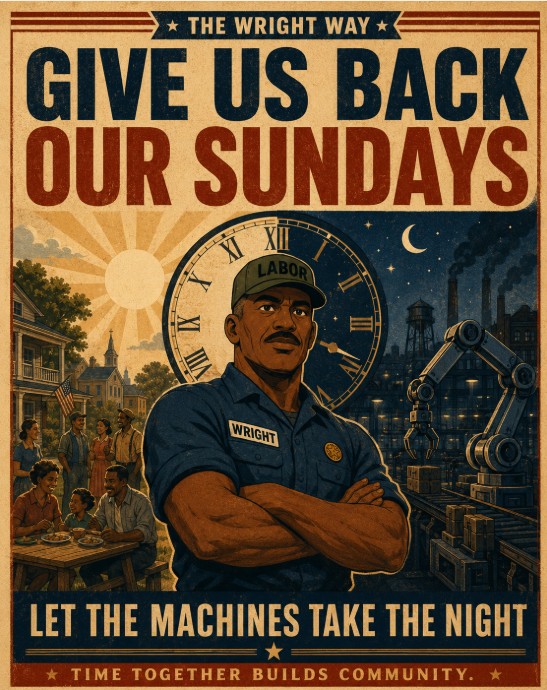
Part two: let the machines take the graveyard. For once the robot argument runs our way. They keep telling us automation is coming for our jobs — fine, then send it to the hours no human being was built for. A robot has no circadian rhythm. A robot has no anniversary. Let the machines run the dark and let the dividend get paid out where it belongs: everybody back on a human clock, together. Understand me — I want more than fewer hours. Shorter weeks where every worker’s days still land different from his wife’s solve nothing. I want shared hours. Synchronized. The whole street turning at once, the way my neighborhood did, the way the Brotherhood’s Sundays did.
Because here’s the thing they fear, and it’s the reason the shuffle was worth so much to them: people who share time share notes. Randolph knew it — you couldn’t organize porters scattered across ten thousand miles of track until you found the hours where they gathered. Neighbors who sit on porches at the same hour become a neighborhood. Workers who eat lunch at the same table become a local. Families that gather become the kind of people who can’t be told the family down the street is their enemy. Every hour we spend together is an hour their whole arrangement gets weaker, and they know it better than we do.
So that’s the demand, plain as I can make it. Pay the night what the night is worth. Send the machines into the dark. And give the people back the one thing this movement fought for before wages, before benefits, before any of it — time in each other’s company. It was the Brotherhood’s first victory. Let it be ours again.
They spent forty years pulling us apart one schedule at a time. We can put ourselves back together the same way. One shared Sunday at a time.
Now you know, Jack.