Remembering England with a House
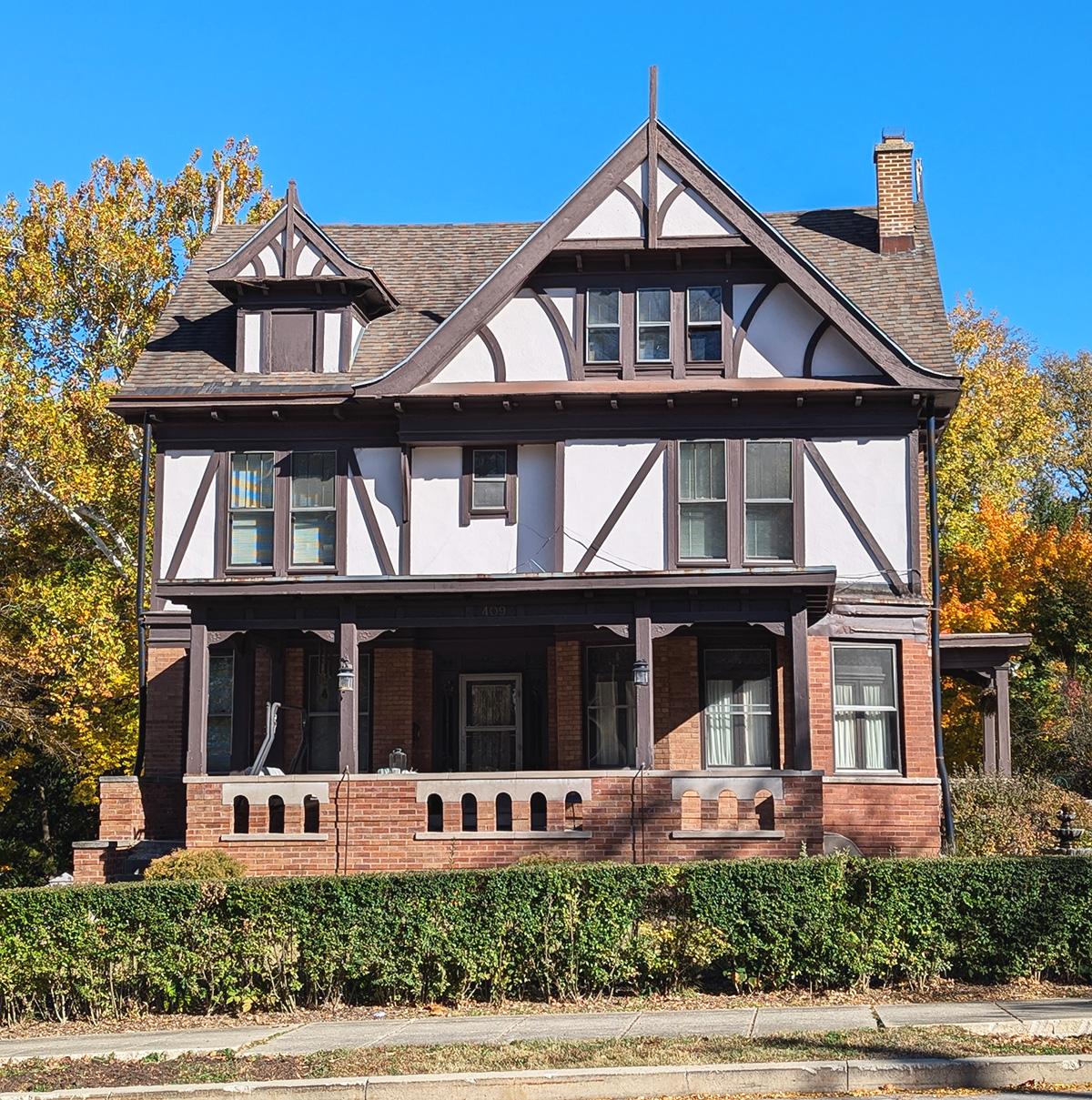
Stand across the street from this house on a bright autumn afternoon and you’re looking at two architectural eras shaking hands. The address plate says 409. The bones say 1895 to 1925. The surface says Merrie Olde England, as imagined by an American builder who had never crossed the Atlantic and didn’t need to.
The style is Tudor Revival, and the tell is right there on the upper stories: dark brown boards laid over pale stucco panels in a pattern of verticals, diagonals, and gentle curves. On a genuine sixteenth-century English house, that timbering would be structural — the actual oak skeleton of the building, with wattle-and-daub or plaster infill packed between the members. Here it’s decoration, pure and simple: dimensional lumber applied over a conventional balloon or platform frame to conjure the look of a manor house in the Cotswolds. Nobody was fooled then and nobody is fooled now, and that was never the point. The point was romance.
Look closer at the timbering and you can see the designer’s hand at work. The pattern isn’t random. The gable peaks carry curved braces — arcs springing from the verticals to meet under the ridge, a flourish borrowed from decorative English bargeboard work. Below, the boards divide the stucco into tall panels punctuated by diagonal struts, echoing the herringbone and chevron infill patterns of the genuine article. The stucco itself is the smooth, troweled variety typical of the period, not the rough-cast pebbledash some Tudor Revival houses wore. Every intersection is deliberate, laid out on paper before a single board went up.
The roofline does its part. A big central gable pitches steeply toward the street, flanked by a smaller gabled dormer on the left and a broad sweep of shingle that folds around the corners. Watch the eaves: they flare outward at the bottom in a subtle bell-cast kick, softening the steep pitch just before it terminates — a refinement that costs the carpenter extra framing and rewards the eye forever after. Tudor Revival houses lean hard on dramatic roof geometry, and this one delivers, right down to the finials spiking the ridgelines like exclamation points. The second story oversails the first slightly, carried on a deep boxed cornice with modillion-like brackets marching along the belt line — a nod to the jettied upper floors of medieval townhouses, where each story leaned a little further over the street than the one below.
The tall grouped windows in the main gable follow the pattern too: vertical, clustered in threes, a simplified American take on the leaded casements a stricter English Revival house would have used. Most of the sash here is one-over-one double-hung — the practical American standard of the era — with a single small casement tucked into the timbering at center, likely lighting a stair landing or closet. Stone sills and lintels punctuate the brick below. The chimney rises through the roof plane in warm variegated brick, finished with a corbeled cap that steps outward course by course, one more small ceremony in a house full of them.
Then look down, and the house changes nationality. The full-width front porch — brick piers on stone bases, an arched brick balustrade with dressed stone caps, broad horizontal roof carried on a heavy timber frieze — is thoroughly American. The arches in that balustrade are worth a pause: each one a small feat of masonry, brick laid in rowlock courses over curved formwork, repeated a dozen times across the front like a Roman aqueduct in miniature. English Tudor Revival at its most orthodox favors a small entry porch, maybe an arched stone doorway, compact massing. This porch belongs to the Queen Anne and transitional Victorian tradition, the great American front-porch era, when a house was expected to offer shade, a place to sit, and a stage for watching the neighborhood go by.
That combination is the real story here. This is a large American house form — Victorian in its massing, its asymmetry, its generous porch — dressed in Tudor costume. The brick base, stucco-and-timber upper stories, and dark trim over light fields are the standard vocabulary of early twentieth-century English Revival work in American cities, when builders and homeowners wanted the dignity of old England grafted onto the comforts of new prosperity. The façade is composed but deliberately irregular: dormer left, gable center, bay and chimney right. The picturesque effect is the whole game.
Call it Tudor Revival with Queen Anne bones, built somewhere in that window between the 1890s and the 1920s when American residential architecture raided every century of European history for costumes and wore them all with total confidence. The house isn’t medieval and never claimed to be. It’s a romantic reinterpretation — an American memory of an England that mostly existed in storybooks — and a century on, still holding the corner with complete conviction.