The Mine: A Concept for the Ohio Street Vacancy
A BMG feasibility note on adaptive reuse, civic draw, and what one empty box on a state highway could mean for Johnstown.
Observe
The Rite Aid at Ohio Street, on the corridor between Moxham and the Stonycreek River, has closed as part of the chain’s national wind-down, and the property is now listed for lease or sale. What’s available is a roughly 13,000 square foot standalone commercial building on a generous lot, with a loading dock, a deep stockroom, multiple egress doors, commercial-grade HVAC, heavy electrical service originally specified for pharmacy refrigeration, an existing sprinkler system, ample parking, and clear sightlines from a state-maintained roadway with strong daily traffic counts.
Stated plainly: this is a building most of whose expensive components — the structure, the slab, the roof, the service drops, the parking lot, the loading infrastructure — are already in place and depreciation-paid. What’s needed is reconfiguration of the interior rather than new construction. And because the listing is live, the question has a clock on it.
The market will eventually fill this box with another retail tenant, probably a discount chain, probably running thin and seasonal. That outcome doesn’t move Johnstown forward. It just resets the clock on the next vacancy.
There’s a better answer, and it’s one Johnstown is uniquely positioned to support.
The case for a mid-size music venue in Johnstown
Pennsylvania has a structural gap in live music infrastructure between Pittsburgh and Harrisburg. National and regional touring acts in the 500–1,000 capacity bracket currently route past central PA because there is nowhere appropriate to play. Pittsburgh is saturated; Altoona and State College have college-aligned but limited rooms; Johnstown has no dedicated mid-size music venue at all. The acts that would otherwise stop here drive past us on US-22 to play Cleveland or Philly.
A purpose-built room at this capacity, located on a major corridor with parking, becomes a regional draw the moment it opens. Audiences travel an hour for shows they can’t see closer; this is how secondary markets like Reading, Lancaster, and Bethlehem built their music economies. Cambria County is within a 90-minute drive of roughly 4 million people. The catchment is real.
And the value of capturing that catchment goes well past ticket revenue. Live music venues are among the highest-multiplier cultural investments a city can make: studies of local music economies consistently find that every dollar spent on a ticket generates several more in surrounding spending — restaurants, fuel, retail, lodging — and that mid-size venues in particular anchor the nighttime economies that make downtowns feel alive and safe. Cities from Bethlehem to Chattanooga to Huntington have used cultural venues as the first domino in corridor revival, because a venue does something a retail tenant never does: it imports people. Every show night, hundreds of visitors who had no other reason to be in Johnstown arrive, spend, and leave with a changed impression of the city. No marketing budget buys that. A venue manufactures it 120 nights a year.
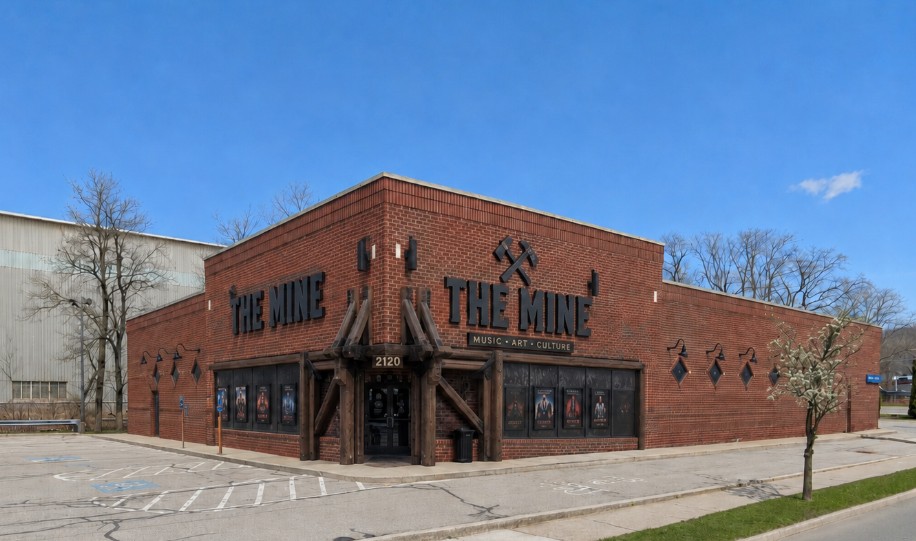
Working name: The Mine — a nod to the working roots of this community, the industry that built these neighborhoods and the people who went down into it. Every genre plays the room.
The opening programming emphasis is deliberate, though: heavy and dark music in crossover rotation with hip-hop and pop. That’s the booking mix that reaches the under-30 audience — a crowd that moves fluidly between a hardcore matinee and a rap show, is chronically underserved in this region, and travels for shows. It’s the fastest route to foot traffic, and it makes The Mine a room built first for young people: a place for Johnstown’s teenagers and twenty-somethings to be on a Friday night that isn’t a parking lot.
Design
The conversion follows a room-within-a-room plan that uses the building’s full footprint.
The stage and auditorium occupy the center two-thirds of the building — a purpose-built performance hall constructed inside the retail shell. Wrapped around it is a wide public corridor running the perimeter in a horseshoe: encircling the hall on three sides, with the fourth segment closed off as backstage, production, and load-in access connecting the stage directly to the existing loading dock.
The room-within-a-room approach is standard practice for serious music venues and earns its cost several times over. The auditorium’s independent walls provide acoustic isolation, so the hall can run loud while the corridor stays conversational and the neighbors hear nothing. The corridor provides code-clean egress on every side. And the separation means the perimeter can operate as its own destination — open on dark nights, open during the day — independent of whatever is happening on the stage.
Auditorium capacity at PA fire code lands in the 600–750 range standing, with elevated viewing along the pharmacy-side wall.
The original pharmacy zone — slightly raised on most Rite Aid builds, with a deep counter — becomes the concessions and merch hub. The structural elevation is a feature: sightlines into the hall without building a balcony, a ready-made service counter, and back-of-house depth for a real kitchen. House merch — venue-branded goods, show posters, gallery pieces — sells from the concessions counter. Touring bands get dedicated, well-lit sales space alongside it, and they keep every dollar of what they sell. The Mine takes no merch cut. This is a small line in a business plan and a large one in the touring economy, where merch is often the margin that keeps a band on the road. Rooms that take care of artists get talked about between artists, and routing decisions follow. Artist-forward economics is a competitive strategy here as much as a principle.
The drive-thru pharmacy window becomes a takeout food window. The kitchen built to feed a concert crowd runs the rest of the week serving order-ahead food to drive-up customers — genuinely good food, the kind people order for the house on a Tuesday. This turns the kitchen from an event-night cost center into a seven-day revenue stream, keeps staff on payroll between shows, and puts daily traffic in the parking lot of a building the neighborhood needs to see busy. Will-call moves to the front vestibule alongside the ticketed entry checkpoint.
The stockroom and pharmacy back-of-house become green room, production office, and dressing rooms. The loading dock feeds the closed segment of the horseshoe: bands roll cases from van to stage on one floor with no stairs, which touring acts notice and remember.
The gallery in the horseshoe
The rest of the perimeter corridor — most of the horseshoe — operates as an art gallery.
This is the design decision that changes what the building is. A wide, climate-controlled, well-lit, continuously monitored corridor with high foot traffic is exactly the exhibition space that regional artists lack. The gallery runs rotating shows of western Pennsylvania artists on a commission model, with wall space, display cases, and short-run installations. Ticket holders walk the gallery on every entry and exit; on dark nights and daytime hours, the gallery opens on its own schedule, drawing an audience that might never buy a concert ticket.
The gallery does four jobs at once. It’s an income stream — sales commission, exhibition-adjacent events, opening nights with the kitchen catering. It’s a draw for an audience the concert calendar doesn’t reach, including the daytime and older visitors who anchor a healthy cultural facility. It’s programming for the broadcast stream, giving the off-hours feed something worth watching. And it’s a civic statement: a city that hangs its artists’ work in a busy public building is a city that has decided artistic culture is infrastructure. Cities that make that decision attract residents, employers, and investment that no tax abatement can buy — the creative-economy literature has said so for two decades, and the towns that acted on it are the ones people now drive to on weekends.
A safety architecture worth modeling on
The single most distinctive operational feature of The Mine is also its strongest civic argument: comprehensive interior and exterior video surveillance, broadcast publicly and continuously over the open internet, with clear signage at every entrance disclosing the practice.
Most music venues operate on the trust-us model: cameras may exist, recordings are private, incidents are reported selectively, and patrons take the operator’s word that the room is safe. Years of reporting on harassment, assault, and predatory behavior in venues across the country has shown how that model fails — particularly for women, particularly for younger fans, and particularly in genres where boundary-crossing has been historically tolerated.
A publicly broadcast venue inverts the equation. Anyone — a parent dropping off a teenager, a fan checking on a friend, a city official, a journalist, the operator’s own staff during a quiet shift — can watch the room. Bad actors lose the cover that private cameras provide. Allegations of misconduct have an objective record. Staff response times become observable. The room is, in a real sense, accountable to the public it serves.
The all-ages mission depends on this. Johnstown parents deserve the ability to verify — at any moment, from any device, without a phone call — that the show their kid begged to attend is a safe room. The broadcast model makes that verification possible.
Done correctly — video only, no audio in the public stream, two-party-consent compliance via posted notices, retention windows set by counsel, blackout protocols for backstage and bathroom areas — this becomes a feature insurance underwriters reward. Documented monitored CCTV with public consent architecture is a recognized risk-reduction practice. Premiums move accordingly.
It also produces something else, almost incidentally: continuous original content.
The content economy of a streaming venue
A 24/7 publicly broadcast venue is a media property as well as a building.
The interior cams during off-hours show the stage being prepped, crews running cable, soundcheck, the room filling, the gallery and its installations. The exterior cams show the lot at golden hour, the load-in dock, the takeout window doing lunch business. None of this is rights-encumbered content; it’s the venue’s own physical operation, broadcast with consent, and it’s exactly the kind of ambient cultural texture that builds an audience when paired with active social media.
The revenue model has three layers.
The live stream itself, hosted on YouTube and Twitch, monetizes through ads, channel memberships, and viewer donations. A regional venue that develops a following can realistically reach 30,000 to 100,000 subscribers within three to five years. At industry-standard CPMs for music-adjacent content, that translates to roughly $40,000 to $120,000 per year in passive ad revenue, scaling with watch time. The stream runs whether or not anyone is watching, so incremental viewership is incremental revenue at near-zero marginal cost.
Original short-form content — soundcheck clips, load-in time-lapses, green room interviews, gallery installs, kitchen features, the staff-eye view of a night running well — feeds Reels, TikTok, and Shorts. This drives ticket sales and builds the venue’s brand as a destination. Bands leave with footage for their own channels, which means every show becomes a backlinked promotion of the room. Regional artists film their visits. The venue becomes the visible center of a scene that didn’t have a center before.
Long-form documentary and concert content, where rights can be negotiated with performing artists — on terms that favor the artists, consistent with everything else in this plan — opens a third stream: official live recordings, multi-camera concert films, documentary work on the local music ecosystem. This is patient money and depends on relationships, but it’s where venues like Brooklyn Steel and 9:30 Club have built lasting cultural value beyond their physical capacity.
Combined social and content revenue at maturity, projected conservatively: $60,000 to $180,000 per year, on top of primary ticket, food, and gallery revenue, with the additional benefit that every dollar of content marketing reduces the need for paid promotion.
The base business model
A note on intent before the numbers: The Mine is an artist-forward room, and the profit model exists to make the room exist. The economics below are presented because buildings get bought with banker conversations, and banker conversations run on projections. Nothing in them requires squeezing performers to work.
A typical show at design capacity — call it 450 paid out of a 700-cap room at an average $22 ticket — produces roughly $10,000 in gross ticket revenue, of which the venue retains $2,000–$2,500 after talent split, plus around $4,500 net from food and beverage at industry-standard per-cap spend, plus ticket fees and house merch sales. Bands keep 100% of their own merch. Net per typical show lands in the $6,000–$9,000 range — and the goodwill from the merch policy is part of what keeps the calendar full at those numbers.
The takeout window adds a weekday food business on top of that. A kitchen doing modest but steady drive-up volume contributes meaningful monthly revenue while carrying kitchen labor costs the event calendar would otherwise bear alone. The gallery adds commission income, event revenue, and daytime utilization of a building that would otherwise sit dark twenty days a month.
The room operates well at 8–12 ticketed events per month, supplemented by private rentals — weddings, corporate events, fundraisers, school showcases — on dark nights, with the gallery corridor as a rental amenity no other room in the county can match. Pennsylvania’s Performing Arts Facility and Public Venue liquor license categories, both exempt from the county quota system, give the venue a clean path to liquor service without the six-figure cost of a quota license, while the state’s food-revenue provisions for minor admission keep the all-ages mission legally sound.
At a working calendar of 10 ticketed events per month plus rentals, takeout, gallery, and content revenue, the venue projects to comfortable cash flow with reserves for facility improvement. Below that it requires patience; above that it scales handsomely. Neither tail is unusual for venue operations, and Johnstown’s competitive landscape — there is no competitive landscape — favors the upside.
Multiplier effects
A regional draw venue does not exist in isolation. Fans driving 45 minutes from Altoona, an hour from State College, 90 minutes from Pittsburgh fill gas tanks at Johnstown stations, eat at Johnstown restaurants before the show, sometimes book Johnstown hotel rooms. Touring acts and their crews — typically 4 to 12 people per band, often three bands per night — eat, sleep, and spend in the city for 24-hour stretches. A venue running 120 ticketed nights per year is a real piece of hospitality infrastructure, and it lifts the businesses around it whether or not those businesses ever coordinate with it.
The venue is also a hiring center: production, hospitality, security, kitchen, gallery operations, cleaning, marketing, content production. Realistically 10–18 full-time-equivalent positions and another 20–40 part-time and event-based roles at full operation. Most are accessible jobs that don’t require a degree, paying meaningfully above retail wages, with a clear path to skilled production work for anyone who wants it. In a labor market like Cambria County’s, an employer of that size in the cultural sector changes what young people believe they can do here without leaving.
And there is the harder-to-price effect, which may matter most: retention and return. The single most cited reason young people leave towns like this one is that there’s nothing to do — and the single most visible proof that a city is coming back is a lit-up building with a line outside it. Cities that have a regional music venue describe themselves differently than cities that do not. A city whose venue is also its busiest art gallery describes itself differently still. Johnstown deserves to describe itself as a place where things happen. The Mine gives that description a physical address.
Intervene
The path forward is methodical, and the live listing makes it immediate.
The property is on the market now, which means the first step is a direct conversation with the listing broker: asking price, lease terms, condition disclosures, and how motivated the seller actually is. Vacant big-box retail in 2026 is a buyer’s market, and a serious approach at realistic pricing is the right opening move. Purchase or long-term lease are both viable paths.
Concurrent and inexpensive: a written inquiry to the PLCB Bureau of Licensing on PV/PAF availability in Cambria County, an informal conversation with Johnstown City zoning on assembly-use conditional approval, a single quote from an entertainment-specialist insurance broker, and a one-page conversion feasibility memo from a local civil engineer or architect — with the interior hall and perimeter corridor as the specific question. These four pieces, total cost under $5,000, establish whether the project moves forward, and they can be completed inside 60 days.
If the answers come back encouraging — and based on BMG’s preliminary read, they should — the next phase is community engagement. Johnstown City Council, the Greater Johnstown/Cambria County Chamber of Commerce, the Redevelopment Authority, the Cambria County Tourist Council, and Vision Together 2025 all have demonstrable interest in adaptive-reuse projects with clear civic returns. The gallery component opens additional doors: arts councils, the Community Foundation for the Alleghenies, and PCA project grants have funding categories a music venue alone cannot access. The right framing throughout is an offer rather than a pitch: this is what your city could have, and here is how we get there together.
Funding is approachable. State adaptive-reuse grants, Keystone Communities program funds, federal Main Street and Opportunity Zone instruments, arts-facility grants for the gallery build-out, USDA Rural Development financing for cultural facilities in qualifying areas, and traditional commercial lending all have applications here. A blended capital stack on a project of this scale and clarity is a reasonable banker conversation.
What this is, really
It is a vacant pharmacy on a state highway with a for-sale sign on it, and it is also a chance to put a serious cultural institution into a city that has been told for thirty years to expect less. Johnstown is a beautiful place. The river bends through it. The Inclined Plane still runs. The neighborhoods have bones most American cities would envy. What’s been missing is investment that takes the city seriously as a place where things should happen — a place to build in.
A 700-cap hall wrapped in a public art gallery, with a transparent safety architecture, a seven-day kitchen, an artist-forward economy, a regional draw, a content engine, and an all-ages mission is exactly that kind of investment. It treats the building as already valuable. It treats the city as already worth visiting. It treats the artists of this valley — the ones on the stage and the ones on the walls — as already worth paying well, and the kids in Moxham as already deserving of somewhere to go on a Friday night that isn’t a parking lot.
The pharmacy has closed. The building is listed. The capacity is here. The market is here. The path is here.
The only thing still missing is the decision to do it.
Bright Meadow Group is a Johnstown-based systems design and consulting practice. BMG’s ODI methodology — Observe. Design. Intervene. — applies to physical infrastructure, civic planning, and adaptive reuse projects across western Pennsylvania. Inquiries: robert@brightmeadowgroup.com