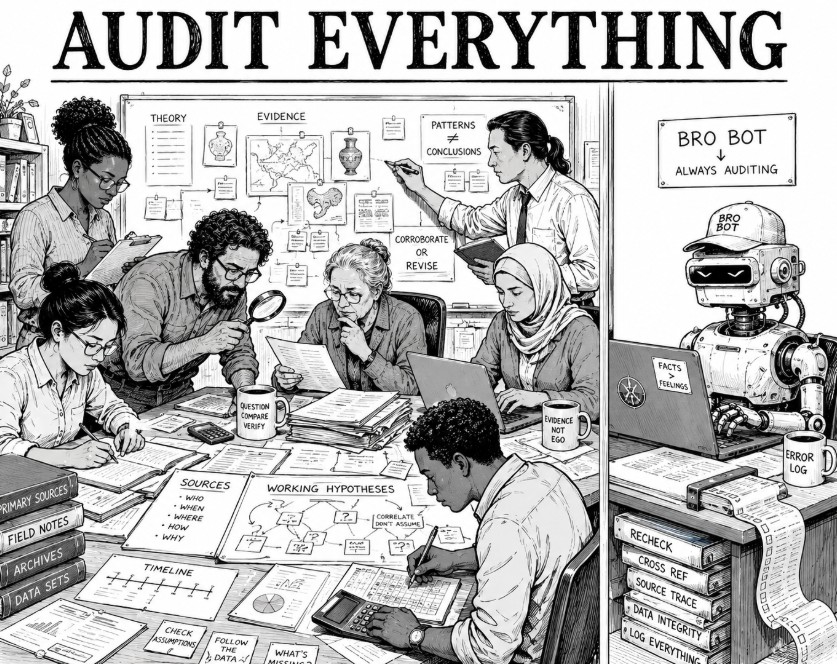
The Map We Inherited
Over the last three pieces I’ve been pulling a single thread through what look like unrelated topics. In Early Egyptians Were Blackity Black and If Egypt Was Black, Then Carthage?, Egypt got written whiter than it was and Carthage got racialized centuries after it fell, by people who needed the story to run a certain way. In The Peopling of the Americas, the settlement of a hemisphere got flattened into one walk across a land bridge and defended for a century after the ground began saying otherwise. Treated separately, these are three interesting corrections. Treated together, they stop being about Egypt or Carthage or the Bering Strait at all. They are about the machine that produced the errors, and that machine is the ordinary human institution of knowledge itself.
Here is the uncomfortable version of the claim, and I’m going to spend the rest of this making the case for it. A very large share of what we file under settled knowledge was not assembled by neutral observation. It was assembled inside social systems carrying their own pressures — racial hierarchy, colonial politics, national prestige, professional rivalry, funding, and the plain human difficulty of admitting that a conclusion your career was built on is wrong. Those pressures left fingerprints on the record. And because later work builds on earlier work, the fingerprints got buried under a century of confident construction and called bedrock.
The reflex is to assume this means bias in the ideological sense — the Victorian scientist reaching for a lost white race because he could not stand to credit the people in front of him. That corruption is real and I documented it, the mound builders assigned to Atlanteans, Great Zimbabwe assigned by statute to Phoenicians. But the ideology turns out to be optional. The rot runs just as deep when nobody is a racist and everybody means well, because the real driver is structural: status, competition, incentive, and momentum. To see that clearly, leave race entirely and go look at the dinosaurs.
Much of the foundation of American paleontology was laid during the Bone Wars, the vicious rivalry between Othniel Marsh and Edward Cope across the last decades of the nineteenth century. The two men were racing to name more species, to publish faster, to humiliate each other, and they built the early corpus in that spirit — describing specimens in haste, sometimes from fragments, sometimes wrong. In 1879 Marsh named Brontosaurus. In 1903 Elmer Riggs concluded it was the same animal as the Apatosaurus already on the books, and under the naming rules the older name took priority, so Brontosaurus was struck from the record as an error. That correction stood for over a century, taught as settled. Then in 2015 a team led by Emanuel Tschopp ran the largest analysis of these animals ever attempted — 477 anatomical features across 81 individual specimens gathered from around the world — and concluded that Brontosaurus had been a distinct genus all along. The thunder lizard was named, un-named as a mistake, and reinstated, across a hundred and thirty-six years.
What I want you to take from that is Tschopp’s own remark about the century of paleontologists who were wrong, rather than anything about the dinosaur itself. Until very recently, he said, calling Brontosaurus the same as Apatosaurus was completely reasonable based on the knowledge they had. They weren’t fools and they weren’t villains. They made the best call available, it entered the record as fact, everything built on top inherited it, and it took a new method — specimen-level comparison at a scale no earlier generation could perform — to reopen a question everyone had agreed was closed. And even now it isn’t fully closed, because other specialists point out that where you draw a genus boundary is partly a judgment call, with no standard rule for which features count. The corrected answer is itself provisional. That is the actual texture of knowledge, all the way down.
The taxonomy was the small correction. The whole picture got redrawn. For most of a century the standard dinosaur was a sluggish, scaly, tail-dragging reptile — a cold-blooded lizard blown up to monstrous size, which is exactly the animal the Victorian founders expected to find and so exactly the animal they reconstructed. Then in 1996 a farmer in Liaoning, China, split a slab and found Sinosauropteryx, the first feathered dinosaur outside the bird line, its body ringed in filaments. The finds have not stopped since. Feathers turned up across the theropods, wishbones and brooding postures and hollow bones alongside them, until the conclusion became unavoidable and now sits at the center of the field: birds are not the descendants of dinosaurs, they are dinosaurs, the one theropod branch that walked out of the extinction, and there are something like thirteen thousand living species of them outside your window. The reptile got replaced by the bird. And the tyranny of the biggest name did not survive it either — in 2012 a team described Yutyrannus huali, “beautiful feathered tyrant,” a tyrannosauroid weighing close to a ton and preserved with a coat of filaments, a feathered animal on Tyrannosaurus rex’s own branch of the tree. Whether the giant adult T. rex kept a full coat or shed most of it at that body size is genuinely still argued, since scaly skin impressions from its big relatives cut the other way. The audit is live even now.
I have a personal stake in this one, and it is the reason I know the method in this essay works, because I ran it myself as a rank amateur. The image that always bothered me was the arms — those tiny forward-facing limbs that every model and movie hangs off the front of a T. rex, an appendage so useless it defies the logic of an animal successful enough to leave the fossils it left. Looking for a living comparison, I kept landing on the cassowary, a big flightless bird whose vestigial wing bones read, to my untrained eye, like the T. rex forearm, and it seemed to me the received picture had the posture wrong before it had anything else wrong. In 2020 I put the question to a group of working paleontologists, and one of the most prominent T. rex specialists alive was generous enough to answer at length. He confirmed the part I could actually check: theropods almost certainly carried their arms tucked back against the body in life, not dangling out front the way they are drawn, for the mechanical reasons the shoulder structure implies. My broader hunch, that the animal was more bird than lizard, was running toward exactly where the evidence has since moved. The fuller version of my argument — that the reduced forelimb was being repurposed toward display and thermoregulation rather than serving as the grasping arm of the textbook — remains my standing thought experiment rather than a proven claim, and I laid it out in Misunderstood Chicken. The point for this essay is smaller and firmer than my pet theory: an untrained person, refusing the received image and checking it against a living animal, landed on something a credentialed expert confirmed and something the field was already moving toward. That is not a boast. It is the whole method in miniature.
If you think all this is a disease of the distant, less rigorous past, look at what happened when modern science turned the tools on itself. In 2015 the Open Science Collaboration tried to reproduce a hundred published psychology studies, using the original materials, often with the original authors’ help. Ninety-seven of the hundred had reported statistically significant results. Thirty-six of the replications did. The effects that survived came in, on average, at half the size originally claimed. These were not fringe papers; they were peer-reviewed, cited findings in respected journals, and more than half did not hold up. When a parallel effort took on high-impact cancer biology, it couldn’t even attempt most of the experiments, because the original papers omitted the protocols needed to repeat them — and of the fraction they could test, effect sizes came back roughly eighty-five percent smaller. The pressures behind all this are the same ones the paleontologists lived under a hundred years earlier: publish or perish, reward novelty over verification, and never spend a career re-checking someone else’s foundation when you could be laying a floor of your own with your name on it.
The same shape appears in how societies encode the rules they live by, and there the motive is preservation rather than error. Institutions inherit a set of arrangements, and over time the arrangements stop being seen as choices and start being taken for the natural order. Power writes the rules, and a generation later the rules read as objective description rather than as the interests they encoded. This holds across ideologies, because the people inside any institution answer to that institution’s incentives, and “this is simply how it’s done” is the most comfortable sentence in any language. The inherited assumption puts on the costume of expertise, or tradition, or law, and defends itself with the full authority of the thing it’s impersonating.
Lay all of it side by side and one structure emerges. Every domain of inherited knowledge is a stratigraphy — recent confident conclusions resting on older ones, resting on older ones still, down to a base laid by people working under pressures we’ve half-forgotten, for reasons that had as much to do with careers and politics and rivalries as with evidence. We call the whole stack settled, and we do it for an honest reason: re-examining the base is expensive, unglamorous, and threatening to everyone who built the upper floors. So the corrections come only when some individual insists on the unwelcome reading against the institution’s resistance, and they come slowly, because a single scholar in a single lifetime working a single discipline can audit almost nothing. The mound builders waited until 1894. Great Zimbabwe’s African origin was established in 1905 and denied by law into the 1980s. Brontosaurus waited a hundred and thirty-six years. The bottleneck was never that the audit couldn’t be done, only that it could be done a thimbleful at a time, by whoever was stubborn enough to spend a life on one buried mistake.
Which is the argument I’m actually building toward, and it arrives in two halves, because you can run this audit with the new tools or without them and you need the without first. Every correction I’ve named in this whole series was made without a machine. Radiocarbon dating, genetic sequencing, stratigraphy, morphometric comparison, patient re-excavation, adversarial re-analysis — human method, applied by people who refused the inherited answer and went back to something physical they could verify. That engine already works. The method isn’t mysterious: anchor on what can be checked now against the hard, mind-independent world — the isotope ratio, the genome, the bone — then work backward through the stack, find the joints where inherited assumption diverged from the anchor, and rebuild forward from verified ground. What I’m arguing is that we should do this on purpose and comprehensively, as a standing project across the whole corpus, instead of waiting for the occasional heretic to stumble onto one rotten timber a century late.
What the machine changes is scale, and scale was the entire bottleneck. No human can hold the whole corpus in their head, cross-reference ten thousand papers, or notice that a fact treated as bedrock in one field traces, through six layers of citation, back to a single un-replicated study from 1962 that nobody re-examined because it sat outside everyone’s specialty. No human could have run Tschopp’s comparison across every relevant specimen on Earth. Digital memory and mechanical pattern-recognition lift exactly that ceiling. A system that reads the whole record at once can trace the genealogy of a claim back to its root, surface the load-bearing assumptions the corpus quietly depends on, and flag where a consensus actually rests on convenience sampling, a single lab, or a call made under pressure a hundred years ago. For the first time the audit could run at the scale of the thing being audited.
And here is the catch that keeps this from being a sales pitch, the same one I ended the last piece on. The machine learns from the corpus. It’s trained on the century of confident, sometimes wrong sentences, and it absorbs the confidence along with the content. Ask it a question the record settled badly and it hands you the bad settlement in fluent, authoritative prose, because the sentences that taught it already closed the case. So the identical tool is, at the same moment, the most powerful auditor of inherited error ever built and the most powerful launderer of it ever built, and which one you get depends entirely on how you point it. Trusted as an oracle, it fossilizes the mistakes faster than any textbook could. Aimed at the corpus as a skeptic — asked to show what a claim rests on and whether that base was ever checked, rather than to pronounce the answer — it becomes the scale the human method always lacked.
That’s why the answer is both, and why the two halves aren’t rivals. The machine is unmatched at breadth: reading everything, tracing dependencies, surfacing the candidates for re-examination no specialist would ever notice. The human method is the ground truth: the physical anchor, the adversarial judgment, the willingness to go dig the trench and run the date and refuse the fluent answer. The machine proposes; verified fact and human skepticism dispose. Run it as an oracle and you get a faster, prettier version of exactly the problem we started with. Run it as an instrument pointed at the foundations, checked at every step against something you can hold in your hand, and you get the first real chance to audit human knowledge at the scale it was accumulated.
I want to be clear about the ceiling, because the whole point of this exercise is refusing false certainty. It does not deliver Truth. Tschopp, with the best method available and a mountain of data, produced an answer other experts still call partly a judgment call. The goal was never a final map, only a better and more honest one, where we can finally tell which features are anchored to something physical and which are inherited guesses we’ve been walking on as if they were terrain. A civilization cannot steer intelligently into its future while standing on a map of its own past that it has never audited, and for most of history that audit was simply impossible at scale. The excuse is gone. We have the memory and we have the instrument. The mounds, the granite city, the thunder lizard all got their honest look eventually, decades or a century too late, one stubborn person at a time. The argument of this whole series is that we no longer have to wait for the stubborn person and we no longer have to accept the century-long lag. We can read the whole record at once, hold it against what we can actually verify, and start rebuilding from the roots — as close to true as we are currently capable of getting, which is the only honest destination there has ever been.
Related reading in this series: Early Egyptians Were Blackity Black · If Egypt Was Black, Then Carthage? · The Peopling of the Americas · Misunderstood Chicken