The Continent We Were Allowed to See
The last two pieces argued that the record was falsified along one axis — that Egypt was written whiter than it was, and that Carthage was racialized centuries after the fact by people who needed the story to run a certain way. This one widens the charge. The problem was never a handful of misread civilizations. The problem is the machine that read them, and the peopling of the Americas is where you can watch that machine fail across an entire hemisphere and then teach its failure to children as settled fact.
Archaeology sells itself as recovery, the careful lifting of a real past out of the ground, when the thing it performs is reconstruction, run through a living person who arrives at the dig already holding a picture of who the dead were permitted to be. So the honest first question about the Americas has never been only what happened here. It is also what we were prepared to let ourselves find.
For most of the twentieth century the answer was Clovis First: one population out of Siberia, across the Bering land bridge, through a corridor between two ice sheets around thirteen thousand years ago, filling an empty continent from the top down. It is finished. Human footprints at White Sands in New Mexico have been dated by three separate materials — seeds, pollen, and lakebed mud — across independent labs, and they keep landing between twenty-one and twenty-three thousand years ago, which puts people deep in the interior at the coldest point of the last ice age, thousands of years before the corridor those people supposedly used had opened. Monte Verde in Chile broke the wall decades earlier and took years of institutional resistance to be accepted. The empty continent entered single-file was a story the discipline told itself, and the ground has spent forty years contradicting it.
Then the Mound Builder chapter, the ugliest of the corrections. When settlers met the earthworks along the Mississippi and the Ohio — Cahokia, the Hopewell geometries, effigy mounds a hundred feet high — the educated consensus refused the obvious builders and reached for a lost race: Israelites, Atlanteans, wandering Phoenicians, some vanished white civilization the Indians had presumably wiped out. The fantasy did real work; Andrew Jackson reached for it in the run-up to Indian Removal, because a people who had themselves annihilated the true first Americans could hardly object to being moved along. It took Cyrus Thomas and the Bureau of American Ethnology, in an 1894 report built on two decades of excavation, to put on the record what Thomas Jefferson had already found with a shovel a century before: the ancestors of living Native Americans built the mounds. And here is the tell inside the myth. Its defenders were happy to imagine ancient ocean crossings — they catalogued stone tablets supposedly carrying European, Asian, and African alphabets — so long as the crossing served to write the Indian out of his own achievement. Transoceanic contact was welcome when it dispossessed the right people.
The same machine ran in Africa and left its fingerprints in statute. Great Zimbabwe — a stone city of ten thousand, mortarless granite walls enclosing more ground than twice Central Park, raised by the ancestors of the Shona between roughly the twelfth and fifteenth centuries — was assigned by colonial antiquarians to Phoenicians, Sabaeans, the Queen of Sheba, anyone except the Africans living beside it. Randall-MacIver showed the construction was African in 1905, Caton-Thompson confirmed it in 1929, and none of it mattered under white rule. After Rhodesia’s unilateral declaration of independence, the government made a law of the lie: any official interpretation crediting Africans had to carry an equal number of words crediting someone else. Peter Garlake, the state’s own senior inspector of monuments, was driven into exile in 1973 for refusing to comply, and apartheid South Africa kept the foreign-origin story in its schoolbooks into the 1980s. This is the clearest case anywhere of a reconstruction forced into bias by decree.
Lay the three side by side and the driving assumption names itself. It was never that oceans could not be crossed or that the deep past was unreachable. It was a settled conviction about who was capable of what, applied backward onto people who had no say, and defended long past the point where the evidence had turned. The corrections came every time, and every time they came slowly, against resistance, and only because someone kept insisting on the unwelcome reading until the ground backed them up.
Which is the frame for the question this piece refuses to close. The discipline has never actually been shut to people crossing water. It gave the Solutrean hypothesis — Ice Age Europeans working the Atlantic ice edge into North America — years of respectful debate. It confirmed the Norse at L’Anse aux Meadows. In 2020 it confirmed, from Polynesian and Native American DNA, a real Pacific contact around 1200 CE, exactly the open-ocean arrival the old maps had ruled impossible. Ocean crossings are admissible. The sorting of which crossings earn the patient hearing and which earn the reflexive dismissal has tracked who was doing the crossing more faithfully than it has tracked the strength of the case.
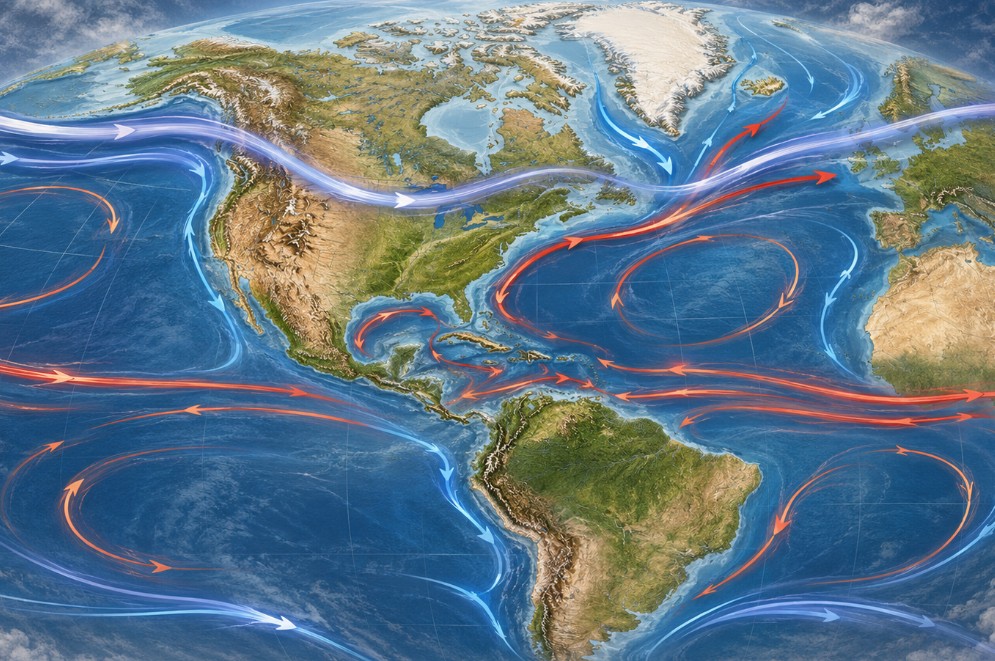
So take the Atlantic the way a sailor takes it. You do not need a West African navigator plotting a heading for Brazil. You need weather. The South Equatorial Current runs east to west and drives into the South American bulge at Cape São Roque; the southeast trades push the same way; the whole system is a conveyor belt that has run the entire span humans have worked that coast in boats. A crew swept out of a river mouth in a storm is surviving a crossing, not attempting one, and Heyerdahl closed the craft question in 1970 when a papyrus reed boat rode the trades from Morocco to Barbados. Multiply a high baseline of coastal traffic by a few thousand years and a current that only runs one way, and occasional arrival stops being a claim to defend and becomes a thing that is hard to prevent. The standard objections dissolve against drift: no waypoints to explain, because the ocean carries; no return voyage to find, because a castaway never sails home to log one; and a thin genetic trace is what a small-founder arrival predicts, because a few people absorbed into a much larger resident population leave almost nothing recoverable a thousand years on.
Honesty requires saying where this does not go. There was no substantial, distinct Black African nation in the pre-contact Caribbean; that specific version has been tested, and it failed the test. A 2020 study generated genome-wide data from 184 ancient individuals across the Bahamas, Cuba, Hispaniola, Puerto Rico, Curaçao, and northwestern Venezuela, spanning roughly three thousand years down to just before contact, and the pre-contact islanders read as Native American — an Archaic population more than ninety-eight percent replaced by an Arawak-related wave out of northeast South America. The African ancestry Caribbean people carry today entered afterward, through the slave trade, and no argument about later importation washing out an earlier signal can reach that result, because ancient DNA is pulled from the pre-contact skeletons themselves. But the result inverts the intuition rather than closing the question. The islands are the best-sampled ground in the hemisphere and they come back Native; the northeast South American coast, the actual landfall the currents predict, has barely been sampled at all. The question does not die there. It relocates, off the islands and onto the mainland shore, where the honest surviving version is narrow: rare arrival, absorbed early, remembered — if at all — in culture rather than in blood.
And that is the version worth holding open, because it is the size of a single life. Forget the hidden nation. Imagine one person, or a handful, born of that thin new blood, striking enough in a population to be remembered, who rallies people and ends up set in stone. That claim needs no detectable genetic trace, and it is the only kind of claim art is the right witness for. Intentional history records what someone wanted remembered, written by the literate and the victorious. Art records what the maker found worth fixing, often without meaning to testify. The Olmec colossal heads are individual ruler portraits, and you do not need a foreign people to account for a portrait — you need a person worth carrying fourteen tons of basalt to keep. Whether that face records foreign descent, or the stylization stone imposes, or a man simply unusual for ordinary reasons, stays open. The mechanism fits inside the evidence instead of straining against it, and it is exactly the kind of thing the record is built to lose.
None of this is a conclusion, and it is not trying to become one. A current that can carry a boat is not a boat that came, and a face in stone is not a birth certificate. These particular arrivals — the storm-blown crew, the absorbed founder, the remembered individual — have not been conclusively disproven, and the one place the direct test exists returned a verdict about the islands while leaving the mainland dark. So the honest ledger reads short. The peopling of the Americas is not a settled story with a few footnotes. The only thing we truly know about it is that the science we inherited was wrong — wrong in the same shape, for the same reasons, that it was wrong about the mounds and the granite city — and that the confidence which replaced inquiry was a projection every time.
Which raises the question this series has been walking toward. If the corpus was assembled by a machine that could not see past its own assumptions, and if we have spent a century building upward from its errors and calling the result knowledge, then the task is not to trust the record and not to burn it, but to re-audit it from the hard facts down. That is a job of a size no single scholar has ever been able to do — reading the whole inherited structure at once, holding every correction against every assumption, working backward from what we can verify now toward a root we can actually build on. We may, for the first time, have a tool equal to the scale of it. Whether that tool inherits the same stain or finally lets us see around it is the next question, and it is the one worth asking.