A Big Chicken With a Tail
The thoroughly-thought-out case that Tyrannosaurus rex was a bird — and would have opened you up like a cassowary.
Start with her laying, because it’s the least monstrous thing she ever did, and it tells you everything.
Two tons of tyrant lowers toward the ground — and she does it the way every big ground bird still does it. She folds down onto her shanks, knees drawing up toward her body, and settles back until her tail takes her weight. That tail isn’t dead cargo dragging behind her. It’s the third leg of a tripod, the counter-brace her whole hindquarters lock against, the same anchor an ostrich uses when she sinks down over a clutch. Braced low and wide and still, she arches her back, and that entire rigid frame of hips pitches down and back until the opening at the base of her tail comes to bear on the ground. She doesn’t strain. She doesn’t force anything through anything. The egg already made the trip — down the oviduct, on a slow wave of muscle, to the single vent she also empties her gut through, because she is built like a bird the whole way down. A few unglamorous seconds of push, and it’s lying in the dirt beneath her.
Her hips never spread. They can’t — they’re one fused piece, welded to her spine, no seam to open. The bones only hold the frame steady while the plumbing does its quiet work. Then she stands back up, two stories of muscle and teeth, and steps over the thing she just made.
That was not a lizard. Lizards don’t do a single part of that. That was a bird — and I’m going to spend the rest of this standing flat-footed on the claim that it always was one.
The living animal beats the sketchbook. Every time.
Here’s the whole spine of it, and it’s almost insultingly simple. A chicken is real. A cassowary is real. An ostrich is real. You can walk outside and stand next to one today — watch it blink, watch it run flat-out on two backward-bending legs, watch it lay. The scaly, tail-dragging, rat-faced lizard-monster we’ve been calling T. rex for a hundred years? Nobody has ever seen one. Not once. It was assembled — reconstructed out of incomplete bones by men with a flair for the dramatic — and then it hardened into the picture in everyone’s head and never got redrawn.
So when a living animal and a Victorian sketch disagree about what a body can be, I know which one I trust. And I’ll say the quiet part at full volume: the sketch is wrong. Not “incomplete.” Wrong. The picture in the public’s head is a lizard costume thrown over a bird, and the bird has been trying to show through the whole time.
It stands on a chicken’s leg.
Go to the ground first, because that’s where the lie is easiest to catch. Find the joint halfway up the leg that bends backward — the one that looks like a knee installed upside down. It isn’t a knee. It’s an ankle. The real knee is up high, tucked against the body, exactly where a chicken keeps its. Those long lower bones are the same thing you strip off a drumstick: raised heel, toes down, the whole animal standing on tiptoe. That is not a lizard’s belly-low sprawl. That is a bird’s leg, scaled to two tons.
And low on the back of that foot rides a little toe that never touched the ground — reduced, tucked, aimed away — the same digit a chicken carries at the back of its foot. A leftover. A dewclaw. Hanging right there in the open on the “lizard.”
Don’t make the mistake of thinking a bird foot is a gentle thing, either. My overweight cassowary out in the paddock carries a straight dagger-claw up to four inches long on its inner toe, and it will lay a man open from sternum to hip with one kick. That’s a living bird, today, with a knife on its foot and the temper to use it. Put two tons behind that same foot and tell me, honestly, that you’d rather meet the lizard.
Crack it open and the bird is already inside.
This isn’t skin-deep. T. rex had a wishbone — a furcula — the same bone you snap for luck off a Thanksgiving carcass. It had air sacs threaded all through its skeleton, the fingerprint of the one-way, flow-through lung that only birds run today, the most efficient set of bellows any land animal has ever carried. Its bones grew fast and hot, the way a bird’s do — not slow and cold, the way a reptile suns itself into shape. And its business end was the single all-purpose cloaca of a bird, not the split plumbing of a mammal. We even got to look, once: the only dinosaur ever fossilized with its vent intact had exactly that single opening, ringed in bright pigment and apparently used to signal — the animal’s own back end flashing color at the neighbors. Front to back, inside and out, it was already a bird. We just kept painting a lizard over the top.
Feathers — and the tell in why it lost them.
Its close cousins wore feathers; we have those fossils in the ground. The giant tyrannosaurs seem to have thinned their coat as they got enormous, and the leading reason is the one that should stop you cold: heat. Get big enough and a full coat cooks you from the inside. That is not evidence it was a lizard. That’s the thermostat of a bird — the exact trade a hot, fast, feathered body makes as it scales toward two tons. The feathers didn’t vanish because it ran cold. They thinned because it ran warm, a running bird with a big-animal heat problem, keeping exactly as much fluff as it could afford.
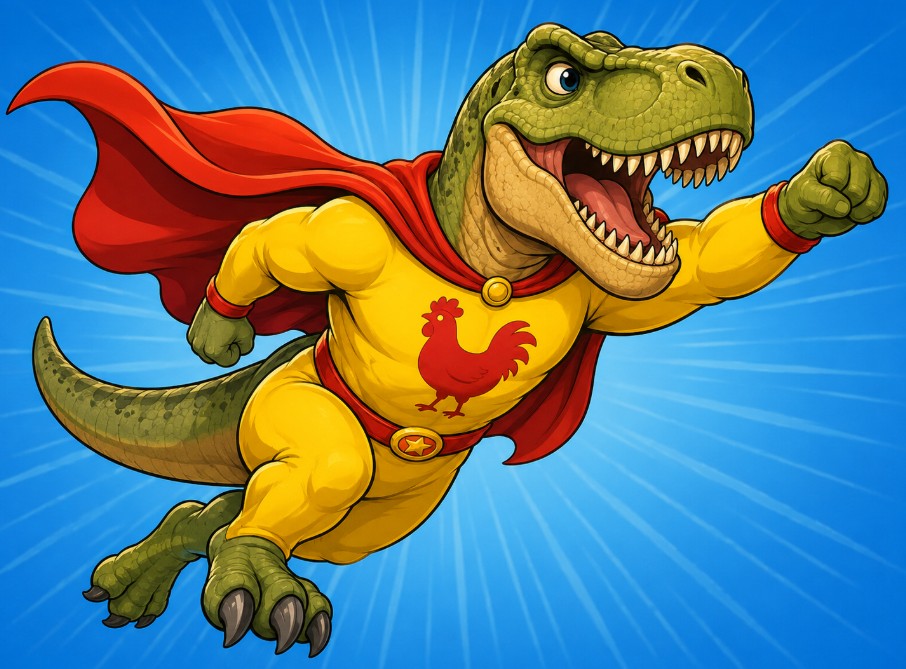
A big chicken with a tail.
Now run the family tree the direction nobody runs it. We read it forward — terrible lizard, then somehow, eventually, birds. Turn it around. On the road to modern birds the body went through a shrink ray: barrel chest pared down, the huge counterweight tail collapsed to a feathered stub, the arms drawn back out into wings, the teeth traded away.
I’ll be straight about one thing, because I want this to hold weight: a chicken didn’t literally descend from a T. rex. They’re cousins that split off the same earlier, smaller line deep in the tree. So “shrunk-down T. rex” is a picture, not a pedigree. But it is the right picture, because it aims you at the truth — walk a T. rex back toward that shared ancestor and you are walking straight at a chicken, not a lizard.
The jaws are part of this, too. Those weren’t a lizard’s teeth in a lizard’s skull — that head was the animal’s entire toolkit. It caught prey with its head and it killed prey with its head; the mouth did the whole job, which is precisely why the arms were free to become something else. And down the bird branch, that same kind of jaw eventually gave up its teeth altogether and hardened into a keratin beak. The tyrant kept its teeth because it was still using its face as the weapon — but a head that is the one tool that matters, with a beak waiting at the end of the road, is a bird’s story, not a lizard’s. The beak is where this kind of skull was always headed. T. rex just hadn’t gotten there, and didn’t need to.
The one bone that argues against me.
I’m not going to pretend the whole skeleton salutes. There’s one spot that reads old, and I’d rather point at it myself than let you catch me stepping around it.
Look at the hip from the side. Three bones fan off the socket like a pinwheel: one bolted up to the spine, one raking back toward the tail, and one raking forward, tipped with a heavy knob we call the boot. That forward-pointing bone is the pubis, and it’s the giveaway — because real birds swung that bone backward, laid it alongside the rear one, and opened up the whole undercarriage, which is generally read as making room to pass a big rigid egg. T. rex didn’t do that. Its pubis still points the old way, forward and down, boot and all.
So here’s the honest scorecard. The foot is a bird’s. The ankle is a bird’s. The lungs, the wishbone, the vent — all bird. But the hip is the one place the animal still reads early: not a lizard, just a bird that hadn’t finished becoming one. And I’ll take that trade every day of the week, because an argument that names its own weak joint is a great deal harder to shove over than one that swears every bone is perfect.
Here’s where I leave the map — on purpose.
Everything above this line I will defend to a hostile expert. This next part I can’t prove, and I’m telling you that to your face instead of smuggling it past you.
I don’t think those famous little arms were arms in the way we mean the word. I think they were feathered display structures — and I think they turned back along the body, folded like wings, not forward like the grabbing hands every museum poses them as.
Here’s why. Strip a bare arm down small and you’ve got a useless stub; nobody signals with a bare stick. But feather it, and a small limb becomes a flag — surface, color, motion, something built to be seen. That’s the whole logic of a cassowary’s stub and an ostrich’s plume-arm: too small to fly, and used constantly anyway, for display, for threat, for courtship. Feathers are what turn a shrunken forelimb from a leftover into a signal. So when I picture those arms, I picture them plumed.
And I picture them swept back, not held out front. A flightless bird doesn’t dangle its wings forward to reach — it folds them back against the flank, tucked along the body, where they ride out of the way until it wants to flare them. That’s the posture I think we’ve had backwards. We keep reconstructing T. rex reaching forward with open palms, asking what those hands could grab. I think the limbs laid back along the body, feathered, and flared out to be seen when it mattered — the same way the living birds carry theirs right now.
I can’t hand you a fossil that closes that. Nobody can, yet. So I’m flagging it as mine — a hypothesis I’ll stand on but haven’t nailed down — but I will take a hunch based on animals I can see instead of some Victorian bone collector trying to get famous.
How the lizard got drawn in the first place.
The rat-lizard is a first draft nobody redrew hard enough. The whole field took its shape during the Bone Wars of the late 1800s — two rival collectors racing to name more monsters than each other, working from partial skeletons and topping up the gaps with imagination and showmanship. The tail-dragging, belly-low reptile got baked in early, by men who never once watched the animal move, because nobody ever has. And a picture, once it’s loose in the world’s head, corrects at a crawl — even as the bones underneath quietly say something else.
Here’s my favorite monument to the whole mess. The textbooks split the dinosaurs into “bird-hipped” and “lizard-hipped.” T. rex is filed under lizard-hipped. And yet the lizard-hipped line is the one that actually produced birds, while the “bird-hipped” bunch is a side branch that went nowhere near them. Even the man who drew up the categories pinned “bird” on the wrong pile. If that doesn’t tell you how backwards we’ve had this animal from the very start, nothing will.
So here’s where I stand, ten toes down.
I don’t have to reconstruct anything. I don’t have to imagine a feather or invent a behavior. I can walk outside and watch the evidence breathe — running on a bird’s legs, on a bird’s foot, with a leftover toe and a wishbone in its chest and a single bird’s vent and a knife on its heel, folding down over its eggs like a hen. Chickens still exist. Cassowaries still exist. The scaly rat-lizard has never existed anywhere but on paper.
When the living animal and the drawing disagree, I take the animal.
It was a bird. It was always a bird. It would have opened you up like a cassowary and swallowed the pieces, and then it laid its eggs in the dirt like a hen — and we drew a lizard over the top of it and forgot to go back and check.