A young fella asked me the question last week. Good worker, honest hands, no malice in him. He said, “Mr. Wright, why does labor need to be organized? If a man does good work, won’t the work speak for itself?”
I told him I’d answer him on the twelfth of July. He asked what was special about the twelfth of July. I said that’s the answer, son. Sit down.
In 1892, in a Pennsylvania river town called Homestead, the men at the Carnegie steel works did everything right. Skilled men. Proud men. The kind who could read the color of molten steel the way a farmer reads sky. The company decided their wages were an inconvenience, locked them out, and sent three hundred armed Pinkerton agents up the Monongahela on barges to take the mill by force. The workers met them at the riverbank. Men died on both sides that day — the sixth of July — and by evening the Pinkertons surrendered. The workers had defended their town and won.
Six days later came the twelfth of July. Eighty-five hundred state militia marched into Homestead with rifles and artillery and took the town for the company. The men who had won the battle lost everything after it. The union was broken. Steel stayed unorganized for forty years, and every mill town in America learned the lesson the state intended: you can beat the company’s private army, and they will simply send you a public one.
Twenty-five years later, to the very day. July twelfth, 1917. Bisbee, Arizona. Copper miners struck for safer conditions and honest pay. Before dawn, a sheriff deputized two thousand company men, and they went door to door with guns. They rounded up thirteen hundred miners and anyone who stood with them, marched them through town, and loaded them into cattle cars with manure still on the floors. Hauled them a hundred and eighty miles into the desert and left them there. No water. No food. No trial. The company controlled the telegraph lines, so the story couldn’t even leave town. And when it finally did, nobody was ever convicted of a single thing.
Now hold those two days side by side, because the pattern is the lesson. In both cases the workers asked politely first. In both cases they worked within the rules until the rules were used against them. In both cases they were winning on the merits. And in both cases the answer came as armed force — once wearing a state uniform, once wearing a deputy’s badge handed out that same morning — and the law looked away in both directions.
That’s what happened to working people who stood alone or stood in small numbers. It wasn’t argued with. It was ended.
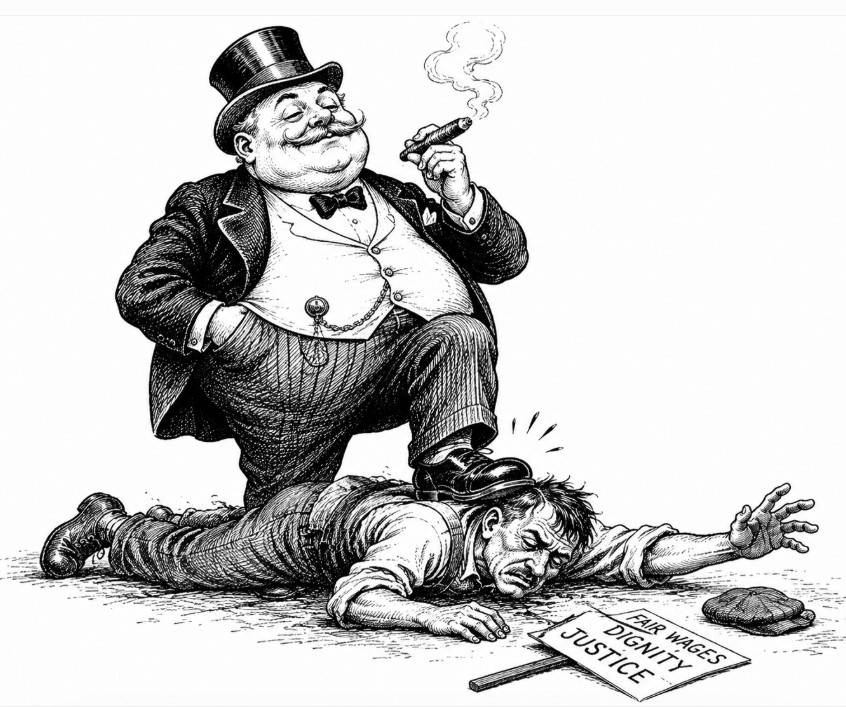
So when the young fella asks why labor needs to be organized, here’s what I tell him. Organization is what you build when you learn that being right is insufficient protection. One righteous man is a nuisance to power. Ten are a problem. Ten thousand, organized and disciplined and patient, are a fact that has to be negotiated with. The whole history of the labor movement is the long, bloody discovery that dignity requires arithmetic.
I carry a piece of that history in my own name. My father was a porter. He named me after A. Philip Randolph, who organized the men who carried other folks’ baggage across this country. It took the Brotherhood of Sleeping Car Porters twelve years to win their first contract — twelve years of firings, spies, and threats — and when they finally signed it in 1937, it was the first major contract a company ever signed with a union of Black workers in America. Randolph never fired a shot. He didn’t have to. He had the arithmetic. When he told a president that a hundred thousand men would march on Washington, the president found his pen. That’s what organization is: the ability to be heard without having to be mourned first.
Because here’s the accounting nobody likes to say plainly. Homestead, Bisbee, Ludlow, Blair Mountain, the Memorial Day Massacre — working people paid in blood for things we now call normal. The eight-hour day was purchased. The weekend was purchased. The safety rail, the fire exit, the child in school instead of the mill — purchased, every one, and the price was paid by people whose names most of us never learned. When a man enjoys those things while asking why unions ever mattered, he’s a fella spending his inheritance while asking why anybody bothered to work for it.
And I’ll say this to keep my own side honest, because that’s the steward’s job. Organization is a tool, and a tool answers to the hand that holds it. A union that forgets its members, that protects the lazy man the same as the diligent one, that becomes just another distant office — that union has broken faith the same as any bad employer. The contract runs both ways. You want a fair day’s pay, you give a fair day’s work. Your labor is your product. Build it to last.
But don’t ever let anyone tell you the organizing itself was the trouble. The trouble was what got done to people before they organized, and what still gets tried whenever they forget how.
The twelfth of July, son. That’s why.
Now you know, Jack.