Man Made Special Edition: Big Boy No. 4014 Crosses the Stone Bridge
At 12:21 this afternoon, the largest operating steam locomotive on Earth crossed the most stubborn bridge in America, and half of Johnstown turned out to watch it happen.
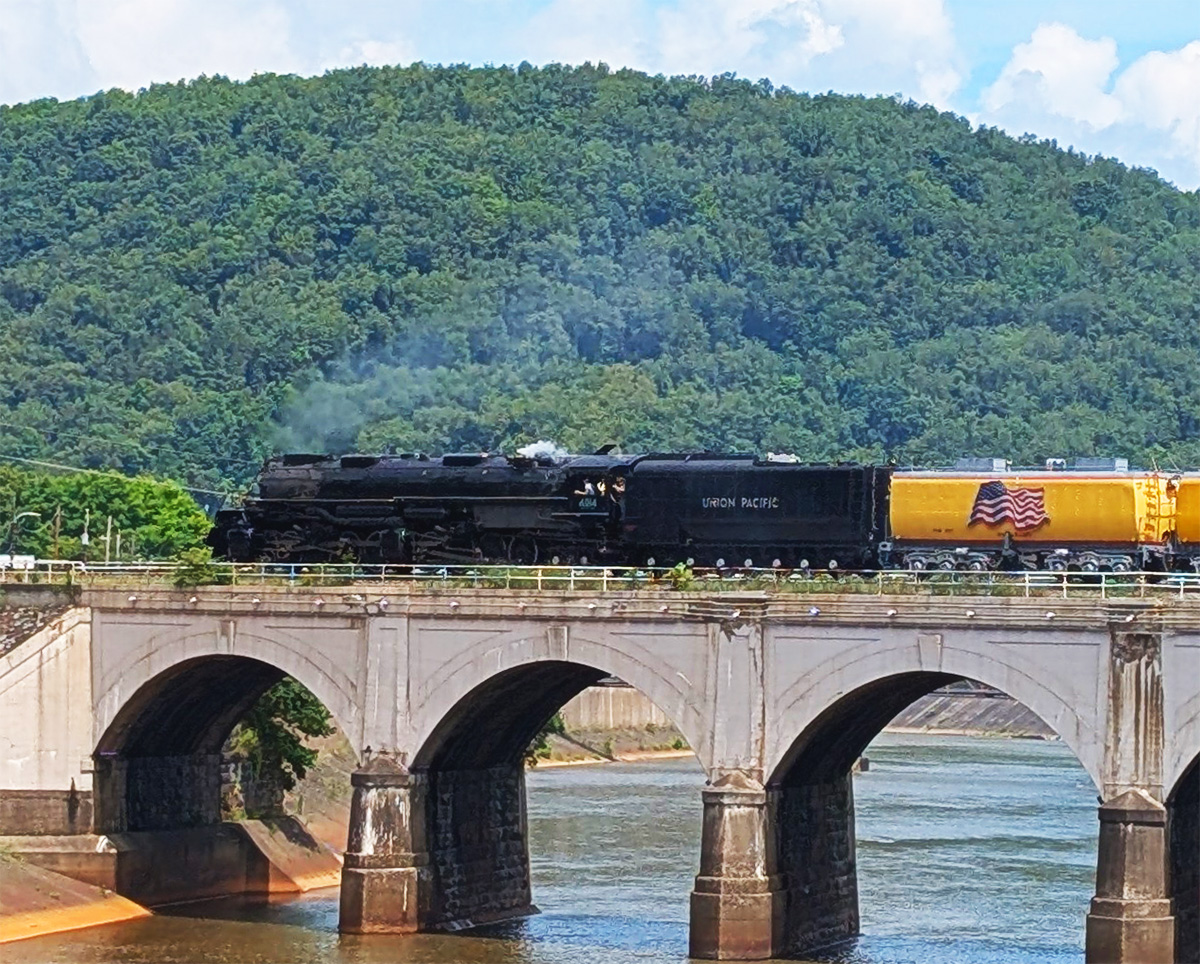
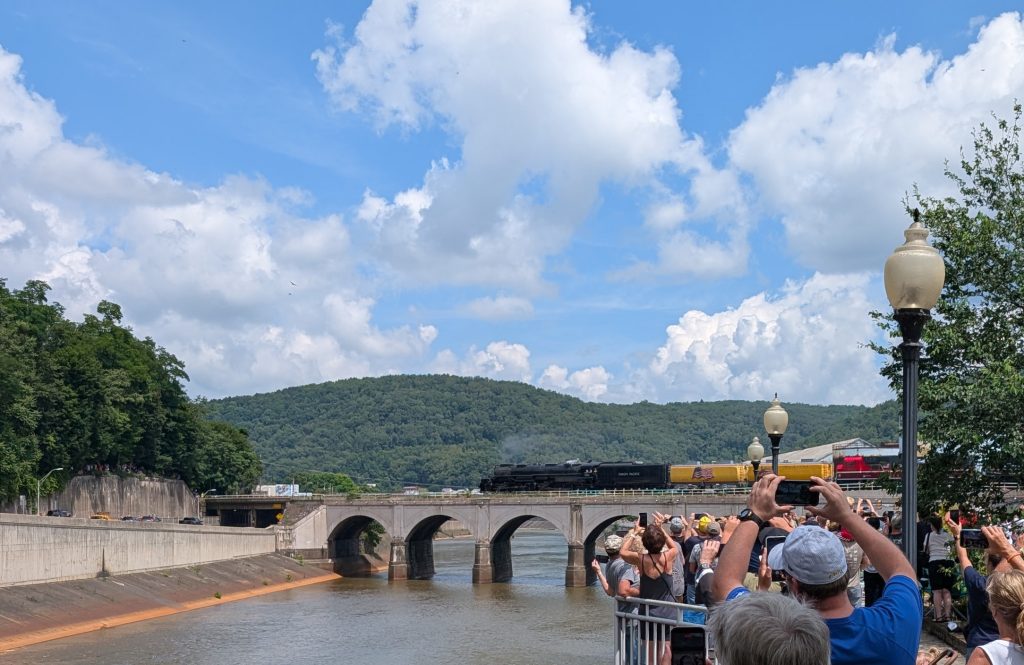
I’ve featured the Stone Bridge on these pages before, and I’ll feature it again, because it’s the kind of structure that keeps earning its second look. But today it had company worthy of it. Union Pacific’s Big Boy No. 4014 — 132 feet, 1.2 million pounds, black boiler shouldering along ahead of that Armour-yellow tender with the flag on the flank — came down the valley from Cresson and South Fork and rolled across those seven stone arches on its way to Pittsburgh. First time a Big Boy has ever run the East Coast. Part of the coast-to-coast tour for the country’s 250th birthday, running over Norfolk Southern rails, which is its own small miracle of cooperation between competitors.
The crowd told the story before the train did. Washington Street closed at eleven. Toddlers rode shoulders. Every phone in Cambria County pointed the same direction. And when that whistle came down the Conemaugh — a sound this valley built its whole life around and hasn’t heard at this scale in generations — you could feel the crowd change. People don’t gather like that for nostalgia. They gather for power, and this machine is honest about having it.
So let’s talk about the power, because the Big Boy is a rolling engineering lecture the same as everything else on this page.
Start with the question that created it. In 1941, Union Pacific needed to haul heavy wartime freight over the Wasatch Mountains in Utah without stopping to add helper engines. More pulling power means more drive wheels, more drive wheels means a longer locomotive, and here’s the problem: a rigid frame that long can’t go around a curve. The wheels bind. Physics says no. The answer was to break the rule that a locomotive is one solid thing. The Big Boy is articulated — two complete engine sets, eight drive wheels each, under a single massive boiler, with the front set mounted on a hinge. The machine bends. It’s a 4-8-8-4: four guide wheels, eight drivers, eight more drivers, four trailing. One boiler feeding two engines that steer independently underneath it. When the design can’t get bigger, it gets smarter about being big. That’s the lesson, and it applies to more than trains.
Everything downstream of that decision is about appetite. A firebox with roughly 150 square feet of grate. Around 6,300 horsepower. A tender carrying enough coal and water to feed a machine that ate mountains for a living — today it runs on oil, one of the changes made when Union Pacific restored it in 2019 after 58 years of retirement. Eight Big Boys survive. One runs. It came through Johnstown.
Now the bridge underneath it, because the pairing is the point.
The Stone Bridge is an 1887 Pennsylvania Railroad structure, seven arches of sandstone crossing the Conemaugh right where the two rivers meet. Stone arch bridges work by compression — every load pressing down gets translated into stone pressing against stone, all of it channeled into the piers and the earth. There’s almost nothing in the design that can fatigue, rust, or loosen. It’s the oldest structural trick humans know, and the reason it’s still the trick you reach for when failure is not an option.
In 1889, failure was not optional and the bridge knew it. When the South Fork dam let go and the flood took this city, the wreckage of Johnstown — houses, mills, rail cars, and the people who couldn’t get free of it — piled against these arches in a debris field that then caught fire. It was the site of some of the worst suffering of the worst day this valley ever had. And the bridge held. It held against a wall of water that had just erased a city, and then it went back to work carrying trains, which it has done every day since. That’s the fortitude in this photograph. The Big Boy is the power. The Stone Bridge is the thing power gets measured against.
Do the arithmetic on today and it gets better. The men who laid those arches in 1887 were building for the heaviest locomotives they could imagine, and the heaviest steam locomotive ever put into service didn’t exist for another 54 years. Today it rolled across their work — 1.2 million pounds of it, plus tender, plus train — and those seven arches took the load the way they’ve taken every load for 139 years: without comment. Overbuilding is a gift you send to people you’ll never meet. Somewhere under that bridge today, a stonemason’s margin of safety was cashing a check written before anyone alive was born.
One machine built to conquer mountains. One bridge that refused to be conquered by the worst this valley could throw at it. For about a minute this afternoon, they were the same picture, and a few thousand of us stood in a park with our arms in the air trying to keep it.
The whistle faded west toward Pittsburgh. The bridge went back to work.