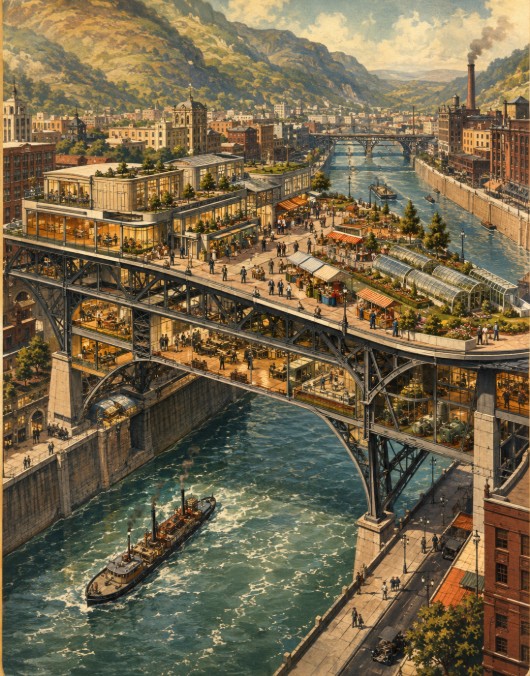
The Next Urban Land Rush
Part One of Three
Every American city with a river running through it is sitting on a real estate inventory it has never listed. The water corridor — the channel, the canal, the engineered flood course — is the last large, contiguous, centrally located parcel in most downtowns, and it is almost universally treated as a void to be bridged rather than a volume to be occupied. That is about to change, and the cities that understand the change early will write the lease terms. The ones that understand it late will watch someone else write them.
The premise is simple. Land at the center of a city is expensive because it is scarce, and it is scarce because it is surrounded by other land that is already spoken for. The air above a river is surrounded by the same expensive land, enjoys the same address, and is spoken for by nobody. It cannot be farmed, parked on, or subdivided in the ordinary way, so it has sat outside the market entirely. A structure built above the water creates square footage where none existed, displaces no tenant, demolishes no building, and condemns no parcel. It is the rarest thing in urban development: pure addition.
Who owns the air over the water
The logistics begin with ownership, and the ownership is friendlier than most developers assume. The beds of navigable rivers are generally held by the states in public trust; the flood channels through many cities are federal works maintained under Army Corps authority; canals are frequently owned outright by municipalities, authorities, or their successor agencies. In nearly every configuration, the counterparty for an air-rights lease is a public body — which means the revenue from this new real estate flows to the public by default, before a single policy choice is made. A city that ground-leases the volume above its own channel has invented an endowment. Structure the lease so proceeds are earmarked for the maintenance and renewal of the existing building stock, and the new town literally pays for the old one.
The permitting is real work. Building over a federal flood project triggers Section 408 review; building over navigable water triggers Section 10 of the Rivers and Harbors Act; every square foot sits in a mapped floodplain and answers to FEMA and to state dam and encroachment law. None of this is prohibitive. All of it is legible, and the requirements converge on the same design answer, which is convenient, because it is also the right one.
Ship hull thinking
The design answer is to stop thinking like a building and start thinking like a ship. A vessel is a structure that lives permanently in a hostile, wet, moving environment and expects to. Its logic is transferable regardless of material — wood, steel, concrete, composite — because the logic lives in the shapes: cambered decks that shed water toward scuppers instead of pooling it; bilge channels that collect what gets in and carry it out; bulkheads that compartmentalize failure; a hull bottom that is assumed to take abuse and is detailed to be inspected, maintained, and if necessary sacrificed. A structure over a river should have a floodable lowest level the way a ship has a bilge: no critical systems below the flood of record, marine-grade coatings and connections throughout the splash zone, and a frame that treats the hundred-year event as an operating condition rather than an act of God.
This is also what makes the concept material-agnostic and therefore cheap to prototype. A timber deck on steel spans, detailed like a wharf, is an over-water structure. So is a concrete platform, and so is a tensioned composite shell. The shapes carry the discipline; the budget picks the material.
What goes up there
The range of uses is wider than the postcard version suggests.
Environmental crossings. The gentlest entry point: green decks and wildlife passages that reconnect habitat severed by channelization, planted esplanades that give a walled river back its banks. These build permitting precedent and public affection before anything commercial is attempted.
Retail and tourism. The inhabited bridge is seven hundred years old and still solvent. Florence’s Ponte Vecchio and Bath’s Pulteney Bridge remain fully leased because a shop over moving water is an experience as much as an address. A promenade deck lined with stalls, studios, and food vendors is the highest-visibility, fastest-payback use, and it doubles as the public’s introduction to the whole idea.
Office and general commercial. Water views command premiums everywhere they exist; a structure over the water manufactures them. For cities whose office stock is aging, new Class A space that requires no land assembly is a serious proposition.
Residential. The hardest use, because dwellings raise the stakes on egress, flood safety, and insurance — and the most transformative, because housing over water in a landlocked downtown adds population without adding sprawl. Amsterdam and Rotterdam have decades of floating and over-water residential precedent to borrow from.
Light industrial. The sleeper category. Workshops, grow operations, cold storage, and data infrastructure all benefit from the river’s microclimate — a permanent layer of cool air sitting on the water, available for passive ventilation and heat rejection at almost no operating cost. Industry came to the rivers for power and shipping; it can come back for thermodynamics.
The river will not hold still
Now the honesty. Rivers move. Not metaphorically — physically, constantly, and with total indifference to what has been built near them. Channels migrate laterally, chewing into one bank while abandoning the other. Floods scour bed material from around anything placed in the flow, and scour has killed more bridges than earthquakes have. Rivers carry ice and trees and, in flood, whole buildings, and they will deliver all of it to any structure standing in the current. Sediment shifts the bed elevation year over year, and a channel that was navigable becomes a bar, and a bar becomes an island.
The design consequence is close to absolute: keep the structure out of the water. Clear spans, or the fewest possible piers, founded behind the banks or on armored, deep foundations designed for full scour depth. Deck soffits above the design flood profile with margin to spare — flood conveyance is the non-negotiable in every review, and it should be, because a structure that impounds floodwater has converted itself into a dam and its neighbors into a reservoir. Channelized urban rivers are the friendliest hosts precisely because the hardest problem, bank migration, has already been engineered away; the walls hold the river where it is, and the structure bears behind them. On natural rivers, the corridor of historic channel movement has to be treated as the river’s property, held in reserve for its return.
Where this matters most
The strongest case is geographic. In a mountain river valley, the river occupies the best land in the region — the flat bottom — and everything else climbs. These towns cannot annex their way to growth; the topography has already voted. Every buildable acre in the valley floor is either occupied, floodprone, or both, and the one broad, flat, centrally located corridor left is the river itself. For the mill towns of Appalachia and the mountain West, whose channels were walled and straightened generations ago for flood control, the infrastructure that once symbolized constraint is now the foundation system for the only expansion physically available. The valley town that builds over its river hasn’t run out of land. It has discovered that it was holding some in reserve the whole time.
The land rush is coming because the arithmetic is too clean to ignore forever: free ground, public landlord, central address, and a construction discipline that shipwrights perfected centuries ago. The only open question is which towns move while the lease rates are still an idea.