THE HOUSES WE LET GO: BLIGHT, THE TAX BASE, AND A NEW TOOL AIMED AT BOTH
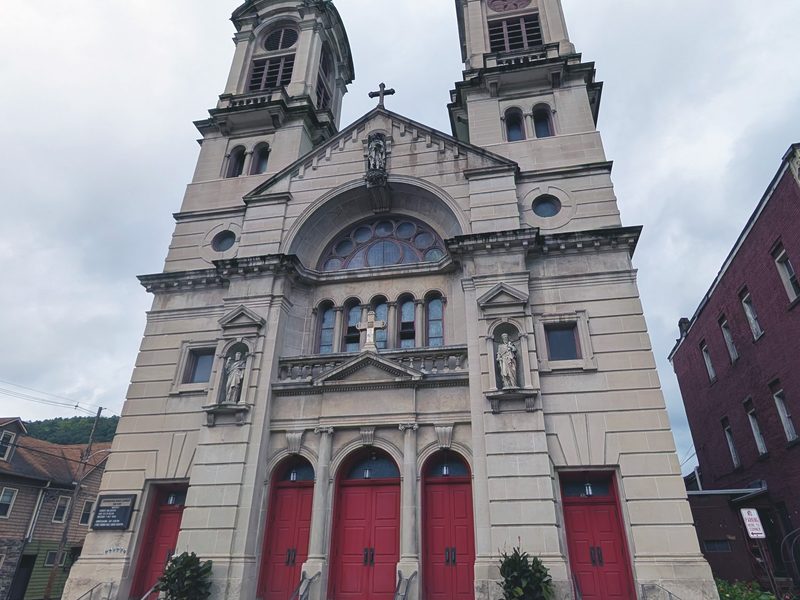
Walk any of the older neighborhoods in this city — Moxham, Hornerstown, Kernville, Prospect, parts of Cambria City off the main drag — and you can read the whole story from the sidewalk. These blocks were built for workers, by the thousands, in a hurry, when the mills ran three shifts. The houses went up close together because the men who lived in them walked to work. For two or three generations they were owned by the people inside them, and owner-occupied houses get painted, get new roofs, get their porches fixed.
Then the work left, and the story every Rust Belt town knows played out house by house. The owners aged. The kids moved where the jobs went. When the owners passed, the houses went to heirs three states away or sold for next to nothing to whoever would take them — and whoever would take them was, too often, a landlord who ran the numbers and decided the house was worth more as a slow liquidation than as a maintained property. Collect rent, defer the roof, defer the wiring, defer everything, and when the house finally can’t pass for habitable, walk away and let the tax claim bureau have it. A house built to hold a family for eighty years got strip-mined for its last fifteen years of rent checks.
The city’s own inventory tells you where that ends. More than 300 non-commercial buildings in Johnstown need to be torn down, and 147 of them need it immediately, according to City Manager Art Martynuska. That’s the count of the ones past saving. It says nothing about the blocks-worth of houses one bad winter behind them.
What decay does to the ledger
Here’s the part that doesn’t show up in the sidewalk view, and it’s the part that strangles everything else: every one of those houses used to pay for something.
A city runs on assessed value. When a neighborhood’s housing stock decays, its assessments collapse, and the tax base collapses with them. The costs don’t collapse to match — the fire department still has to reach every block, the streets still need plowed, the water still has to flow. So the burden shifts onto the shrinking pool of properties still worth taxing, and the millage climbs. Johnstown spent three decades as a state-designated distressed municipality under Act 47 wrestling with exactly this arithmetic. High rates on low values is the signature of a town caught in the spiral: the healthy properties pay more because the sick ones pay nothing.
And that spiral is precisely what inhibits the commercial and tourism growth everybody keeps calling for. A business scouting locations looks at two things before anything else: the incomes of the people nearby and the condition of what surrounds the site. Blighted residential blocks answer both questions badly. A restaurant can’t survive on rooftops that are caving in. A visitor riding the Inclined Plane or tracing the flood history sees everything between the attractions too, and what sits between the attractions is the sales pitch whether we like it or not. Tourism money follows the same rule retail money follows — it goes where the surroundings say somebody cares. You can build all the venues and trailheads you want; if the approach to them runs through collapse, you’re pouring water into a cracked bucket.
So the problem, stated whole: decayed housing guts the tax base, the gutted tax base drives rates up and services down, and both together repel the commercial and tourism investment that could refill the base. That’s the loop. It’s been running for forty years. Breaking it requires making the decayed ground itself worth rebuilding, and until this month, nobody had handed this county a tool designed for that specific job.
The tool
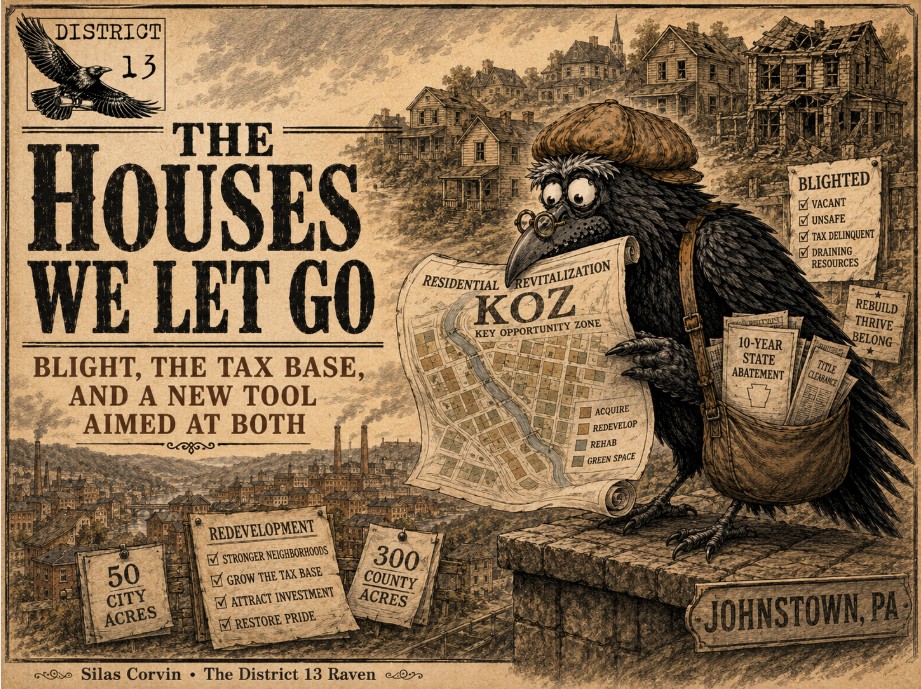
The 2026-27 state budget, signed July 12, creates a first-of-its-kind Residential Revitalization Keystone Opportunity Zone for Cambria County and Johnstown — 300 aggregate acres across the county, 50 of them inside the city, designated for state tax exemptions, deductions, abatements and credits. State Rep. Frank Burns, D-East Taylor Township, led the effort to create it.
Keystone Opportunity Zones have been around since the late 1990s, and the logic has always been blunt: land the market has written off generates nothing for the treasury, so the state loses little by suspending its taxes on it for a stretch of years. Zero percent of something beats a hundred percent of nothing. For nearly three decades the program served commerce — industrial parks, brownfields, office ground. Cambria County already holds one of those commercial zones: 300 acres, 40 in Johnstown.
The new zone is a different design. Every property in it must be primarily used for residential redevelopment, and the blighted sites selected must carry a residential component — a house. For the first time, the tax holiday is aimed at the front porch.
Worth noting how it was written. The legislation never names Cambria County or Johnstown. It applies to fourth-class counties with 2020 Census populations of at least 130,000 but fewer than 135,000, and third-class cities within them. Check the census tables and exactly one county and one city qualify. That’s an old Harrisburg drafting technique — a general law with a keyhole one key fits — and it tells you the measure was built for this place from the first line.
“The hope and the goal of this is to get private investment to come in and take some of these homes down and rebuild,” Burns told The Tribune-Democrat. “So by removing blight, we’d also be replenishing our housing stock on the former blighted property sites.”
The offer
Under the program as Burns lays it out, a person or business purchasing one of these properties gets a 10-year, state-only tax abatement. Tear down the shell, rebuild, live in it, and you pay no state income tax for a decade. The abatement reaches the sales tax on the materials used to build the home.
Run the numbers on a working household. Sixty thousand in income pays about $1,840 a year under Pennsylvania’s 3.07% flat tax — better than $18,000 over the decade. Add the materials sales tax and the state is putting $20,000 or more behind every owner-occupied rebuild, delivered as taxes never collected instead of grants ever administered. No panel to satisfy. No reimbursement forms. The incentive travels with the parcel.
One qualifier belongs in the same breath: state-only. County, municipal, and school taxes are a separate matter, and nothing in the record shows local taxing bodies waiving their share. In a city where the mills run high, anyone pricing a project will price the whole stack. Whether local abatements get layered on top is a question for council chambers, and the answer will matter.
The clock
The first move belongs to municipalities and industrial and commercial development authorities, which must identify blighted parcels for a list the state will approve. Applications are due Oct. 1, 2029; approvals or rejections come by Dec. 31, 2029; selected parcels then get promoted to developers and individual buyers, with the state Department of Community and Economic Development facilitating.
Three years is less time than it sounds. A parcel list means title work, and blighted title in a county this old means tax liens, absent heirs, and estates nobody probated. The municipalities that start surveying and clearing title now will file strong applications. The ones that wait will file scraps. And the selection itself — which parcels, which criteria, which wards — is where the accountability sits. Fifty city acres could mean scattered infill or concentrated blocks, and those are different strategies serving different people. Those choices get made in public meetings between now and 2029, on the record.
Straight assessment
If it works: a family buys a condemned shell cheap, rebuilds with abated materials, banks a decade of state income tax, and owns equity years ahead of any conventional path — repeat that a few dozen times and a neighborhood’s direction changes. The rebuilt houses go back on the assessment rolls, and the tax-base loop starts running in reverse. The commercial and residential zones now sit in the same county, so a business in one and worker housing in the other could both operate under abatement — nobody’s designed for that pairing yet, and somebody should. Burns wants the demonstration: “I’m hoping we can get it to work and show others what they can do in their areas, and we can lead by example here.”
If it doesn’t: the state’s own KOZ history includes zones that expired with the weeds still standing. An abatement cuts the cost of building where demand exists. It doesn’t manufacture demand. The zones will produce houses where jobs, schools, and safe streets give somebody a reason to want the house — meaning this tool works in harness with everything else this county is attempting, and barely works alone.
The state finished its paperwork on July 12. The paperwork that decides whether this amounts to anything gets written here, over the next three years, in parcel lists and meeting minutes. This column reads those for a living. Expect follow-ups.