We know where everything is. We’ve known for seventy years.
Before anything else: I’m sorry.
This isn’t what you come here for. You come here for mugs and scarf weather and the light in somebody’s kitchen window at four in the afternoon. I’ll be back there next week. Today I’m not there, and I’d rather warn you than surprise you. Skip this one if you want. That’s allowed.
Okay.
I have a rule about the news before coffee, which is that I don’t. Make the pot, grab whichever scarf is nearest the door, let the kitchen warm up, and then maybe look. I broke the rule this morning and I have been mad since about seven-fifteen.
The article was about military navigation. Somebody is building a system that maps the magnetic field of the Earth with quantum sensors so a vehicle can find its way without satellites. Enormously expensive. Enormously clever. Whatever, I thought. Another billion dollars spent on the question of how to get somewhere and blow it up. I was ready to be tired about it and move on to the crossword.
Then they explained how it works, and I have not moved on.
The crust of the Earth is a patchwork. Different minerals, different densities, different deposits, each one pulling on a magnetic field its own particular way. That’s why coal mines sit where the coal is. That’s why wells go where the oil went. The ground has a fingerprint and the fingerprint is made out of what’s in it.
Read that again, because I did, three times, standing up.
We have the map. Not a map somebody might build someday. A map that exists. There is a record of where the iron is and where the water runs shallow and where the soil goes deep enough to feed a county. We built the instruments. We flew the surveys. It’s paid for. It’s sitting on a server right now.
My grandmother taped an index card inside the pantry door. What was on each shelf, how much, when she bought it. If you asked whether she had flour enough for the month she didn’t guess — she looked at the card. That was the point of the card. You keep an inventory so that when somebody turns up hungry you know without hunting whether you can feed them.
We have the card for the planet. We’ve had some version of it since before my parents were born. Which means hunger stopped being a question of whether the food exists and became a question of who gets to say where it goes. We knew. We’ve known for seventy years. And we kept the shelves arranged exactly as they were.
And then we took the finest version of that card anybody has made — sensors delicate enough to feel a mountain’s worth of iron tugging at a needle, which is a beautiful thing for a human being to have figured out, a thing I’d cry about in a different context — and we handed it to a machine so the machine could find a city and blow it up.
I want to swear. I’m not going to, because this is a family publication and because my mother reads it. But I want to, and I want you to know I want to.
People will tell you it’s complicated. It is complicated. Complicated is also the word that comes out when the simple version is embarrassing, and the simple version here is that we have the coordinates of the pantry and we’re using them to plan the fire.
Here’s what’s eating me, though, and it isn’t the anger.
That same survey is a blueprint for the other thing. Not a fantasy — the actual, itemized, already-purchased blueprint. Water here. Minerals to build with there. Ground deep enough to grow on, mapped out in a resolution my grandmother would have found indecent. Somebody could open that file tomorrow and start drawing a world where a hungry kid is a solved problem, the way smallpox is a solved problem, the way a toothache stopped being something you just lived with. Fed, housed, warm, and free to go be curious about something. That world has been sitting behind glass since the fifties, fully funded, waiting.
And we don’t take it, because taking it would mean admitting the pantry belongs to the house and not to whoever’s holding the key. We’ve organized a whole planet around the idea that my shelf only counts if yours is emptier. Everybody armed to the teeth, holding the same inventory, each of us using it to price the other one’s destruction — over pride. Over standing. Over who gets to be the one who says.
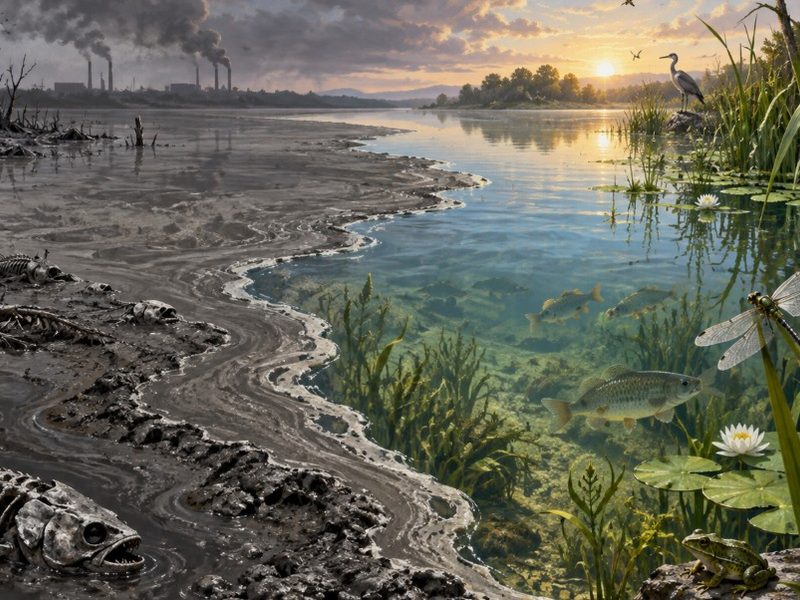
That’s the part I can’t put down. The scarcity is a choice we keep re-signing. The competition is a costume. The map doesn’t care who wins; it just says what’s here and how much.
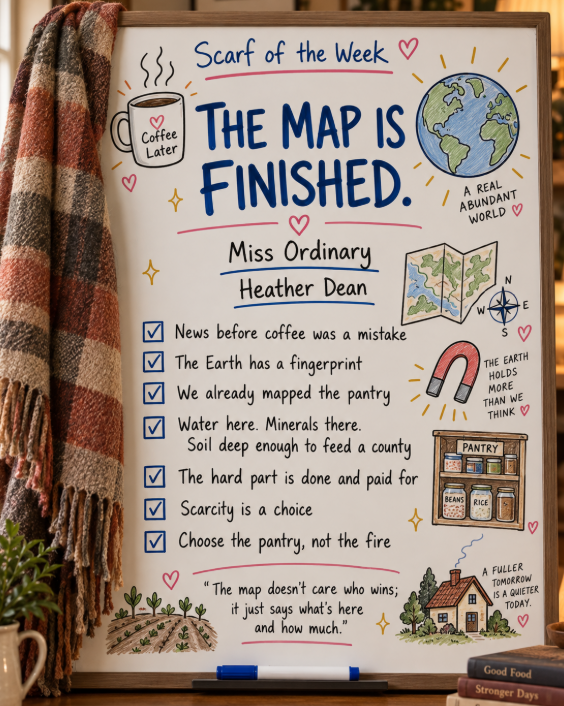
So here’s my soft true thing, and it’s the only one I’ve got today. The map is finished. The hard part, the expensive part, the brilliant part — done, paid for, ours. What we point it at is a decision, and a decision is something people made on purpose, which means people can make it differently on purpose.
Somebody chose the fire. I’d like to know who, I’d like them to say it out loud in a room with the rest of us, and I would like — once, in my lifetime — to watch somebody choose the pantry instead.
I’m going to go stand in the yard now. Not because I feel better. Because the light is good and there’s a world we could have had by Thursday, and I intend to be paying attention when someone finally reaches for it.
— Heather Dean writes as Miss Ordinary for the Blue Ribbon Team. She lives in Johnstown with too many scarves and a coffee maker she trusts more than the news.