Pull up a crate. Today’s date carries some weight.
September seventeenth, nineteen hundred. John Mitchell and the United Mine Workers called the hard-coal miners of eastern Pennsylvania up out of the pits. The operators had been asked to sit down and bargain. They said no. They were asked to let an arbitrator settle it. They said no to that too.
The union had maybe nine thousand members in the anthracite fields. Inside a week, better than a hundred thousand men had set their picks down.
Sit with that arithmetic. Nine thousand men holding cards, and a hundred thousand walking out.
The operators hadn’t figured on it. For twenty years they’d been filling those patch towns with Poles, Slovaks, Lithuanians, Hungarians, Italians. Men with a dozen languages between them, and the thinking in the front office was they’d struggle to find enough common words to stand in one line. Three Septembers earlier, a sheriff’s posse at Lattimer had opened fire on a column of those same men marching unarmed behind an American flag. Nineteen dead. The bosses expected the survivors to take one lesson from that: stay down and stay apart.
They took a different one.
Now let me tell you about management’s favorite tool. The rifle makes the papers, and they will reach for it at times but…
The tool they reach for first sits in the kitchen. It’s the empty pantry.
Hunger is patient, and it works cheap. You don’t have to break a strike if you can outwait it. Let the rent come due on the company house. Let the credit dry up at the company store. Let a man’s kids go to bed with the cold coming through the walls, and let him lie there doing sums. Sooner or later he walks back to the gate on his own feet, and the boss gets to call it a free choice.
The anthracite operators knew that play by heart. Back in ’75 they waited out the miners the better part of half a year, the Long Strike, and the men went back hungry and their union went down with them. Twenty-five years later, the operators figured on running the same clock.
They use that tool one worker at a time too. The steward who asks too many questions finds his hours trimmed. The woman who files the grievance lands the worst schedule on the board. The man who testifies loses the overtime he’d been counting on for his kid’s braces. The pink slip stays in the drawer. They make disagreeing expensive and let the bills do the talking.
Take it or leave it. That’s the offer. And the boss says it with a straight face because he’s betting you can’t afford the second half.
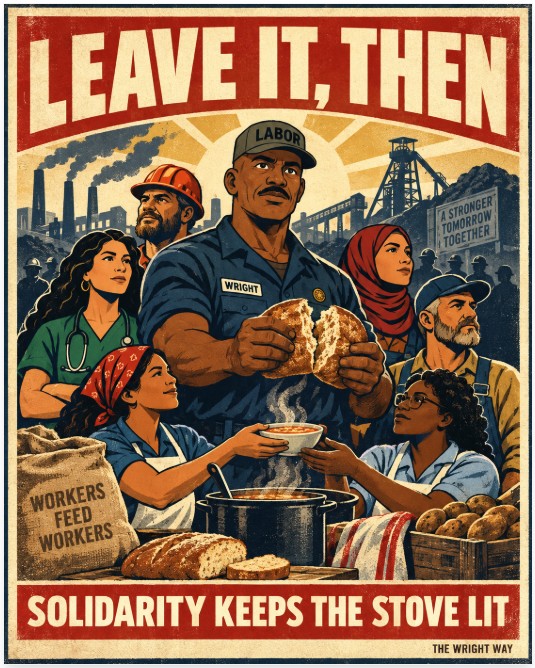
So solidarity has to live in the kitchen too. It’s the neighbor who sends over a pot of soup. The union hall that keeps a stove lit and a kettle on. The man with a garden who leaves a sack of potatoes on the porch of the man without one. Plain, steady care for the folks around you with less, so the people on your line don’t have to go begging for scraps.
The first family that has to beg shows the boss where the door is.
Being able to answer him together, “Leave it, then,” depends on full stomachs up and down the line and a fire in each grate.
Mind what that meant in those coal patches. Those men dug the anthracite that warmed parlors in Philadelphia and New York. Their own families picked what they could off the culm banks. Keeping a neighbor’s stove going through a strike was something you could feel with your hands.
Six weeks. That’s how long the operators had to hold out, and they didn’t have six weeks of patience in them. It was an election year. McKinley was running on the Full Dinner Pail, and Mark Hanna could picture a hundred thousand of those pails sitting on a front page. Hanna went to J.P. Morgan, whose money stood behind the railroads that owned the mines, and the railroads got the message. In October the companies tacked notices up at the collieries: ten percent more pay, and the sliding scale was finished. They wouldn’t sign a thing with Mitchell. They posted the raise on the wall as if it had been their idea. On the twenty-ninth of October the men went back down, and the miners kept that date as Mitchell Day.
They didn’t win recognition out of it. That took two more years and a bigger fight. But around a hundred and twenty-five thousand new members came in behind that win, and they came in knowing something.
The operators’ plan rested on a guess. That a Slovak wouldn’t feed a Welshman. That an Italian wouldn’t split a sack of flour with a Pole. That a hundred thousand hungry men would crack one kitchen at a time.
They guessed wrong.
My father told me about the Pullman men in his day. When the company found out a porter had signed with Randolph’s Brotherhood, they’d find a reason to let him go. So on payday the other men passed a hat, and that family made rent. No ledger kept track of it. The company kept its books, and the men kept theirs.
Look after the hands on either side of you. Keep the pantry full down the line. Then when they slide the paper across and say take it or leave it, you’ll be in a position to choose.
Now you know, Jack.
Sources
John Mitchell Papers finding aid, Cornell University Library: http://rmc.library.cornell.edu/EAD/htmldocs/KCL05502mf.html
Global Nonviolent Action Database, Swarthmore College: https://nvdatabase.swarthmore.edu/content/pennsylvania-anthracite-coal-workers-strike-better-wages-and-working-conditions-1902
Pennsylvania Center for the Book, “The Greatest Strike Ever”: https://pabook.libraries.psu.edu/literary-cultural-heritage-map-pa/feature-articles/greatest-strike-ever
Pennsylvania Heritage Magazine, “The UMWA Wins America’s Approval”: http://paheritage.wpengine.com/article/umwa-wins-americas-approval-john-mitchell-anthracite-strike-1902/
Anthracite Coal Region, Schuylkill County: https://anthracitecoalregion.org/category/schuylkill-county/