Step off the trail into an old hardwood stand in late October and you are standing inside the finest materials-recovery operation on the continent. A fallen red oak lies across the slope, its heartwood gone soft, shelf fungi climbing its flank like a staircase. Beetle larvae work the inner bark. Rain carries what they loosen down into the duff, and the duff feeds the maple saplings already reaching for the gap the oak left in the canopy. Given a few decades, the forest takes that tree apart down to its carbon, nitrogen, calcium and phosphorus and builds new trees from the pieces. The woods keep no landfill.
John Muir wrote, “When we try to pick out anything by itself, we find it hitched to everything else in the Universe.” Human industry has spent a century and a half learning, one discipline at a time, how to do what that oak log does. The Cernunnos Foundation holds that those separate lessons are now arriving at the same place together, and that their meeting point deserves far more public attention than it receives.
A Different Kind of Singularity
Talk of the technological singularity usually centers on artificial intelligence: a machine grows clever enough to improve itself, improvement compounds, and history passes through a wall beyond which our forecasts stop working.
That may come. We see a second convergence already underway, and its effects may run deeper.
Five capabilities have matured over the past hundred years along separate paths. We have become very good at taking matter apart. We have become very good at putting matter together. We are getting good at producing energy from a long list of sources, and better each year at storing and moving it. And machines increasingly handle the labor that connects one of those steps to the next.
Braid those five strands together and the old human problem of scarcity starts to change shape. Our ancestors asked where to find enough stuff. The question in front of us looks more like this: why are we burying so much of what we already have?
Objects Are Borrowed Arrangements
Consider a coffee mug, a telephone, a kitchen chair, a dead battery, a bucket of food scraps, a washing machine with a seized drum. Our economy treats each as a product with a lifespan. A chemist sees iron, carbon, copper, aluminum, silicon, lithium, calcium, phosphorus, hydrogen, oxygen, nitrogen, nickel and chromium, with a few dozen other elements tucked into the complicated parts, held together for a while in a particular shape.
Thermal, hydrothermal, chemical, mechanical and electrochemical processes can already dismantle a very wide range of manufactured and biological materials into simpler streams. Supercritical water, for example, can take complex organic molecules apart so thoroughly that what leaves the reactor is mostly carbon dioxide, water and mineral salts.
There is no magic box yet where a refrigerator goes in and tidy ingots of iron, copper and aluminum come out. Separation is hard engineering. Rare earth elements resist being pulled apart from one another. Streams get contaminated. Trace elements scatter. The last few percent of recovery can cost more than the first ninety.
Look closely at those obstacles and a pattern shows through. Each one comes down to cost, and a large share of that cost is energy. We bury the refrigerator because separating its atoms costs more than digging fresh ore out of a mountain somewhere else. That is an economic condition dressed in the clothing of a physical law.
The Forest Floor, Industrialized
A conventional factory starts with refined feedstock such as sheet steel, plastic resin, glass and copper wire, and spends energy arranging it into something more complicated.
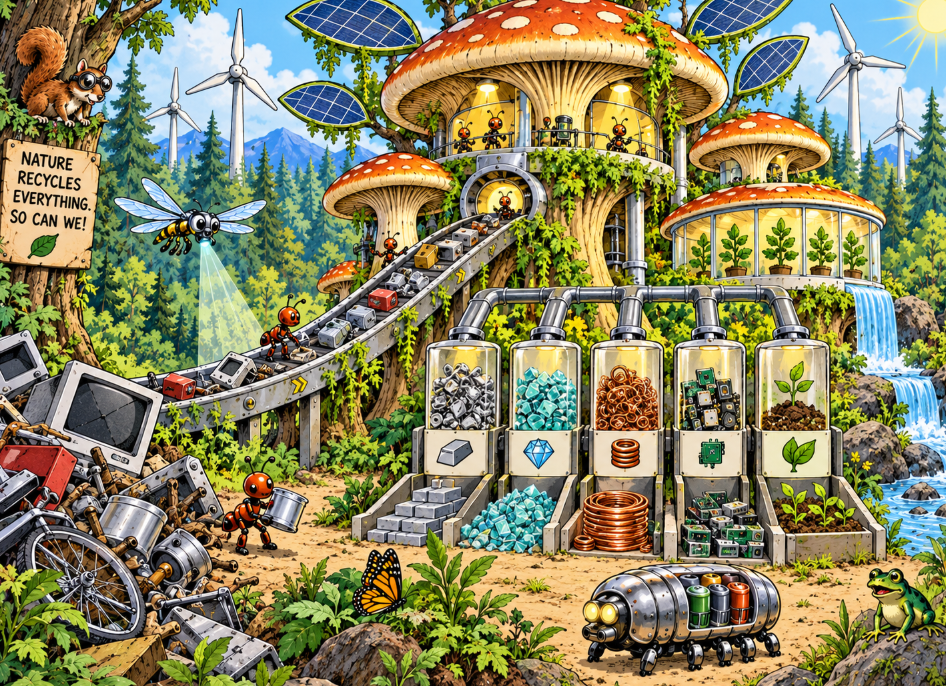
Picture that factory running in reverse. It starts with the complicated thing and works backward toward simplicity: crush it, sort it, heat it, dissolve what will dissolve, break down the organic molecules, capture the gases, precipitate the minerals, electrorefine the metals, regenerate the chemicals, and send the leftover residue around for another pass under different conditions. Eventually the television stops being a television and becomes feedstock, the same way the oak stopped being an oak.
Building a general-purpose reverse factory today would be enormously expensive. Expense is a price, though, and prices follow their inputs. Which brings us to energy.
The Energy Menu Keeps Growing
For thousands of years, civilization went hunting for concentrated energy: wood, draft animals, wind, falling water, coal, oil, gas, uranium. Each new source widened what people could do.
Today the menu reads like a seed catalog: solar photovoltaics, solar thermal, onshore and offshore wind, hydroelectric, conventional and advanced geothermal, nuclear fission including small modular designs, wave and tidal systems, waste-heat recovery, bioenergy where the land supports it, and, farther out, fusion.
No single entry has to win. For decades the energy debate has sounded like a horse race. A healthy grid can work more like a mixed hardwood forest, where oak, hickory, cherry and maple each hold the ground that suits them, and the stand comes through droughts that would flatten a monoculture.
The harder half of the problem sits on the storage side, since a flood of solar power at noon does little for a hospital at midnight. Here the creativity on display borders on the absurd: lithium, sodium-ion and solid-state batteries, flow batteries, molten salt and other thermal stores, compressed air, pumped water, gravity systems, flywheels, hydrogen and other chemical carriers, and new chemistries arriving by the season. Many of those ideas will fade. They only need to work somewhere.
Batteries alone show how fast the ground is shifting. According to the International Energy Agency, the world added 108 gigawatts of battery storage in 2025, about 40 percent more than the year before, and installed capacity now stands at roughly eleven times its 2021 level. The same agency reports that battery costs fell by more than 90 percent between 2010 and 2025.
That is what convergence looks like up close: thousands of engineers working separate pieces of one problem, the way hundreds of small runs and springs gather into a single river.
Fusion Is a Bonus
Fusion could eventually add an enormous source to this picture, and Germany is doing serious work toward it. In May 2025, the Wendelstein 7-X stellarator in Greifswald sustained a world-record triple product for long plasma pulses, holding that combined measure of plasma density, temperature and confinement time for 43 seconds. W7-X is a research device built to test whether stellarators can support continuous fusion power, and it sends no electricity to the German grid.
The next step is underway. Proxima Fusion, a spin-off of the Max Planck Institute for Plasma Physics, signed an agreement in February 2026 with the State of Bavaria, the utility RWE and the institute to build a demonstration stellarator called Alpha in Garching, aimed at showing net energy gain in the 2030s, with a commercial plant called Stellaris to follow at the former Gundremmingen nuclear site. In July 2026 the company closed a €411 million funding round to move Alpha forward.
The convergence described here stands on its own legs regardless. If commercial fusion arrives in ten years, the transition speeds up. If it takes fifty, the transition continues on the sources already in hand.
Waste Becomes Inventory
Set the two halves side by side and the meaning of waste changes.
With abundant electricity, a recovery process that made no sense yesterday starts to pencil out. A plant can grind material finer, run one more separation stage, hold a batch at temperature longer, desalinate its own process water, pull metals from mine tailings, draw phosphorus out of sewage, recover metals from electronics and spent batteries, and turn organic wastes into chemical feedstock, with machines running the line.
Thermodynamics still holds, and entropy still collects its toll. Equipment wears, trace amounts escape, and some materials spread so thin that chasing them turns ridiculous.
Civilization can manage without perfect recycling. Think of a farm pond: it loses a little to evaporation and seepage each week, and the owner tops it off from the well. A society that recovers 98 percent of a material on each pass only needs outside supply to cover the 2 percent that leaks. Mining shifts from the start of each production cycle to the top-off.
Under those conditions a landfill looks like a badly organized mine. Sewage looks like a nutrient stream. Demolition debris looks like aggregate and mineral feedstock. Yesterday’s machines become the raw stock for tomorrow’s.
Machines as the Mycelium
Now add automation. Machines already sort materials, run factories, monitor systems, balance electrical grids, work fields, fabricate parts and diagnose failures. Artificial intelligence layered over that work fills the role mycelium plays on the forest floor, carrying signals and resources between the pieces and keeping decomposition and regrowth in step. In this picture, AI serves as the control system for the material convergence.
Count what has come together. We can capture energy from sunlight, wind, water, heat and atoms. We can store it. We can turn it into motion, heat, chemical change and computation with great precision. We can dismantle enormous classes of materials, purify many of their constituents, and build intricate objects from them. And machines can carry more of the repetitive labor between those steps.
For the first time, the engineering path toward a civilization where matter moves in loops, the way nutrients cycle through a healthy watershed, is visible on the map. Once matter moves in loops, energy becomes the currency underneath the physical economy. And as energy grows abundant, the economic logic built around permanent material scarcity starts losing its footing.
So Why Are We Still Fighting?
Human civilization grew up under scarcity. Fertile land, timber, coal, oil, navigable water and workable ore came in limited supply. Whoever held the resource held the future. Whoever held the shipping lane held access to the resource. Whoever held the territory held the people who needed it. Under those conditions, war carried a grim internal logic.
Technology is now pressing on the premise beneath that logic. A community that generates much of its own energy, recycles much of its own material, purifies its own water, grows more of its own food and manufactures a growing share of what it uses gives geography less power to hold its survival hostage.
Some of that power remains. Certain resources will stay concentrated in particular places. Ecosystems can’t be manufactured. Land stays finite. Some minerals will resist substitution. And people have shown a talent for inventing artificial scarcity once natural scarcity eases.
The dark version of this future grows from that talent: abundant energy owned by a handful of entities, automated production whose returns flow to its owners alone, legal fences around technologies capable of producing plenty, and intellectual-property regimes that ration knowledge even though knowledge copies at close to zero cost. A society holding the tools for plenty could still enforce deprivation.
That outcome is possible, and it is also a choice. The hopeful version of this future stands on sturdier footing than a wish that people will become kinder. It rests on changing the physical conditions that have fed human conflict for ten thousand years.
Asking a Better Question
We have organized civilization around one question: how do we divide scarce resources? The Cernunnos Foundation proposes a second: how do we stop manufacturing scarcity?
That question belongs first to engineers and designers, then to the people who decide ownership and build infrastructure, and finally to the culture at large. If energy grows abundant, materials move in loops, machines carry more of the compulsory labor, and knowledge crosses the globe at close to zero cost, a great deal of the machinery we built to ration scarcity begins to look strange. Some of it may look obsolete.
The same reasoning guides how The Cernunnos Foundation shares its own design work. A seed head gives its seeds to the wind, and the meadow that follows belongs to the hillside.
This is why we say the singularity is here. Dozens of technological curves that humanity climbed separately for a century are beginning to cross: energy, storage, materials science, chemistry, automation, computing, manufacturing, recycling and artificial intelligence. None of them delivers abundance alone. Together, they might. The great work of the coming century may be recognizing that we hold enough, and doing so before we wreck ourselves fighting over who gets it.
Markets will remain. Trade will remain. Scarcity will linger in places, and human foolishness will stay with us. What may be ending is compulsory scarcity, the long arrangement in which civilization spends its strength buying one more turn of the survival wheel. If that ending is real, the question of our age shifts from how we will survive to what we are still fighting for.
Sources
International Energy Agency, Global Energy Review 2026, Battery Storage: https://www.iea.org/reports/global-energy-review-2026/technology-battery-storage
Energy Storage News (pv magazine ESS News), battery additions and cost decline: https://www.ess-news.com/2026/06/02/global-battery-additions-reached-108-gw-in-2025-according-to-iea/
Max Planck Institute for Plasma Physics, Wendelstein 7-X performance records: https://www.ipp.mpg.de/5532945/w7x
Proxima Fusion, Alpha and Stellaris agreement (Feb. 2026): https://www.proximafusion.com/press-news/proxima-fusion-rwe-the-free-state-of-bavaria-and-max-planck-institute-for-plasma-physics-sign-agreement-to-build-the-worlds-first-commercial-fusion-power-plant-in-europe
Max-Planck-Gesellschaft, Proxima Fusion €411 million round: https://www.mpg.de/26861952/proxima-fusion-raises-411-million-euros
John Muir, My First Summer in the Sierra (1911)