What I Overheard at the Coffee Shop (EEEK)
I was at my usual table by the window Saturday morning, the one with the wobbly leg I fix with a folded napkin, halfway through a maple latte and a list I was writing on the back of a receipt. Two women came in and sat at the table next to mine. I didn’t know them. Neighbors, I think, from the way they talked about the same stretch of road.
I wasn’t trying to listen. The shop is small, and they weren’t whispering.
“Did you fill your tank yet?”
“I called Thursday. I about dropped the phone.”
“Same. I told him to just put in a hundred gallons for now and I’ll figure out the rest later.”
“Later when, though?”
They both laughed the kind of laugh that isn’t really about anything funny. Then one of them said she was thinking about closing off the upstairs this year and moving the grandkids’ visits to the living room, and the other nodded like she’d already done the same math.
Oh my gosh.
I looked down at the scarf around my neck, and right then I was so glad I love scarves as much as I do. I have a closet shelf that could keep a small town warm. Thrifted ones, inherited ones, the plaid one I bought twice because I forgot I already owned it. For years my family has teased me about it. Saturday, sitting next to those two women, it felt less like a quirk and more like a plan.
It’s been cooling off all week. The mornings have that damp edge now, and the fog sits on the Stonycreek until almost nine. Friday I finally retired the thin cotton “decorative” scarves of summer and put on my first real scarf of the year: the rust-colored wool one with the fringe my aunt gave me. It itches for about an hour, then settles in like a new pair of boots.
I’m shy. I didn’t turn around and say anything to those women. I finished my latte and went home and did what I do when something gets stuck in my head. I looked it up.
Here’s what I found.
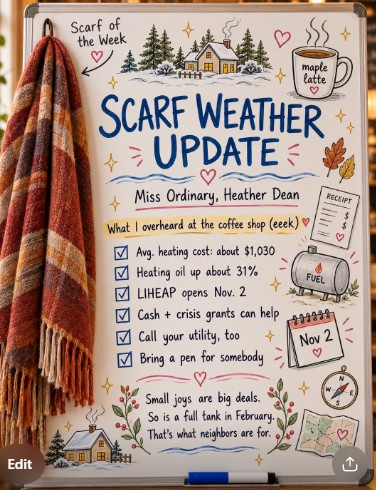
The National Energy Assistance Directors Association, the folks who run heating help programs across the country, expects the average household to spend about $1,030 to heat their home this winter. That’s $82 more than last year, rising at more than twice the rate of inflation. Electric heat is projected to cost about 9 percent more. Natural gas, around 6 percent. Heating oil, the thing my coffee shop neighbors were talking about, is looking at roughly 31 percent more. Since the winter of 2021, heating costs have climbed by almost a quarter.
About one in six households is already behind on utility bills. Picture your street. Picture a dozen porches. Two of them.
So here’s the list I wish I’d handed to those two women, written on a receipt and stuck to my fridge with the pear magnet.
Mark November 2. That’s the day Pennsylvania’s heating assistance program, LIHEAP, opens for the 2026–27 season. It runs into April. Last year it opened a month late, in December, so seeing a November date on the state’s website made me happier than a government webpage has any right to.
Know what it is. LIHEAP sends a cash grant straight to your fuel dealer or utility, and you don’t pay it back. It covers heating oil, propane, kerosene, gas, electric, even wood. There are also crisis grants if you get a shutoff notice or your oil tank is running low, and you can get more than one crisis grant in a season if trouble comes back around. For oil customers like my neighbors at the next table, that crisis grant can mean a delivery instead of a hundred gallons and a prayer.
Check your mailbox. If you got LIHEAP help last year, the state sends a postcard with a registration number so you can apply early. It looks like junk mail. Please don’t toss it with the pizza coupons.
Know where to go. Apply online through COMPASS on the state’s Department of Human Services site, or through your County Assistance Office. The LIHEAP helpline is 1-866-857-7095. From what I’ve read, the income limit sits around 150 percent of the poverty line, roughly $49,500 a year for a family of four. If you’re close, apply anyway and let them sort it out.
Call your utility, too. The big gas and electric companies in Pennsylvania offer customer assistance programs for lower-income households, separate from LIHEAP. The number’s on your bill. A ten-minute phone call now can feel like finding twenty dollars in a coat pocket come February.
Go easy with the space heater. My mom’s rule: plug it straight into the wall, keep it three feet from anything that can burn, and turn it off when you leave the room or go to sleep. Older houses have older wiring, and Johnstown has a lot of wonderful older houses.
And bring a pen for somebody. Forms make some people’s stomachs flip. There’s something about a government application that makes a smart adult feel like they’re taking a test they forgot to study for. I happen to like forms. I like the little boxes. So if you have a neighbor who’s older, or raising kids alone, or just tired, knock on their door in early November with a plate of cookies and an offer to sit at the kitchen table and fill it out together. Bring two pens, in case one skips.
I’ll be back at my window table next Saturday. If those two women come in again, maybe I’ll be brave enough to slide this across the table. If not, maybe one of you knows them.
A scarf is a small way of holding on to heat you already have. A warm house through March is the bigger version of the same idea, and some of us need a hand getting there. That’s what neighbors are for.
Small joys are big deals. So is a full tank in February.
Stay clean, stay kind, stay caffeinated.
— Heather