Observe
A mind-controlled video game already exists. In 2021 Neuralink released footage of a macaque named Pager playing Pong through a brain implant, and a human participant with the same implant has since played Civilization and Mario Kart. The ceiling for brain-driven play has been demonstrated. The price of admission is neurosurgery.
The non-invasive route, sensors worn on the head, has been improving on a separate track, and the gains came from the chip side. An EEG system in the 1980s was a cart of rack-mounted amplifiers. Today Texas Instruments’ ADS1299 handles eight channels of amplification and digitization on a chip the size of a fingernail for tens of dollars, and that one part made open-source headsets like OpenBCI possible for a few hundred. Active electrodes, with a tiny amplifier at each scalp contact, cut enough noise that dry sensors replaced gel and skin scrubbing.
Magnetoencephalography, which reads the magnetic fields produced by the same neural currents, is following the same path. Its sensors once required liquid helium and a room-sized machine. Chip-scale magnetometers developed at NIST led to optically pumped sensors, and in 2018 a University of Nottingham team mounted them in a wearable helmet that let subjects move their heads during recording. The remaining obstacle is shielding. Earth’s field and nearby electronics drown out the brain’s signal, so these systems still run inside shielded rooms.
Two findings from the research shape this concept. First, the skull limits what scalp sensors can read, and scalp EEG delivers somewhere in the range of tens of bits per minute, well short of what a game controller at play speed asks for. Second, people get better with practice. First-time users often can’t produce a usable signal, and trained users push left-versus-right accuracy from the 60 to 70 percent range into the 80s and 90s. Jonathan Wolpaw and Dennis McFarland had subjects steering a cursor in two dimensions with scalp EEG in 2004.
That second finding is the opening. Brain-computer control is a skill, and skills take hours of repetition. Research labs pay volunteers to sit through training sessions. Online games get millions of people to grind for hours on their own time, for free, because someone else on the leaderboard is ahead of them.
Design
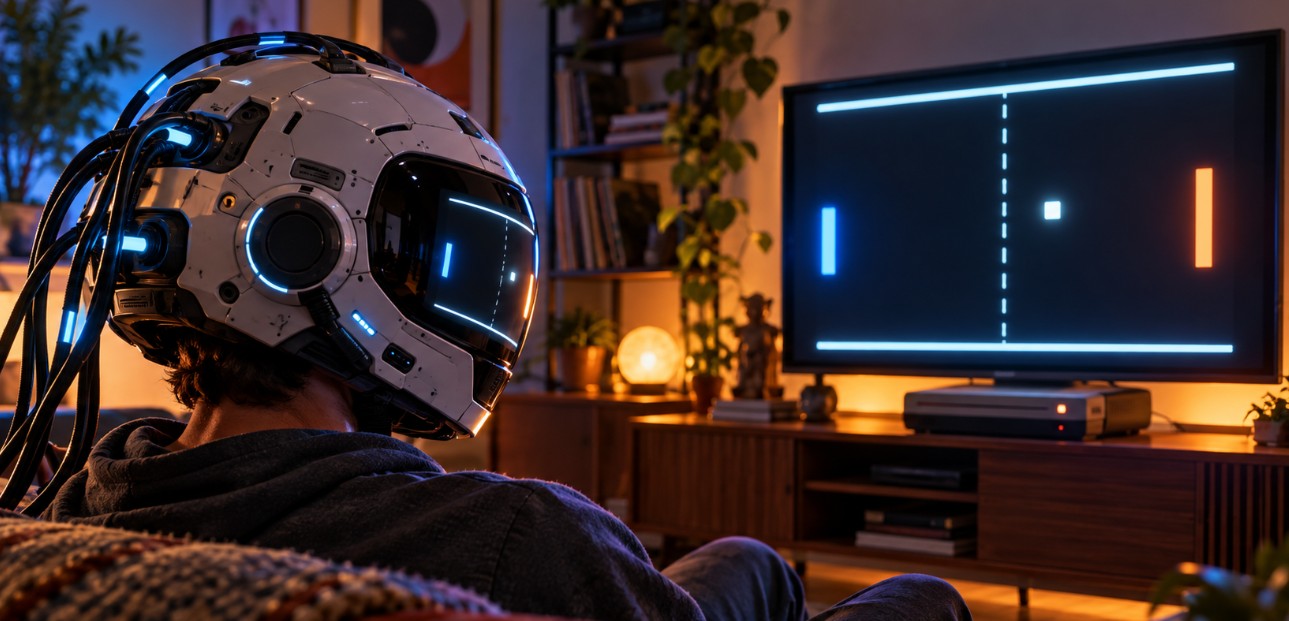
The helmet is the controller. The game teaches the brain to use it. Online competition keeps the player coming back to practice.
Hardware. A sensor helmet sits inside a shielding box. The outer layer is conductive, a Faraday cage that blocks electrical interference, mains hum, and radio. Inside it are layers of mu-metal, a nickel-iron alloy that carries low-frequency magnetic fields around the interior instead of through it. The first generation runs on EEG, which the box already improves. The enclosure leaves room for wearable magnetic sensors as they get cheaper and more portable.
The ladder. The curriculum follows the history of home gaming, starting with Atari-era games built for a single button and a paddle.
Level one is a single button. The system learns to tell intent from rest, and the player learns what mental action produces a clean signal.
Level two is two buttons, mapped onto imagined left-hand and right-hand movement, which shows up over the motor cortex.
Level three is the fade between those two choices. The strength of the imagery sets the position, and two buttons become a paddle.
From there, inputs get added one at a time: paddle plus button, then two axes, then more buttons, climbing toward a full PlayStation-style controller held in the head. At the top of the ladder, the player puts on the helmet and plays regular games.
Online competition. Each rung of the ladder is a ranked online bracket. Players go head to head in Pong-style matches against others at the same level, with global and regional leaderboards tracking who has climbed furthest and fastest. Unlocking a new input feels like earning a new ability, and players can see who got there first. Seasonal rankings reset the race so newcomers have a shot at the top.
The format already has a proof of concept. Since 2016, ETH Zurich’s Cybathlon has run a brain-computer interface race where paralyzed pilots steer game avatars by thought, with teams training for months to compete. Online play turns that event into a year-round league anyone with a helmet can enter.
Competition also builds the community that feeds the tips. The game publishes guidance drawn from the research: which kinds of imagery produce clean signals, how practice schedules affect learning, what separates strong users from struggling ones. Top players stream their sessions and share what’s working for them, the way speedrunners trade routes. The tips page grows from both directions.
Intervene
The Atari tier is buildable now on published research and off-the-shelf chips. Each rung above it is a research contribution, and a game company running an online league would be funding that research through play instead of grants, with its players doing the training hours on their own time because they want to win.
The pieces needed are hardware manufacturing, online infrastructure, and an audience willing to put a box on their heads for brain powers. Kids already wear boxes on their heads for no reason at all.
Each of the major players has a piece of this already. Sony owns the controller the ladder climbs toward and runs PlayStation Network. Microsoft built the Xbox Adaptive Controller around players who can’t use a standard gamepad. Valve runs Steam and has worked with OpenBCI on Galea, a research headset aimed at gaming and VR. Nintendo put motion control in living rooms with the Wii and announced a pulse-reading Vitality Sensor for it in 2009 before shelving the device.
This concept is published openly, as an invitation. So here’s the question for the industry: which one of you takes this seriously and changes how people interact with computers?
Sources
Neuralink, Pager “MindPong” demonstration, 2021; participant gameplay reports, 2024
Texas Instruments, ADS1299 analog front-end product documentation
OpenBCI and Galea headset project materials
Boto, E. et al., “Moving magnetoencephalography towards real-world applications with a wearable system,” Nature, 2018
Wolpaw, J. R. and McFarland, D. J., “Control of a two-dimensional movement signal by a noninvasive brain-computer interface in humans,” PNAS, 2004
ETH Zurich, Cybathlon BCI race, 2016 onward
Microsoft, Xbox Adaptive Controller, 2018
Nintendo, Wii Vitality Sensor announcement, E3 2009