The Jet That Rivals Built
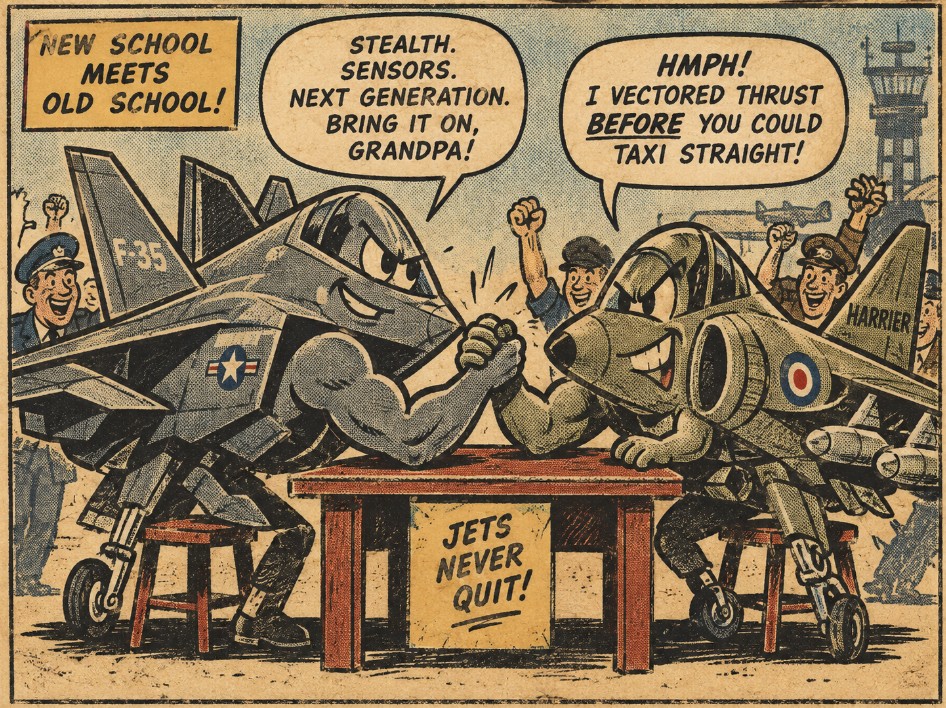
A video made the rounds recently. An F-35B drifts in over a bay, slows to a hover, holds there like a hummingbird at a feeder, then swings its nose and slides off in a new direction. The post was simple admiration. The comments went another way: “Impressive 60 years ago when the Harrier did it.” Variations on that line stacked up under the video like empty cans after a tailgate.
The commenters have a fact on their side. The Harrier’s ancestor, the Hawker P.1127, first hovered in 1960, and the Harrier entered RAF service in 1969. It was a marvel then and still is. Its Pegasus engine pushed thrust through four swiveling nozzles, and small puffer jets at the nose, tail and wingtips kept the airplane balanced while no air moved over the wings. Pilots flew the hover largely by feel, juggling throttle, nozzle angle and stick, and the aircraft earned a reputation as a demanding ride.
The trouble is the conclusion they draw. Calling the F-35 less impressive because the Harrier came first works like calling a Shelby Cobra less impressive because the Model T also had four wheels. The Harrier’s breakthrough lives inside the F-35. The newer jet is what that breakthrough grew up to be.
Look at how the F-35B hovers. Behind the cockpit sits a lift fan, driven by a shaft off the main engine, pushing a column of cool air straight down. At the tail, the engine nozzle bends downward through three rotating sections. Roll posts in the wings handle side-to-side balance. A flight computer blends the pieces, so the pilot asks for a direction and the system works out the arithmetic. The result looks steady enough to set a coffee cup on, and the lag between command and movement keeps getting shorter.
This is where the story turns. That hover system carries fingerprints from teams that spent decades trying to beat each other.
Start with the engine. Rolls-Royce builds the F-35B’s LiftSystem. In 1966, Rolls-Royce absorbed Bristol Siddeley, the company that built the Harrier’s Pegasus engine. The people who made the Harrier hover went on to build the next answer under the same company roof.
Then the Soviets. In the late 1980s, Yakovlev flew the Yak-141, a supersonic vertical-takeoff fighter with its own swiveling rear nozzle. After the Cold War ended, Lockheed paid Yakovlev for design data from the program. Engineers still debate how much that data shaped the final F-35 nozzle, and an earlier American design from Convair explored similar ideas. Still, the program drew on Soviet test results. Knowledge built to win one side of a rivalry ended up feeding the other side’s aircraft, once the rivalry cooled enough for it to cross the border.
Then the allies. The F-35 was developed as a partnership, with the United Kingdom, Italy, the Netherlands, Australia and other nations putting in money, engineering and factory work.
So the jet in that video rests on three layers of cooperation. Across time, from the Harrier’s designers to their successors. Across former enemies, from Yakovlev’s test stands to Lockheed’s. Across allies, from partner nations sharing the bill and the work.
Consider the setting. Military aviation is the team sport with the highest stakes we have. Nations pour fortunes into it to outdo each other, and the losing side can lose a war. If cooperation built the better machine even there, the case for it in the rest of the economy gets hard to argue with.
That brings me back to the comments. Fandom treats technology like a scoreboard: my jet, my phone, my car company, my team. Under that frame, borrowing looks like weakness and lineage looks like a demotion. The question “how did they solve it” gets swapped for “who won,” and “who won” has room for one answer. Lost in the shuffle are the specs, the improvements, and the long climb from 1903, when the Wright brothers stayed off the ground for twelve seconds, to a fighter that can stop in midair over a bay and choose a new heading. That climb fits inside two long human lifetimes.
An economy that runs on competition alone trains people to see the world that way. Competition has its uses. It pushes teams to try harder and cut waste. Leaned on by itself, it rewards the winning story over the cumulative work, and cumulative work is how engineering moves. Each team picks up the baton from the last.
Kids pick up on that. If the culture says the point is whose side wins, a career spent improving on someone else’s breakthrough looks like a bad bet. You put in fifteen years, deliver a machine that hovers steadier and turns faster, and a crowd tells you a sixty-year-old plane already did it. Why sign up for that?
The answer sits in the video. The F-35B hovering over that bay is the Harrier’s designers, Yakovlev’s engineers, Convair’s drafting tables and a group of partner nations holding the same airplane steady together. We do better together. Even the people who build warplanes figured that out.