A friend talked me into a night out on Polish Hill last weekend. The place she picked is a punk bar, which is a little outside my lane. I wore my thickest gray scarf like a security blanket and ordered a cider. The bartender was lovely, the music was loud, and I spent a good part of the night staring at something on the wall.
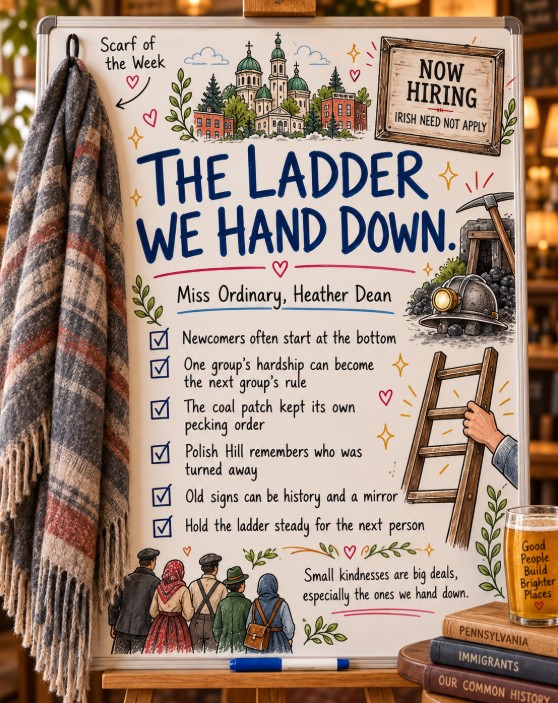
It’s an old sign behind glass, framed with care, the way my aunt framed my grandmother’s recipe cards. The paper has gone the color of weak tea. It says NOW HIRING, and underneath, in the same cheerful type, IRISH NEED NOT APPLY.
The bar has been there a long time, in one form or another. The newsprint dates to the 1920s, when a new wave of young Irish people crossed the ocean after their country’s war for independence and the civil war that followed. Some of them came up the rivers to Pittsburgh looking for work. On this hill, somebody told them to keep walking.
I kept looking at it because of who hung it.
Down in the mines
About seventy years before that sign went up, the Irish were the newcomers. The famine sent them to Pennsylvania in the 1840s and 1850s with very little, and the coal fields put them at the bottom. Above them stood the Welsh and English miners and bosses, who knew the work from home and held the jobs that paid. The Irish took the dangerous, poorly paid work under them. The tension from that arrangement helped feed the Molly Maguires trials of the 1870s, which ended with twenty Irishmen hanged.
Then the Irish climbed. By the 1880s the coal and coke companies needed more workers than they could find, and a new wave arrived from Eastern and Central Europe: Poles, Slovaks, Hungarians, Lithuanians, Rusyns. They spoke little English and worked for less. By then many of the Irish had a generation or two behind them and had moved up to miner, foreman and boss. In the mining towns, the order ran from old-stock Americans, English and Welsh at the top, to the Irish one rung down running the crews, to the Slavic workers underneath doing the hardest labor. The country had no official ranking of people. The coal patch kept one anyway.
In 1897, at Lattimer, sheriff’s deputies fired on a march of unarmed Polish and Slovak strikers on a public road and killed nineteen of them.
Up the hill
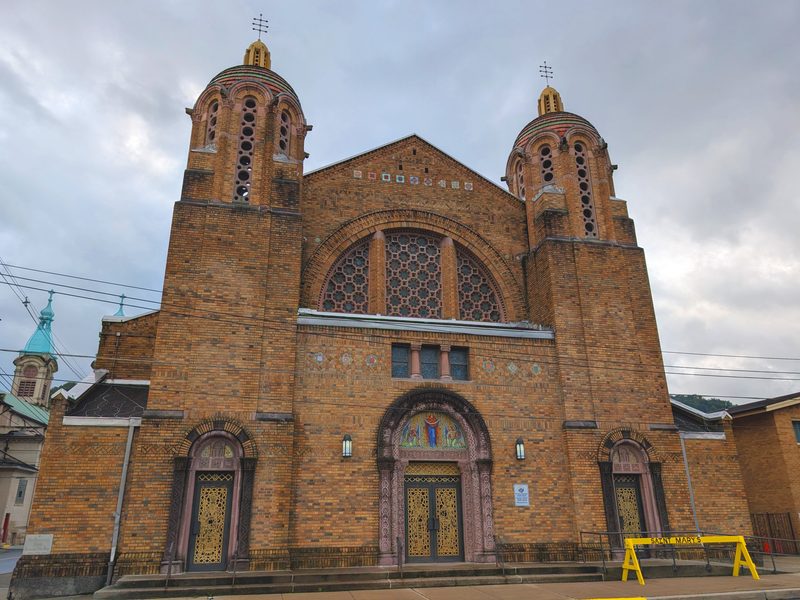
The Poles who settled Polish Hill came for the mills along the Allegheny. They built Immaculate Heart of Mary with their own money and their own hands, and its green domes still catch the light over the Strip District. (I’ve photographed them in the fog more times than I’ll admit.) Over the next few decades they held on, organized, and moved up. Some got better mill jobs. Some opened shops. Some opened bars.
The Irish families who had been here since the famine were busy blending in by then. They smoothed out their names and moved to nicer streets, and some of them drew a line between the “lace curtain” Irish and the “shanty” Irish just off the boat. The new arrivals had the red hair, the long frames and the brogue their grandparents had worked hard to lose, and the old families kept their distance.
So when the 1920s wave came, the established Irish turned away from them, and a Polish bar two generations removed from loading coal under Irish foremen put a sign in its window. The new Irish kid couldn’t get hired to wash dishes.
The ladder
I don’t think anyone in that story set out to be cruel. It reads more like a hand-me-down. The group above passed its treatment down, and the group below kept it folded in a drawer until it had someone of its own to give it to. The Welsh and English stood over the Irish, the Irish stood over the Poles and Slovaks, and the Poles stood over the next Irish. Even the Irish families stood over the new Irish, maybe because the newcomers looked too much like a family photo they’d rather keep in a box.
I like that the bar kept the sign. Whoever framed it might have meant it as history, or as an apology, or as a joke for the folks drinking under it. It works as all three. It also works a bit like a window at night, where you see the street and your own face at the same time.
None of us gets to stay at the top of the ladder for good. We take turns up there, and the way we treat the people a rung or two behind us tends to come back around, sometimes a lifetime later, sometimes on a hand-lettered sign. I’d like to be remembered for holding the ladder steady.
I finished my cider and wrapped my scarf a little tighter on the way out. Small kindnesses are big deals, especially the ones we hand down.
Sources
- Kevin Kenny, Making Sense of the Molly Maguires (1998)
- Michael Novak, The Guns of Lattimer (1978)
- John Bodnar, Immigration and Industrialization (1977)
- Richard Jensen, “No Irish Need Apply: A Myth of Victimization,” Journal of Social History (2002)
- Rebecca A. Fried, “No Irish Need Deny,” Journal of Social History (2016)