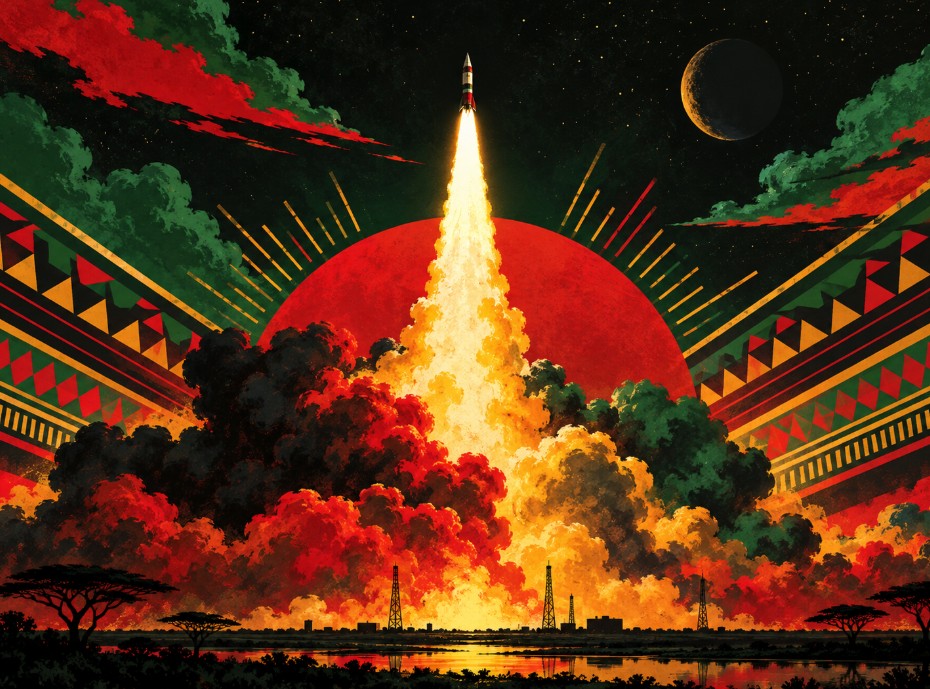
A rocket burns the bulk of its fuel in the first few minutes. On the pad it’s a tower of propellant with a small payload perched on top, and its hardest work happens close to the ground, shoving through thick air against the full pull of the planet. Engineers call this the tyranny of the rocket equation: fuel is heavy, so you need fuel to lift the fuel, and the math compounds against you. By the time a vehicle clears the atmosphere, much of what left the pad has burned off and dropped into the ocean. The satellite or the crew capsule, the whole reason for the launch, rides up on a sliver of the original mass.
I’ve been thinking about that sliver while scrolling.
Social media shows a wide range of people working out what they want the world to look like. Engineers sketch power grids. Teachers argue about curriculum. Farmers trade notes on soil. Among the higher-level thinkers in the US from many races and cultures, a large share of the posting goes straight to the payload: here’s the problem, here’s what I’d build, who wants in.
The Black American thinkers I follow spend their fuel differently. Before the idea, they have to establish that they belong in the conversation. Then they defend that. Then they answer the pushback on the defense. The sharpest Black voices I see online put enormous energy into telling people that Black Americans deserve to be heard, and far less into the conversation they’d rather be having about which people need to be heard and what those people are saying.
The barriers they’re pushing against are thin when you look at them up close. Appearance, hairstyle, dress, cultural style are differences of the kind any group carries. The usual objection points at street gear in offices or courtrooms, but people who show up to a deposition dressed for a block party are a small minority of losers in any group, white guys included. A rounding error is being treated as a verdict on tens of millions of people.
Conflict runs hot online, and outrage travels further than a careful post about municipal finance. It doesn’t run evenly, though. I’m a white man living in liberal culture, and I keep hearing that people like me are under attack there. I don’t feel it in any serious way, and the people pressing that argument are a handful of zealots. No significant share of white Americans is marching in the streets asking the police to stop killing us. The stakes sit on different scales. One argument is about tone and reputation. The other keeps getting dragged back to bodily safety, whether a traffic stop ends with a ticket, whether a teenager walking home gets read as a threat. A Black engineer may spend part of the drive to a conference thinking about how a police stop would go before spending a minute on the presentation.
Now add up the cost. Each hour a gifted Black thinker spends defending the right to speak is an hour that didn’t go into a battery chemistry, a business plan, a policy proposal, a novel, a treatment. Multiply that across tens of millions of people and several generations. The racist infrastructure of this country, and the cultures that support it, knowingly or not, actively or passively, levy that tax, and the bill lands on the nation and the world as a whole. The wasted energy Black Americans have to spend justifying their presence and defending against unjustified actions is blinding us to the full value of Black Excellence. We watch the exhaust plume and judge the launch by it, while the payload barely makes orbit.
Rocket engineers have been chipping at their version of this problem for decades. Some rockets launch from a plane at altitude. Planned fuel depots in orbit would let a ship top off after the hard climb is done. Each idea puts infrastructure under the first stage so the vehicle doesn’t have to haul the whole weight of the climb on its own back.
It will be a really great day when we work out how to start our launches with just the energy it takes to leave from the upper atmosphere and climb out of the gravity band.