A Bright Meadow Group look at the Texas T-Bone and the case for a hemispheric rail hub
Put a pin in a map of the Americas where Texas sits and look at what radiates from it. Mexico City lies south, down a rail corridor Mexico is rebuilding right now. The Midwest and the Canadian prairies lie north. The Gulf and its ports sit to the east. The interstate network to California runs west. Texas sits at the hinge of the continent like the knot in a bow tie. The proposal known as the Texas T-Bone asks what happens if the state ties that knot in steel.
OBSERVE
The idea has been around a while. The T-Bone surfaced in 2009 from a nonprofit coalition called the Texas High Speed Rail and Transportation Corp. Its plan ran a spine from Dallas-Fort Worth through Austin to San Antonio, with a branch splitting off at Temple toward Houston. The trains would average around 200 mph and stop at airports so they could feed long-haul flights. The French national railway later pitched its own T-Bone version to federal regulators, a slower “higher speed” design topping out near 125 mph.
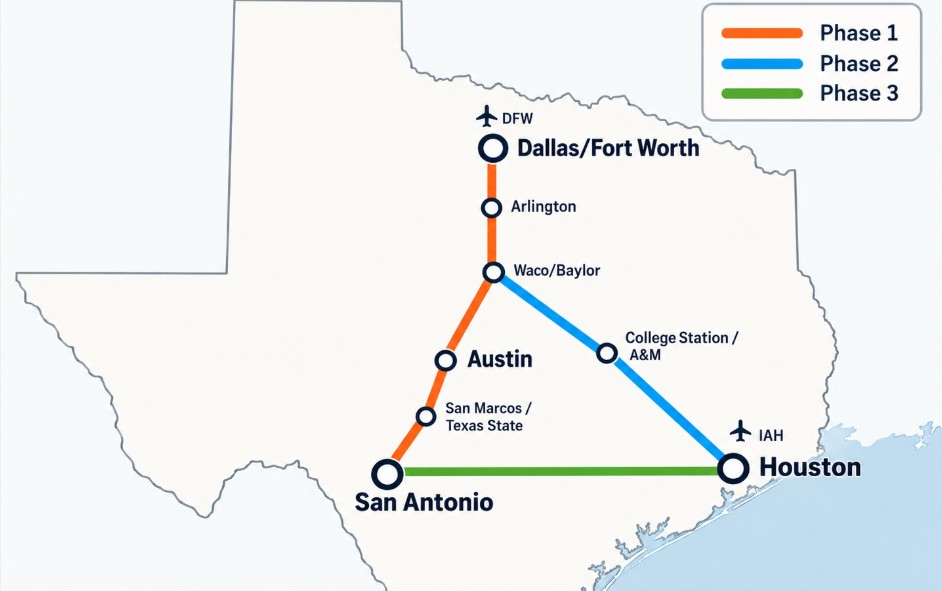
The map now circulating reshapes the concept into a triangle built in three phases. Dallas, Houston and San Antonio anchor the corners. The stops in between are university towns: Baylor in Waco, Texas A&M in College Station, UT in Austin, Texas State in San Marcos. There is also a stop at Arlington’s AT&T Stadium.
Texas has buried this train before. A 1994 plan for a Dallas-Houston-San Antonio triangle collapsed when a French-led consortium couldn’t raise the money. Airlines lobbied hard against it, Southwest in particular, because the trains threatened their short-hop business.
The live project is stuck. The current torchbearer is the Dallas-Houston line first pitched by Texas Central, now operating as Texas High Speed Rail. It would cover 240 miles in under 90 minutes using Japanese Shinkansen technology. On paper the corridor looks ideal: flat, straight and connecting the state’s two largest metros.
The project has had real wins:
- In 2022 the Texas Supreme Court ruled the company qualified as a railroad with eminent domain power.
- In 2023 Amtrak signed on, and the federal government awarded nearly $64 million in planning money.
Then 2025 arrived:
- In April, the Transportation Department terminated the $63.9 million grant. Secretary Sean Duffy said the project had been proposed as a private venture and had leaned on federal dollars as costs ballooned.
- Amtrak walked away.
- The department now puts construction costs above $40 billion. Opponents cite figures as high as $50 billion.
What remains is a single investment group led by Fort Worth’s John Kleinheinz, and a list of approvals not yet in hand.
The hold-ups have names. Much of the friction is land:
- Rural counties. Grimes and Waller counties passed resolutions against the line. Waller County Judge Trey Duhon leads a group called Texans Against High Speed Rail.
- Houston. The company demolished the Northwest Mall for its terminal site. During the pandemic it also bought 41 homes in a Cypress neighborhood that then sat vacant.
- Dallas. The city council opposed an elevated line through downtown. That puts regional planners at risk of repaying up to $7.2 million in federal development money.
- The legislature. Lawmakers heard a bill to bar state and local tax dollars from road work tied to high-speed rail.
Michael Morris, transportation director for the North Central Texas Council of Governments, says the next 18 months will show whether the corridor gets built.
Texans have seen this movie before. The Trans-Texas Corridor, a statewide superhighway-and-rail plan launched under Governor Perry, died in 2009 under landowner backlash. The lesson is that in Texas, a taking for someone else’s enterprise reads as trespass.
Texas already moves the world through the air. In 2025, DFW was the second-busiest airport in the country by total passengers. On international traffic, the leading coastal gateways still pull ahead:
| Airport | International passengers, 2025 |
|---|---|
| JFK (New York) | 34.6 million |
| SFO (San Francisco) | 15.9 million |
| DFW (Dallas-Fort Worth) | 12.7 million |
| IAH (Houston) | 12.4 million |
The Texas pair carries about half the international load of New York and San Francisco combined. DFW’s top international destination is Mexico.
Mexico is building its half of the bridge. President Claudia Sheinbaum made passenger rail a centerpiece of her term. Her plan has three new lines:
- Mexico City to the Felipe Ángeles airport and Pachuca
- Mexico City to Querétaro, Guadalajara and eventually Nogales
- Mexico City through San Luis Potosí and Monterrey to Nuevo Laredo
Federal regulators have already tendered design and construction contracts for sections of the Nuevo Laredo and Nogales lines. The trains are planned as electric with top speeds near 100 mph, with completion targeted before her term ends in 2030. The 2026 federal budget sets aside about 104.6 billion pesos for new passenger trains. That sits on top of the Interoceanic Train, which already crosses the Isthmus of Tehuantepec between the Gulf and the Pacific.
DESIGN
Three corners, three jobs. A triangle works when each anchor does different work, the way a tripod spreads load across three legs.
- Dallas-Fort Worth is the air gate and the northern door. It holds the big airport, American Airlines’ home base, and the route north toward Oklahoma, Kansas City, Chicago and the Canadian prairies.
- Houston is the sea gate. It brings the port, the energy economy and Gulf shipping, plus IAH’s long-haul links to Latin America, Europe and Asia.
- San Antonio is the land gate. Laredo sits about 150 miles south of it, at the point where Mexico’s new line will reach the border.
Close that 150-mile gap and the T-Bone stops being an in-state commuter system. It becomes the American end of a rail corridor that runs to Mexico City and beyond.
The university stops are the ballast. Four major campuses sit along the legs. Students and parents commute and visit. Faculty and labs collaborate across institutions. Alumni flood the line on game weekends. Each campus is a steady ridership generator between the big cities, like water stations spaced along a pipeline that keep the pressure up across the whole run. The AT&T Stadium stop adds event surges on top of that.
Big stations at the anchors. Massive stations at the three corners fit the hub thesis, provided each one is designed for its role:
- DFW and IAH: the stations sit inside the airport circulation, so a passenger can step off a train and check a bag through to Frankfurt or Bogotá.
- San Antonio: the station carries customs and border processing, so international trains clear inspection once and run straight into the Texas network.
- Houston: the station ties into port logistics and the region’s evacuation planning.
The international case. Today Texas handles about half the international arrivals of New York and San Francisco combined. A rail hub grows that number from two directions.
The first is the long corridor. Mexico’s line reaches Nuevo Laredo by the end of the decade, and the Interoceanic Train already links the Gulf and the Pacific. Each extension south through Central America adds riders whose shortest path into the United States ends in San Antonio.
The far ends of the vision run from Panama to Edmonton. To the south, once rail reaches Panama, the one gap left is the Darién, about 60 miles of swamp and jungle. That is a single crossing problem, and solving it opens the way into South America and on toward Argentina. To the north, Edmonton serves as the continent’s upper gate, the way San Antonio serves as Texas’s southern one. Hudson Bay’s Churchill, already reached by rail from Winnipeg, makes a spur for travelers who want polar bears at the end of the line. Each segment pays on its own while the next one is planned.
The second direction is the fly-in traveler. A visitor from Tokyo or Lagos who wants to see the country picks an entry point the way a hiker picks a trailhead, by where the trails go. If high-speed rail fans out from DFW and IAH, landing in Texas becomes the natural start for a rail tour of the continent, much as Frankfurt serves as the gateway to Europe’s rail network. Airlines follow that demand with new long-haul routes, and the gap with the coasts narrows from both ends.
Near-term returns for the state.
- Highway relief. Trains take pressure off I-35 and I-45, two corridors Texans already know as parking lots.
- Energy efficiency. Electric trains between cities beat short-hop flights and solo car trips on energy per passenger.
- Evacuation capacity. In 2005, the Hurricane Rita evacuation out of Houston jammed highways for many hours. A rail line that can run evacuation trains adds a second exit.
- Logistics. Supporters made the same argument back in 2009: fast rail can move personnel and equipment to the Port of Houston in an emergency.
INTERVENE
If I were king of Texas, the playbook would aim at the reasons this keeps dying.
1. Take the fight out of the land question. Put the right-of-way under a public or public-private state authority, so the power to acquire land rests with the state rather than a private company. Where possible, route along corridors the state already controls, such as highway medians and toll-road edges. Brightline did this in Florida, running its Orlando extension along a state expressway. A few miles of extra curve cost less than another decade of litigation.
2. Pay landowners the way Texas pays for pipelines. Rural Texans understand easements that pay annual rent. Offer annual lease payments with an inflation escalator alongside a purchase price, so a family farm keeps earning from the strip the train crosses. People fight a taking. They negotiate a lease.
3. Start talks with Mexico now. Mexico’s Nuevo Laredo line has a target date. The Laredo-to-San Antonio link and the border station need a binational working group running in parallel, so the two systems meet at the river instead of stopping short of each other. The same table can open the longer conversations with Central America and Canada.
4. Make the airlines partners. The 2009 coalition got Southwest to neutral by routing trains to airports. Push that further:
- Code-share tickets, so a train leg can be booked like a flight leg
- Checked bags that transfer between train and plane
- Rail passes sold alongside international flights into DFW and IAH
- Rail as the regional feeder that frees gates for long-haul flights
An airline that sells the ticket stops lobbying against the train.
5. Pay for it with what the stations create. Land near a high-speed station climbs in value. Capture part of that rise through station-district development rights and lease revenue to service construction debt. The Northwest Mall site is a ready-made test bed.
6. Build in phases, and finish each one. The circulating map already sequences the work. The rule that matters is completion. A finished 90-minute Dallas-Houston run, carrying riders and posting numbers, will do more to win the next phase than another decade of announcements.
Texas has argued about this train for longer than some of the students at its future college stops have been alive. Meanwhile the country to its south is pouring concrete. The geography that would make Texas the junction of the hemisphere is already in place, so the open question is whether Texas builds the line before someone else becomes the hub.
Sources
- NBC DFW, “Is High Speed Rail Back on Track in Texas” — https://www.nbcdfw.com/news/local/Is-High-Speed-Rail-Back-on-Track-in-Texas.html
- Off the Kuff, “A SUPERTRAIN for Texas?” and “More on the SUPERTRAIN” — https://offthekuff.com/wp/?p=17910 ; https://www.offthekuff.com/wp/?p=18709
- Fort Worth Weekly, T-Bone coverage — https://www.fwweekly.com/?p=4517
- GovTech, “Is a High-Speed Rail Line Right for Texas?” — https://www.govtech.com/fs/transportation/Is-a-High-Speed-Rail-Line-Right-for-Texas.html
- KPRC Click2Houston, “What happened to the Houston-Dallas high-speed rail project?” (Sept. 2026) — https://www.click2houston.com/news/local/2026/09/18/texas-high-speed-rail-still-stalled-after-two-decades-of-promises/
- Federal Railroad Administration press release, April 14, 2025 — https://railroads.dot.gov/sites/fra.dot.gov/files/2025-04/4.14.2025%20FRA%20Texas%20HSR%20and%20Amtrak%20Press%20Release.pdf
- KUT, “Houston-to-Dallas high-speed rail loses $64 million grant” — https://www.kut.org/transportation/2025-04-15/houston-to-dallas-high-speed-rail-loses-64-million-grant-as-part-of-federal-cuts
- KBTX, “Public testimony reveals new details on Houston-Dallas high-speed rail project” — https://www.kbtx.com/2025/04/01/public-testimony-reveals-new-details-houston-dallas-high-speed-rail-project/
- Fort Worth Report, “Is high-speed rail dead?” (May 2026) — https://fortworthreport.org/2026/05/17/is-high-speed-rail-dead-transportation-officials-to-negotiate-with-dallas-on-rail-route/
- Texas Tribune, Dallas-Houston high-speed rail (2022) — https://www.texastribune.org/2022/08/30/texas-high-speed-rail-dallas-houston
- Miami International Airport, 2025 US and Worldwide Rankings — https://www.miami-airport.com/library/pdfdoc/Cargo%20Documents/2025%20Rankings%20-%20US%20and%20Worldwide.pdf
- Spectrum News, “DFW ranked 6th busiest in the world” — https://spectrumlocalnews.com/tx/south-texas-el-paso/news/2026/02/17/dallas-fort-worth-airport-ranked-6th-busiest-in-the-world
- U.S. International Trade Administration, “Mexico Passenger Rail” — https://www.trade.gov/market-intelligence/mexico-passenger-rail
- Riviera Maya News, “Sheinbaum Names Gulf of Mexico Train” — https://www.rivieramayanews.mx/president-sheinbaum-announces-gulf-of-mexico-train-name-and-new-national-projects/
- KOLD, “Excitement builds for proposed passenger train from Nogales to Mexico City” — https://www.kold.com/2024/12/05/excitement-builds-proposed-passenger-train-nogales-mexico-city/
- Mexico News Daily, passenger rail coverage — https://mexiconewsdaily.com/?p=362141