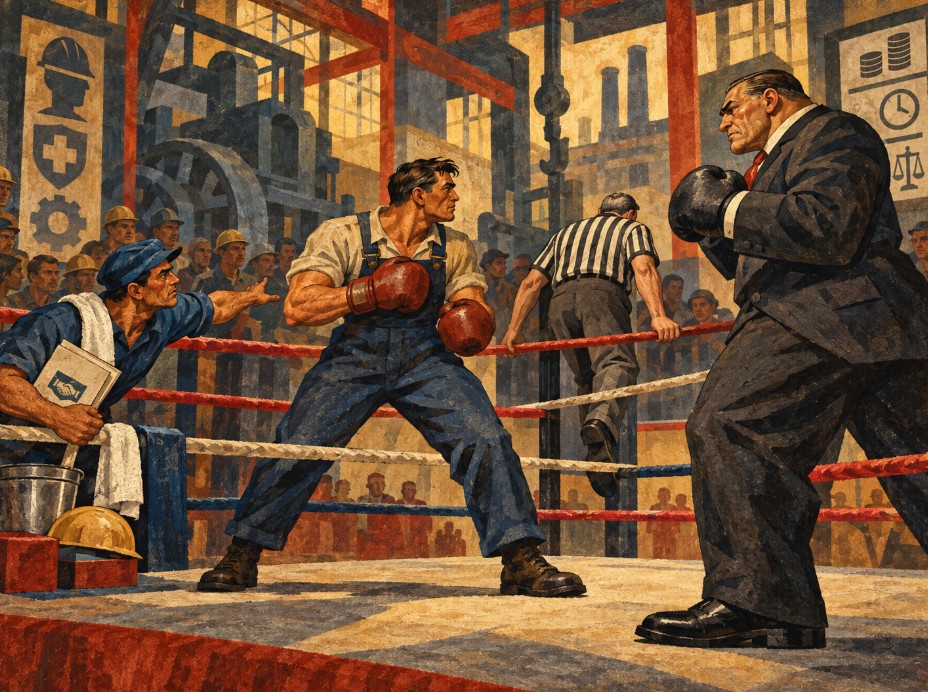
When I boxed Golden Gloves, the smallest man in the ring was the referee. He didn’t throw punches and he didn’t pick the winner. He stood close enough to see a low blow and stepped in before it became a habit. Take him out and you still have two fighters and a bell. What you don’t have is a fair fight.
On October 15, Labor Solicitor Jonathan Berry spoke to a room of labor lawyers at NYU. He said the Department of Labor will generally keep its enforcement attorneys out of workplaces covered by union contracts. That covers wage-and-hour, child labor, and workplace safety. The reasoning is that if there’s a contract and a grievance procedure, the union and the contract can handle it. He’d already sent that instruction to the regional attorneys earlier this year. There are two exceptions. One is credible evidence that the union isn’t fairly representing its members. The other is a case where the contract’s remedies aren’t enough.
The National Labor Relations Board is moving the same way. In February its General Counsel told regional offices to settle unfair labor practice cases and drop the stronger remedies. She also told them to pursue only workplace rules that are plainly unlawful on their face. Two agencies, one direction, one year.
I’ve been a shop steward a long time. So let me walk you through what a union contract does, and what it was built to do.
Two toolboxes
A contract is a deal between an employer and a union. A statute is a law Congress passed, and it covers the worker whether anybody bargained for it or not. Minimum wage. Overtime. Keeping a fourteen-year-old away from a punch press. A guard on the saw blade. Those laws came first, and they belong to the worker the way his name does.
In 1981 the Supreme Court looked at a group of truck drivers who lost a grievance at arbitration. The Court said they could still bring their wage claim under the Fair Labor Standards Act, because a statutory right stands on its own. Contract rights and statutory rights are two toolboxes. Both may ride in the same truck, but you can’t turn a metric bolt with a standard wrench.
How a grievance moves
A grievance runs on steps and deadlines, and some of those deadlines are counted in days. Your steward is handling it on top of a full shift of his own work. If it reaches arbitration, the union and the employer usually split the arbitrator’s bill. So the union has to decide which fights it can afford to fund.
The law gives the union a lot of room in that decision. A union breaks its duty of fair representation only when its conduct is arbitrary, discriminatory, or in bad faith. A union can drop your grievance on poor judgment and still be inside the line. That makes Mr. Berry’s exception a door with a high threshold, and the worker has to prove his way over it.
The ground under the worker
Early in my working life, a foreman knew the contract and a good part of the law. He had to, because he was the one who’d answer for it. Then the companies moved Human Resources to a regional office or a call center. Today’s floor supervisor learned the rules from a slide deck, if he learned them at all. When a question comes up, he calls HR.
HR reads the rule the narrowest way it can be read. That’s the job. HR manages the company’s human resources, meaning cost, risk, and exposure, and its client is the company. I don’t hold it against them, any more than I’d blame a catcher for catching. But no one on that phone call is assigned to the worker’s side of the plate.
Then there’s the union, and I say this as a man who loves his. A local is made of people, and people run for office. There are elections, slates, and favors owed. A grievance from a member who backed the losing slate can sit on a desk a while. Even the good steward is a working man without a law degree, sitting across from company counsel. He’s the corner man. A good corner man can win you a fight from the stool, but the rules keep him out of the ring.
When the union can’t carry it, the worker carries it himself. He hires a lawyer, fronts the costs, loses the hours, and waits years. Some of these laws let a winning worker recover his attorney’s fees. He still has to survive long enough to win.
What it already costs
Let me tell you about a man I know. He’s a veteran and a federal employee, sharp, the kind who reads regulations the way other men read box scores. The hiring law was on his side in writing, and so was his veterans’ preference. He spent years and his savings trying to get the government to place him where its own rules said he belonged. He came close to going broke over it, and that was with the enforcement agencies still on the job.
If a man with the law, the uniform, and the watchdogs behind him can be pushed that close to the edge over basic hiring rights, think about the warehouse picker whose watchdog has been told to look elsewhere.
Why it reaches past the shop
A labor market is a game with rules, and the rules are what let a good worker and a good employer find each other. The boss who shorts overtime sells his product cheaper than the boss who pays it. Every week that goes unenforced, the honest employer falls further behind the cheater. Enforcement protects the decent employer as much as the worker. And wages are what working people spend at the hardware store, the diner, and the car lot. A paycheck that gets skimmed is money that never reaches Main Street.
I’m asking for more from the referee. Stand closer. Step in sooner. Make the low blow cost something, so the next fighter thinks twice before throwing it.
Until then
Keep your own records: hours, pay stubs, dates, names. Know which of your rights come from the contract and which come from the law. A statutory complaint to Wage and Hour or to OSHA is still yours to file. The department has said it will steer away from union shops, and its authority over them stays on the books. File the grievance and the complaint, side by side.
My old man was a porter. He used to say, “We carried other folks’ baggage, son, but never their shame.” A worker shouldn’t have to carry his own case alone either.
Measure twice, act once. Now you know, Jack.