The Brusentsov Drive and the Return of Ternary Computing
An extension of Multi-Dimensional Signal Computing (February 12, 2026)
Abstract
Modern computers run on two answers: on and off, one and zero. That choice gave us cheap, reliable machines that scaled across the planet. It also pushes each decision through a gate with two exits. When the evidence sits between them, the machine picks one anyway, and some of those picks come out as false positives and false negatives.
This paper proposes the Brusentsov Drive, a computing architecture built on semiconductor chips with three states instead of two: on, off, and R, a third state that tells the system to go find an analog answer. The idea has a history. Nikolay Brusentsov built a working three-state computer at Moscow State University in 1958 and spent the rest of his life arguing that ternary was the better foundation for computing. Transistors reported in the last two years suggest the hardware may finally be catching up to his math.
This paper claims no finished device and no measured performance advantage. It lays out the architecture, the history behind it, and the experiments that would test it.
1. The Man Who Carried the Third Answer
In the mid-1950s, Nikolay Brusentsov was working under mathematician Sergei Sobolev at Moscow State University, experimenting with ferrite cores, the small magnetic rings computers of that era used for logic and memory. He found that two cores wired together the right way could hold three stable states instead of two. On January 7, 1956, the team presented the concept of a balanced ternary machine. By 1958 they had built one.
They named it Setun, after a river that runs through Moscow. It used balanced ternary, a number system with three values, −1, 0, and +1, and it supported three-valued logic in the tradition of Polish logician Jan Łukasiewicz, whose system carried true, false, and unknown. During official testing, Setun ran for three weeks without a failure, a strong showing for a late-1950s machine. Its operating memory held 81 words of 18 trits each. The Kazan Mathematical Plant built about fifty of them, and Setun went on to teach computational mathematics at more than thirty universities.
Then the institution moved on. Between 1965 and 1970, Moscow State replaced Setun with a conventional binary computer. The replacement performed about the same and cost two and a half times as much.
Brusentsov kept going. Between 1961 and 1968, he and Evgeny Zhogolev developed Setun-70, which introduced the tryte, a group of six trits encoding one of 729 values, about 9.5 bits of information. Brusentsov reported that Setun-70 cut programming time five- to tenfold. After the project, his lab was moved out of the university’s computer center into an attic in a student dormitory, and the original Setun prototype was destroyed.
In the 1980s, he and his doctoral students built the Dialogue System of Structured Programming, which emulated the Setun-70 architecture on binary computers. He kept his ternary machine alive inside the machines that had displaced it. Until his death in 2014, he ran a dedicated lab and kept looking, without success, for funding to build new base-3 processors.
Donald Knuth later described balanced ternary as possibly the prettiest number system of them all. Brusentsov built a machine on it, watched that machine get hauled off, and spent close to sixty years insisting he was right. This paper names its architecture the Brusentsov Drive in his honor. He carried the third answer his whole life. The people picking it up now owe him the name on the door.
2. Why Binary Won
The math has favored three for a long time. A measure called radix economy weighs how many digits a number system needs against how many states each digit has to hold. The ideal base works out to e, about 2.718, and the whole number closest to it is 3.
Binary won on hardware. A switch that only has to tell high from low can tolerate sloppy voltages, the same way telling day from night takes less effort than telling late afternoon from early evening. Two-state parts were cheap, forgiving of noise, and easy to manufacture. Once factories, design tools, programming languages, and training programs were built around binary, the momentum carried the field. Setun’s cost advantage was real, and it lost anyway.
Two things have changed since then. Researchers are now building transistors with a stable, native middle state rather than coaxing a third state out of extra parts. And the traditional path to faster computing, shrinking transistors, keeps getting harder and more expensive. When you can’t keep making the bricks smaller, packing more information into each brick starts to look attractive.
3. Three States
The Brusentsov Drive uses three states. This paper labels them 1, 0, and R. Brusentsov’s notation used +, −, and 0, so the labels line up this way:
| This paper | Setun notation | Meaning |
|---|---|---|
| 1 | + (+1) | On / yes |
| 0 | − (−1) | Off / no |
| R | 0 | Go find the analog answer |
R is a working state with a job. It tells the system the question can’t be settled with a plain yes or no, and it hands the question to a stage that can look for a graded answer. R covers two cases:
- In between. The answer is a magnitude, such as 0.6 rather than 0 or 1.
- Non sequitur. The question doesn’t apply to the input.
The analog stage receiving an R sorts out which case it’s holding.
Brusentsov’s ordering gives clean rules for logic. Put the states in order from 0 to R to 1. AND takes the lower of its inputs, OR takes the higher, and NOT flips 1 and 0 while leaving R in place:
- 1 AND R = R
- 0 AND R = 0
- 1 OR R = 1
- 0 OR R = R
- NOT R = R
A yes combined with a maybe stays a maybe. A no combined with a maybe is still a no, since one failed condition is enough to fail an AND.
The same trits do arithmetic. In balanced ternary, flipping a number from positive to negative means swapping each + for − and back, with no separate sign bit needed. Rounding happens by dropping digits. Brusentsov chose the system partly for these traits, and they carry over to the Brusentsov Drive without modification.
4. The Math of a Third State
A binary device holds one of two states. A ternary device holds one of three. The gap grows fast as devices are combined:
| Devices | Binary combinations | Ternary combinations |
|---|---|---|
| 1 | 2 | 3 |
| 4 | 16 | 81 |
| 6 | 64 | 729 |
| 10 | 1,024 | 59,049 |
| 20 | 1,048,576 | 3,486,784,401 |
Each trit carries about 1.585 bits of information, roughly 58.5 percent more than a single binary digit.
The Brusentsov Drive proposes a four-trit group as a basic working unit, holding 81 combinations. It sits alongside Setun-70’s six-trit tryte as a smaller building block, the way a nibble sits beside a byte in binary. Grouped units are where the opportunity for a richer machine vocabulary begins.
More information per device does not translate one-for-one into speed. A ternary circuit has to keep three states distinct under electrical noise, and the extra detection work costs energy and space. Multilevel flash memory already stores more than two states per cell, so storage density alone isn’t new. The open question is whether practical ternary logic can do useful work with fewer parts, fewer connections, or less energy than binary, after paying those costs.
5. Fewer Forced Errors
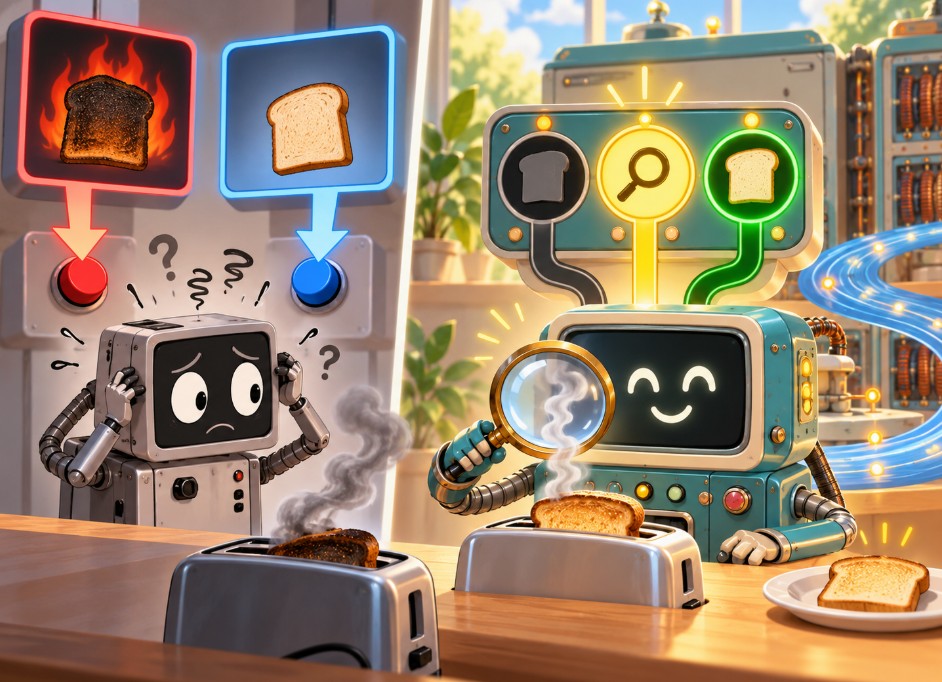
Picture a smoke detector that can only scream or stay silent. Burnt toast and a real fire both push it toward the same decision, and it has to commit. Set it too sensitive, and it screams at toast. Set it too lenient, and it misses the fire.
Give it a third answer, and the faint reading can come back as R: something is there, it doesn’t clear the bar for yes or no, go check. The system can consult a second sensor, take another reading, or wait a few seconds for the picture to clear.
Binary computers can already handle uncertainty in software. Programs track probabilities and confidence scores, and a field called selective classification studies systems that decline to answer when the evidence is weak. The trouble is that at the decision point, the uncertainty usually gets squeezed into a yes or no. The Brusentsov Drive proposes keeping that uncertainty as a native hardware state, so it passes through later operations intact instead of being rounded off at the first gate.
The test needs to be honest. A system that marks hard cases as R and then reports accuracy on only the easy ones will look better than it is. Measurement has to include the false positive rate, the false negative rate, the share of cases sent to R, how accurately those R cases get resolved later, and the time and energy that resolution costs. The goal is fewer costly mistakes across the whole process.
6. The Architecture Already in Your Computer
Partial versions of this idea already ship in conventional chips.
Tri-state buffers use three output conditions: 0, 1, and Z, known as high impedance. Z effectively disconnects a chip from a shared wire, so several chips can take turns on the same line without shouting over one another. The chips on the bus speak binary, and Z lets each one step aside.
Verilog, a language engineers use to design and simulate chips, tracks four values: 0, 1, X for unknown, and Z for disconnected. X lines up with the Brusentsov Drive’s R. Z lines up with a hardware fault, a line carrying no valid signal.
These examples show that engineers already found a need for a third and fourth condition. They also show the limits. Z lives in bus management, and X mostly lives in simulation, where it flags problems before a chip is built. The Brusentsov Drive moves the unknown state into working logic and arithmetic, and it keeps a genuine fault separate from R. A broken wire and an honest maybe are different things, and the system needs to tell them apart.
7. The Hardware Catching Up
Brusentsov had to build each trit out of paired magnetic cores. Researchers are now building the middle state into a single semiconductor transistor.
In 2025, Park and Lim reported in Small Structures a transistor with an oxide channel and a dual-gate design that holds three logic states, off, intermediate, and on, using electron tunneling between the gate and source. Their design drops the barrier junction that earlier multi-state transistors needed, aiming for a simpler structure closer to standard chipmaking.
In June 2026, Lee and colleagues reported in Nature Communications a ternary transistor with three states in a single device: off, on, and an adjustable intermediate state. The team built a ternary inverter that could run three standard types of ternary inverter from one transistor configuration.
Devices like these are early laboratory work and a long way from a full processor. They show the core building block of the Brusentsov Drive, a stable native middle state in one transistor, moving from theory onto the lab bench.
8. First Experiments
The Brusentsov Drive can be tested before anyone builds a new computer.
Experiment One: Emulated Ternary Logic. Brusentsov’s own lab emulated Setun-70 on binary machines. The same approach works today on programmable logic chips. Build the 1/0/R logic, run it on decision tasks, and compare it against a binary system with the same ability to defer an answer. Measure false positives, false negatives, R rates, resolution accuracy, time, and energy.
Experiment Two: The Physical Trit. Test available three-state transistors for how cleanly their states separate, how fast they switch, how much power they draw, and how stable they hold under noise.
Experiment Three: Small Ternary Circuits. Build basic circuits from physical trits, such as an adder and a three-state decision gate, and compare their part count, speed, and energy use against binary circuits doing the same job.
Each comparison has to run against a well-designed binary system given the same information and the same option to defer. Otherwise an apparent win may come from a smarter decision policy rather than from the hardware.
9. Conclusion
Brusentsov built a three-state computer that worked, cost less than its binary replacement, and taught a generation of students. It lost on manufacturing momentum and institutional preference. He spent the rest of his life saying the third answer belonged in the machine, and he died before the hardware showed up to back him.
The Brusentsov Drive picks up his foundation: balanced ternary, three-valued logic, and grouped trits as working units. It adds R as an instruction to go find the analog answer, and it proposes measuring whether that third state cuts down the forced errors binary systems make when the evidence sits in the middle.
None of this is proven yet. The math is on Brusentsov’s side, and the transistors are getting closer. The work now is building the experiments that settle whether he was right about the machine as well as the numbers.
Working status: Architectural proposal. No integrated device or experimental performance advantage is claimed. Published openly for technical development, criticism, and testing.
Sources
- Park, C., and Lim, J. W. (2025). Light-Induced Radix Modulation and Optoelectronic Synaptic Properties in Ternary-Logic Devices. Small Structures, 6(6). https://doi.org/10.1002/sstr.202400530
- Lee, C., et al. (2026). A light-driven multi-state heterojunction transistor for optoelectronic ternary logic circuits. Nature Communications. https://www.ncbi.nlm.nih.gov/pmc/articles/PMC13434661/
- Setun. Wikipedia. https://en.wikipedia.org/wiki/Setun
- Setun-70. Wikipedia. https://en.wikipedia.org/wiki/Setun-70
- Setun, the “forbidden” Soviet computer that challenged binary logic. CloudNews. https://cloudnews.tech/?p=28855
- The Balanced Ternary Machines of Soviet Russia. DEV Community. https://dev.to/buntine/the-balanced-ternary-machines-of-soviet-russia
- Gangrade, A., Kag, A., and Saligrama, V. (2021). Selective Classification via One-Sided Prediction. Proceedings of AISTATS.