Here’s a thought experiment, and a feminist one.
A lot of the conversation about the next generation of Democrats centers on the technocrat: the Pete Buttigieg model, the mayor who shows up, studies the problem, and fixes it. That appetite tells us something. Americans still want competent people running things. So it’s fair to ask what happened the last time we had that kind of candidate at the top of a ticket, with more preparation than anyone in modern memory.
Hillary Clinton spent her adult life training for the presidency, the way a surgeon trains for the operating room. Law school, children’s advocacy, eight years watching the job from inside the White House, a Senate seat, and four years running American diplomacy as Secretary of State. By 2016 she knew where the levers of the federal government were and what each one was wired to. She was a technocrat with a mind of her own, and she was ready to be the first woman to hold the office.
She lost it, in part, to her marriage. She married a fellow giant, and that partnership hung decades of baggage on her: the scandals, the dynasty talk, the sense that a vote for her was a vote for the whole Clinton story. People argue endlessly about the reasons she lost. Set the arguments aside for a minute and ask a different question.
What could we have had?
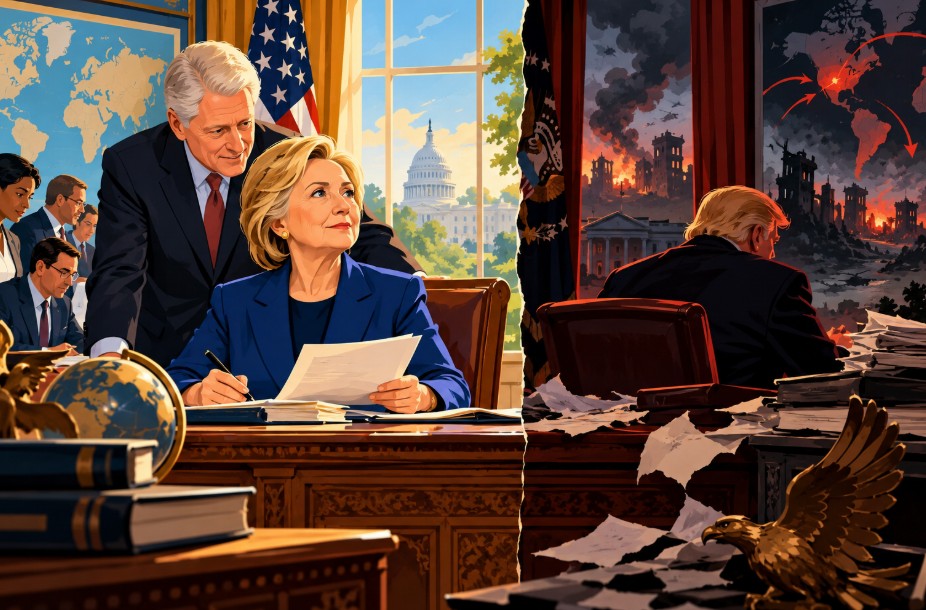
Start with what the marriage would have brought into the building. Bill Clinton was a wildly successful president, if a less successful husband. Under a President Hillary Clinton, he’d have been down the hall: a two-term president with a working knowledge of Congress, foreign leaders, and the economy, available for counsel whenever she wanted it, and probably more often than she wanted it. The same marriage that cost her votes would have given her an advisor no president has had.
Then think about what she would have been building on. From the mid-nineties forward, through her husband’s administration and Obama’s, the country had been developing the systems that grew it: agencies, programs, professional staff, alliances overseas. Think of a house that had spent twenty years getting new wiring and plumbing. In 2016 we had the chance to hand it to the contractor who held the original blueprints and knew where each pipe ran. We handed it to a crew that started pulling out walls.
Foreign policy is where the gap shows most clearly. Clinton was a hawk and a firm friend of Israel, and no dove by anyone’s measure. She was also the Secretary of State who built the international sanctions coalition that brought Iran to the negotiating table, and she backed the nuclear deal that came out of it. She understood the deal was the containment. It’s hard to picture Benjamin Netanyahu talking her into a bombing run on Iran. The idea was too reckless, and the agreement she helped build had made it unnecessary. In her timeline, we could be building a better modern world while, in ours, we’ve been busy blowing up more of the ancient one.
So why didn’t we get her? America’s sexism hurt us in that election. Researchers who studied the 2016 vote found that sexist attitudes moved votes about as much as racial resentment did, trailing only party loyalty. A woman with a lifetime of preparation ran against a man with none, and a share of voters couldn’t picture her in the chair. Eight years later, we did a version of it again with Kamala Harris, a giant in her own right whose vote was suppressed for the same reasons and with more direct racial resentment since Hillary was just getting blowback from racists who became Republicans because Obama was black.
The promise of democracy over kings and strongmen was a chance to choose the most capable people available and put them to work for the rest of us. Whatever else drives our elections, that promise falls apart when we vote with our emotions and our favorite team, the way a fan picks a jersey.
We have to get back to electing smart people who want to do good things for our communities.
Please consider the world we could have when you vote.