A 1937 Packard 120, and what it takes to make one now
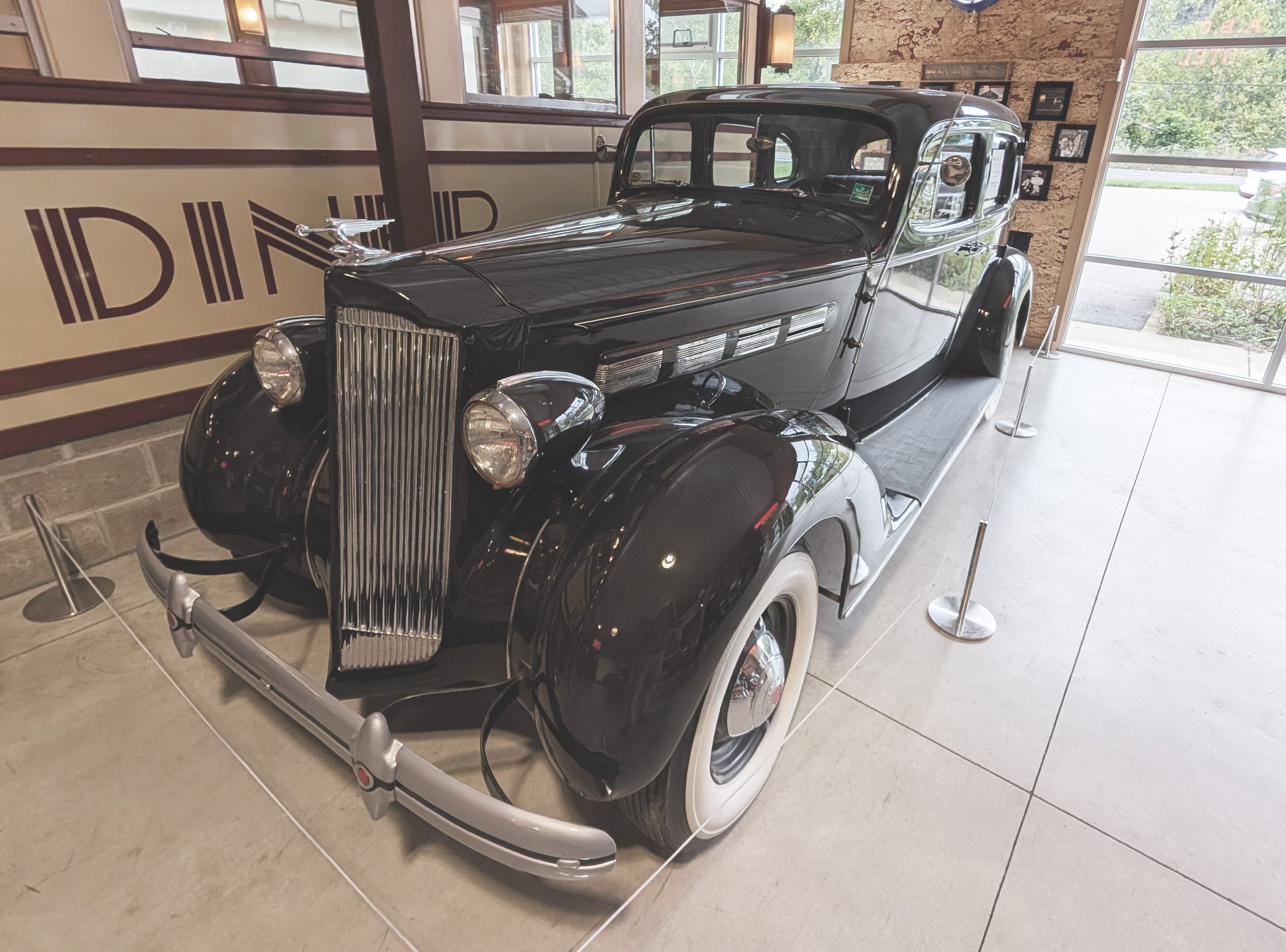
In a glass-walled room on Route 30, a black sedan sits on jack stands next to a restored 1938 dining car. A white card in the rear window asks visitors not to touch the 1937 Packard 120, donated by Jeff and Laurel Evans and kept up by volunteers. The room belongs to the Lincoln Highway Experience, and the pairing makes sense. In 1913, Packard president Henry Joy and Indianapolis promoter Carl Fisher started stitching existing roads into the country’s first coast-to-coast highway. Two decades later, Joy’s company was selling cars like this one to the families driving it.
Packard’s slogan was “Ask the man who owns one.” For this piece the better question is what it would take to build one.
What You’re Looking At
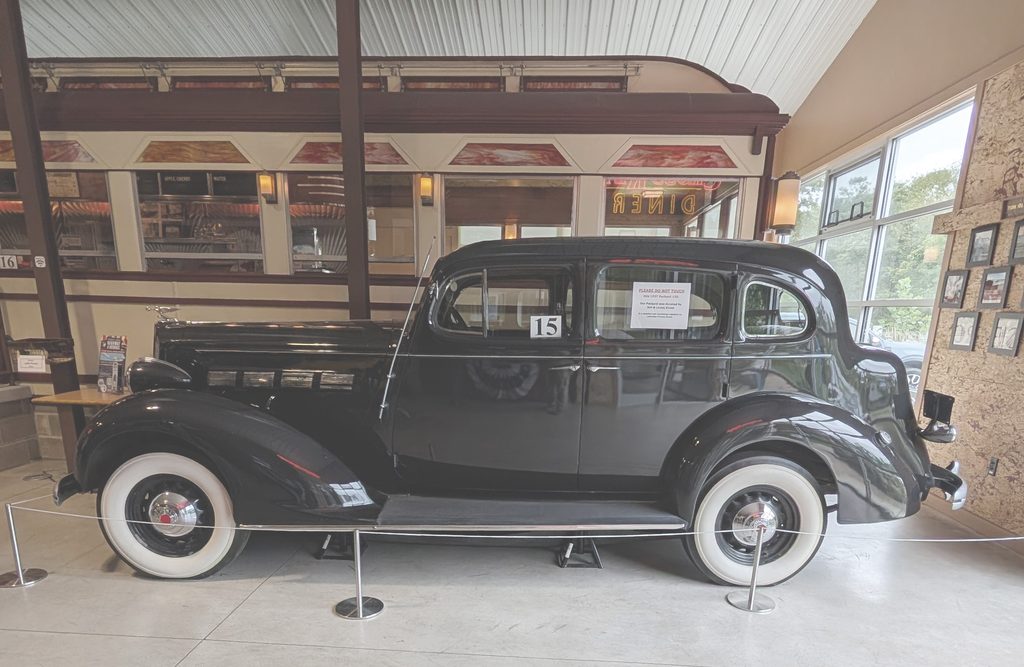
This is a Fifteenth Series One-Twenty touring sedan. Packard catalogued the body as type 1092. “Touring sedan” meant a built-in trunk bulging off the back, so luggage rode inside the bodywork instead of strapped to a rack. You can see that bustle in the side view, where the roofline drops into a rounded tail.
The doors open from the center pillar. The front doors hinge at the front and the rear doors hinge at the back, so the two handles meet in the middle. The windshield is two flat panes set in a shallow V, because curved safety glass was still expensive in 1937. Four chrome hood vents run along each side of the long nose. On top of the radiator shell sits Packard’s cormorant ornament, wings swept back.
The grille is the tall vertical-bar shield Packard used for decades. Its shoulders have the ox-yoke shape that let people identify a Packard from a block away. Look at the bumper guards and hubcap centers and you’ll find small red hexagons, the company’s other badge. The jack stands hold the car’s weight off its whitewall tires so the rubber doesn’t flatten while it sits on display.
The Frame and the Long Nose
Under the body is a steel ladder frame on a 120-inch wheelbase. The model takes its name from that measurement. Two channel-steel rails run front to back, and an X-shaped cross member ties them together under the passenger compartment. Without the X, the frame would twist like a picture frame missing its glass whenever one front wheel hit a pothole. With it, twisting loads cross diagonally from corner to corner. The body bolts on top and rides along, carrying very little structural load.
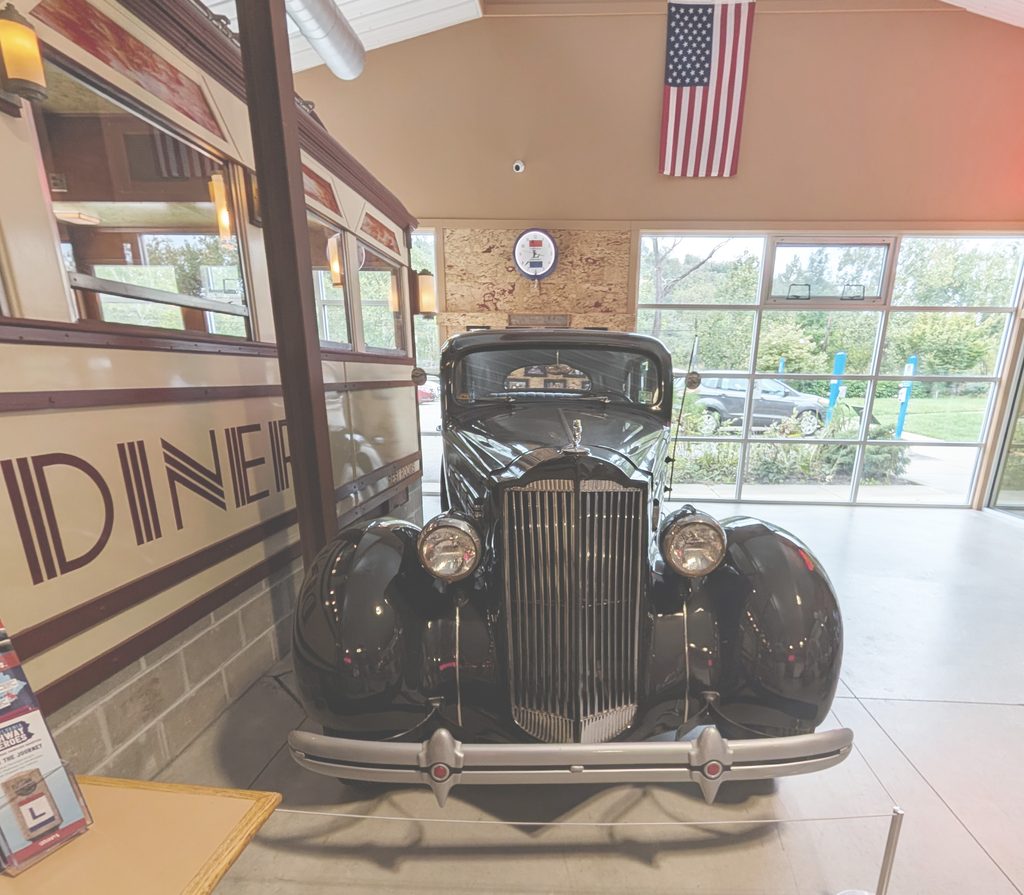
The long hood follows from the engine underneath it. An inline eight puts eight cylinders in a single row. That layout runs very smoothly, because the forces from each piston cancel out along the crankshaft. The trade-off is length, so the passengers sit well behind the front axle.
The Engine
The engine is a 282-cubic-inch L-head straight eight, rated at 120 horsepower at 3,800 rpm and about 250 lb-ft of torque at 2,000 rpm. In an L-head, or flathead, the valves sit in the block beside the cylinders, facing up, instead of in the cylinder head. That makes the head a simple flat lid. It’s cheap to cast and easy to service, though the air-fuel mixture has to take a detour to reach the cylinder, which limits compression. Packard cast the head in aluminum. Aluminum carries heat away faster than iron, so the engine could run a little more compression without knocking.
Packard’s senior eights ran their crankshafts on nine main bearings. The 120 used five. A long crankshaft flexes between its supports the way a long shelf sags between brackets, so fewer bearings meant more flex and more wear over time. It also meant fewer machined surfaces, fewer bearing caps, and fewer hours on the line. That one decision tells you a good deal about how this car was priced.
Safe-T-Flex
The 120 was the first Packard with independent front suspension. Packard called it Safe-T-Flex, and its load paths are easy to trace. A heavy forged support arm reaches from the wheel almost to the car’s centerline, and a coil spring sits in a pad on that arm. The arm carries the car’s weight. A lighter tubular torque arm bolts to it and runs back to the frame near the dashboard, ending in a rubber bearing. When you brake hard, the front wheels try to twist backward, and the torque arm carries that twist into the frame. A smaller upper arm keeps the wheel upright, which controls camber.
Splitting the work this way gave each arm one job. The wide lower arm held wheel alignment well, and the caster angle was fixed at the factory, so it couldn’t drift. Before this design, a front axle was a single solid beam, and a bump under one wheel tipped the other.
The 120 also had hydraulic drum brakes. Fluid pressure spread braking force evenly across all four wheels, while older mechanical systems used rods and cables that stretched and needed adjustment. Packard’s expensive senior cars got both features later than the cheaper 120 did.
How a Luxury Brand Survived by Selling Cheaper
When the Depression hit, the market for $3,000 cars shrank like a pond in August. Packard first tried to move downmarket in 1932 with the Light Eight. It cost nearly as much to build as a full-size Packard and was dropped after a year. Company president Alvan Macauley then hired production people from General Motors, led by George T. Christopher, who knew how to build cars in volume. Packard put about $6 million into tooling and marketing for a new mid-priced eight and set up production to suit it.
The 120 went on sale in January 1935. That year Packard built 24,995 of them, against about 7,000 of its other models combined. Production rose to 55,042 in 1936. For 1937 Packard added an even cheaper Six below the 120, and this car’s model year ran to 50,100 units. Packard built 122,593 cars in 1937, its biggest year to that point.
The cost showed up later. Once a Packard could be bought for about the price of a Buick, the name carried less weight at the country club. Packard historians still argue over whether the 120 saved the company or started its slide. Both arguments can be true.
What It Cost in 1937
A 1937 120 cost roughly $1,150 to $1,600 at the dealer. The coupes and sedans sat near the bottom of that range and the convertible sedan at the top. A touring sedan like this one landed around $1,200. In 2026 dollars, that’s about $26,000 to $28,000, close to the price of a midsize sedan on a lot today.
Packard could charge that because it spread its tooling bill across a lot of cars. Divide the $6 million tooling and launch budget across the roughly 130,000 One-Twentys built from 1935 to 1937, and each car carried about $46 of it. A steel fender came out of a stamping press in seconds.
What It Would Cost to Build One Today
Build one in a shop now and that math runs backwards. There are no dies, so the one car has to absorb all of the setup work by hand. Here’s a rough breakdown, assuming a skilled shop billing $100 to $150 an hour and the goal of a correct car instead of a lookalike:
- Documentation and patterns. Scanning and measuring a surviving car, drawing the parts, and building wooden bucks to shape panels over: 400 to 600 hours.
- Frame. Channel rails, X-member, crossmembers, riveted and drilled to match: 150 to 250 hours plus steel.
- Body. Roof, turret, doors, fenders, hood, and trunk bustle, hand-formed in steel on an English wheel and power hammer. Small panels can take a full day each, and the left and right sides have to mirror each other: 2,500 to 4,000 hours.
- Engine. A new straight eight means new foundry patterns, a one-off block and head casting, and machining. A surviving engine core, rebuilt, is the practical route at $20,000 to $40,000. A truly new engine from patterns could run $100,000 or more.
- Suspension and running gear. The forged support arms would be machined from solid billet, since a one-off forging die makes no sense: $10,000 to $25,000.
- Grille, bumpers, trim, and plating. Dozens of vertical grille bars, the cormorant, and the hubcaps, made or reproduced and then plated: $20,000 to $40,000.
- Paint. Black shows every ripple in the metal underneath it, so the prep runs long: 300 to 500 hours.
- Glass, rubber, wiring, gauges, and upholstery: $25,000 to $50,000.
- Final assembly and sorting: 300 to 500 hours.
Add it up and you get roughly 4,000 to 6,500 shop hours and $100,000 to $250,000 in parts, materials, and outside work. That puts a new 1937 Packard 120 somewhere between $500,000 and $1.2 million. The range lines up with what the restoration trade quotes for top-level work: a full concours restoration commonly runs 4,000 to 5,000 hours and $500,000 or more, and that’s starting from a car that already exists.
A good restored 120 sells for about $24,000 to $39,000. The car on the museum floor cost a family around $1,200 in 1937, would cost a shop around three-quarters of a million dollars to build in 2026, and would trade for about the price of a used pickup. The difference between those numbers is the factory. Fifty thousand people buying the same car paid for the dies, and the dies made a hand-built car affordable.
The diner beside it tells the same story. Serro’s was a factory-built dining car in 1938, and its restoration cost about $500,000 in federal highway money. Mass production made both of them cheap once. Bringing them back is hand work.
Sources
- Wikipedia, “Packard One-Twenty” (citing Kimes, Standard Catalog of American Cars 1805–1942): https://en.wikipedia.org/wiki/Packard_One-Twenty
- Conceptcarz, 1937 Packard One Twenty specifications and prices: https://www.conceptcarz.com/s9543/Packard-120.aspx
- Shannons auction notes, 1937 Packard 120C: https://auctions.shannons.com.au/auctions/2013-shannons-melbourne-summer-classic-auction/GFQ26DX24CY09RYD/
- Christie’s lot notes on George T. Christopher and the 120: https://www.christies.com.cn/lot/lot-1850329
- Supercars.net, 1935 Packard 120 ($6M tooling): https://supercars.net/blog/1935-packard-one-twenty-model-120/
- America’s Packard Museum specifications via diecast.org: https://diecast.org/community/lounge/americas-packard-museum-2023-part-3/
- Detroit Public Library, Packard file photo (body type 1092): https://digitalcollections.detroitpubliclibrary.org/eb01e009
- TribLIVE, Lincoln Highway Experience diner and Packard donation: https://archive.triblive.com/local/westmoreland/vintage-diner-to-help-feed-the-lincoln-highway-experience
- Classic.com, 1937 Packard 120C sale comps: https://www.classic.com/veh/1937-packard-120c-i09226920-4Vb3by4
- Hagerty, restoration cost discussion: https://hagerty.com/media/?p=239904
- ECD Automotive Design, concours restoration hours and cost: https://ecdautodesign.com/uncategorized/what-is-a-concours-ready-restoration-the-full-guide/