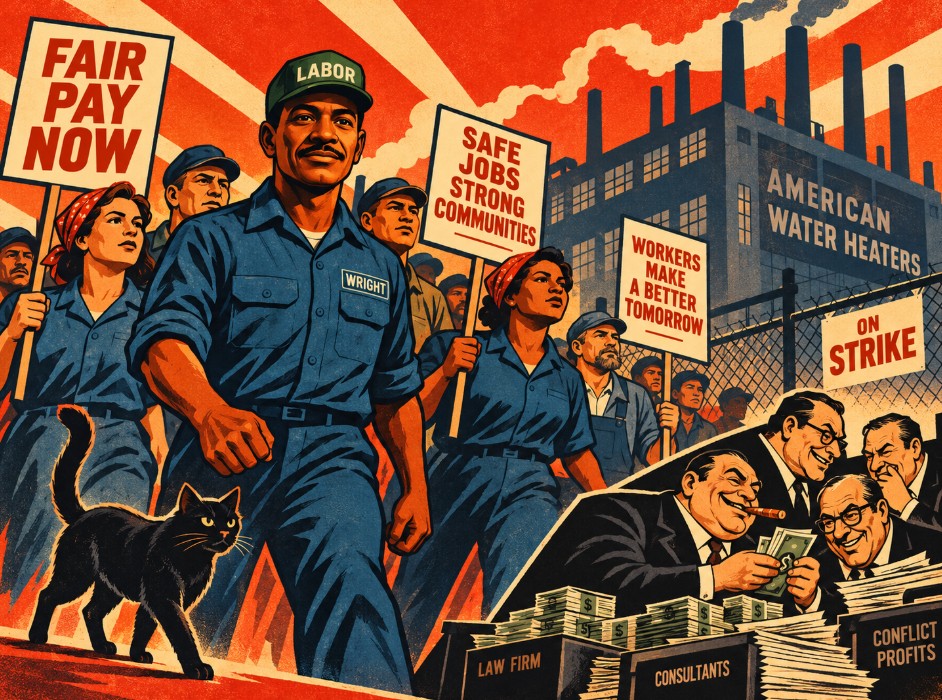
Out in Middleville, Michigan, about twelve hundred men and women who build water heaters for Bradford White walked off the job on September 16. Nobody had struck that plant since 1978. On October 23 they turned down another tentative agreement and stayed on the line. Some of them make less than twenty-one dollars an hour.
That’s a strike, and I’ve walked a few. Here’s the part that stopped my coffee halfway to my mouth: those workers own the company. Bradford White has been employee-owned since 1992, through an employee stock ownership plan. So twelve hundred owners are picketing outside their own plant, and the company they own has reportedly started filling their jobs with other people.
Sit with that a minute.
How the workers came to own it
In 1992 the federal government made a water heater merger give up the Bradford White plant in Middleville to settle an antitrust case. The plant went to a newly formed employee stock ownership trust. Under the usual arrangement, the trust borrows money to buy the shares and the company pays back the loan out of its earnings. Those earnings come off the shop floor. So the people on that line bought the plant with their own work, one shift at a time, and the deed went into a trust run by someone else on their behalf.
That’s the catch. In a privately held ESOP, the workers’ voting rights are usually narrow, and the board and management run the business. It’s like paying off a house and having the bank keep the keys. You can live there, but someone else sets the thermostat. When you ask for heat, they hand you a grievance form.
The snake eating its tail
The old folks had a picture for this: a snake swallowing its own tail. Follow the money in this strike and you’ll see it.
The company’s lawyers are paid out of company money, which is the workers’ money. The union’s lawyers are paid out of dues, which is the workers’ money too. Each day the plant runs short, the stock in their retirement accounts takes a hit. If replacement workers are coming in, they’re paid out of the owners’ own till to keep the owners outside the gate. The worker pays for both sides of the fight and pays for the damage as well. However it settles, the people sure to come out ahead are the ones billing by the hour.
Our law came together in pieces, the way an old house gets additions. One set of rules covers a man as a worker at the bargaining table. Another covers him as a saver with a retirement account. A third covers the corporation he works for. Each has its own lawyers and its own language, and none of them was written with the idea that all three could be the same person. When they are, the law cuts him into three parts and sets those parts against each other. The lawyers have made ownership into something you can hold on paper and never get to use. A man can own the whole company and still have to strike against himself to be heard.
That’s a design flaw. I watched a lot of things built the wrong way in my years, and you don’t fix a bad footing by painting the walls.
A word to both sides of the table
To management: you have a real job. You answer for the retirees, for the folks who’ll be hired ten years from now, and for keeping that plant open. I respect that. But the people on the line aren’t a cost to manage. They’re your owners. You want efficiency? Start with respect. Respect is the first safety rule, and it applies in the boardroom the same as on the floor.
To the workers: hold together. You’re paying for this strike twice, once out of your paycheck and once out of your account, and the folks across the table know it. Keep your craft sharp and your conscience sharper, and keep asking the question no one wants to answer: who runs the company we own?
Fix the footings
This goes well past one plant in Michigan. Labor law in this country needs rebuilding from the foundation up. When workers own the company, ownership should come with a real vote on how it’s run and who runs it. The law should treat a worker and an owner as one person with one set of interests, not three clients for three firms. And the fruit of a man’s labor should end up in his hands, not spent paying people to argue over whose it is.
My father carried other folks’ baggage for a living. He used to tell me, “We carried their bags, son, but never their shame.” The Bradford White workers have carried that company for thirty-four years. Seems to me it’s time the law let them pick up what they’ve earned.
Measure twice, act once. Then build it right.
Now you know, Jack.
Sources:
- U.S. Department of Justice, Antitrust Division press release on the 1992 Bradford White divestiture to an employee stock ownership trust: https://www.justice.gov/archive/atr/public/press_releases/1992/211212.htm
- FOX 17, “Bradford White workers remain on strike as negotiations resume in Middleville” (Oct. 26, 2026): https://www.fox17online.com/news/local-news/barry/bradford-white-workers-remain-on-strike-as-negotiations-resume-in-middleville
- FOX 17, “UAW workers strike at Bradford White plant in Middleville” (Sept. 2026): https://www.fox17online.com/news/local-news/barry/uaw-workers-strike-at-bradford-white-plant-in-middleville
- World Socialist Web Site on the leveraged ESOP structure and the strike: https://www.wsws.org/en/articles/2026/09/18/upxu-s18.html