A two-stroke engine runs on premix: a tank of gas with a measured splash of oil. The ratio is set for the size of the tank. If you keep filling the tank with gas but pour in the same amount of oil each time, the mix comes out right. If someone stops adding gas while the tank keeps getting bigger, the oil starts to dominate. The plug fouls, the engine smokes, and you’re left blaming the machine for a bad mix.
The Electoral College runs on a premix too. Part of it comes from the people and part from the states, and the proportions were set to change as the country grew. That change stopped in 1929, and the presidential vote has been running rich ever since.
Two chambers, two jobs
Congress was built with two constituencies. The Senate represents the states as states. Each gets two seats regardless of size, so Wyoming and California sit as equals. Until the 17th Amendment in 1913, state legislatures picked senators. The Senate was the states’ own voice in Washington.
The House represents the people by headcount. Seats follow population, and the chamber was designed to grow with the country. The Senate speaks for the states, and the House carries the will of the people.
The presidency draws from both. Article II gives each state as many electors as it has members of Congress: its House seats plus its two Senate seats. That makes the presidential vote a blend. House-based electors are the people’s share. Senate-based electors are the states’ share, a flat two per state. The states’ share was meant as a cushion. Fixed at 100, it was supposed to shrink in relative weight as the people’s share grew after each census.
Where the mix went wrong
Nathaniel Leery covered the history in his “Letter on the Size of the House.” The House grew from 59 members in 1789 to 435 by 1913, census after census, as Madison had promised. Then Congress froze it. In 1929, each member spoke for about 280,000 people. After the 2020 census the figure was about 761,000, and it’s headed for a million.
Leery followed the freeze into lawmaking: a House too small to write detailed law for 330 million people hands the details to agencies. The same freeze shows up again in the presidential vote. Capping the House capped the people’s share of the Electoral College while the population kept climbing. The states’ share held at 100, so it now carries far more weight than the blend intended. A Wyoming resident’s vote for president counts about 3.6 times as much as a Californian’s. That gap comes from the 1929 statute and the census, without any vote by anyone to create it.
Restoring the ratio
The Constitution allows up to one representative for every 30,000 people. Bright Meadow Group’s paper “The Distributed House” worked out what a House at that scale would look like and how it could function: about 11,300 members, working from their home districts, meeting in federal delegation halls in each state capital, and voting together over a secure congressional network.
Apply those numbers to the Electoral College:
- Pennsylvania: about 430 House seats plus 2 Senate seats = 432 electors
- California: about 1,300 plus 2 = 1,302
- Wyoming: about 19 plus 2 = 21
Add the 100 Senate-based electors and about 21 for the District of Columbia (the 23rd Amendment gives DC what it would have as a state, capped at the smallest state’s count), and the Electoral College comes to roughly 11,400. A majority falls around 5,700.
Measured per million residents, Wyoming ends up with about 36 electors and California about 33. The gap drops from 3.6-to-1 to about 1.1-to-1. The states keep their two-seat cushion, and the people’s share once again tracks the people. The oil splash stays the same, and the gas finally fills the tank.
No amendment required
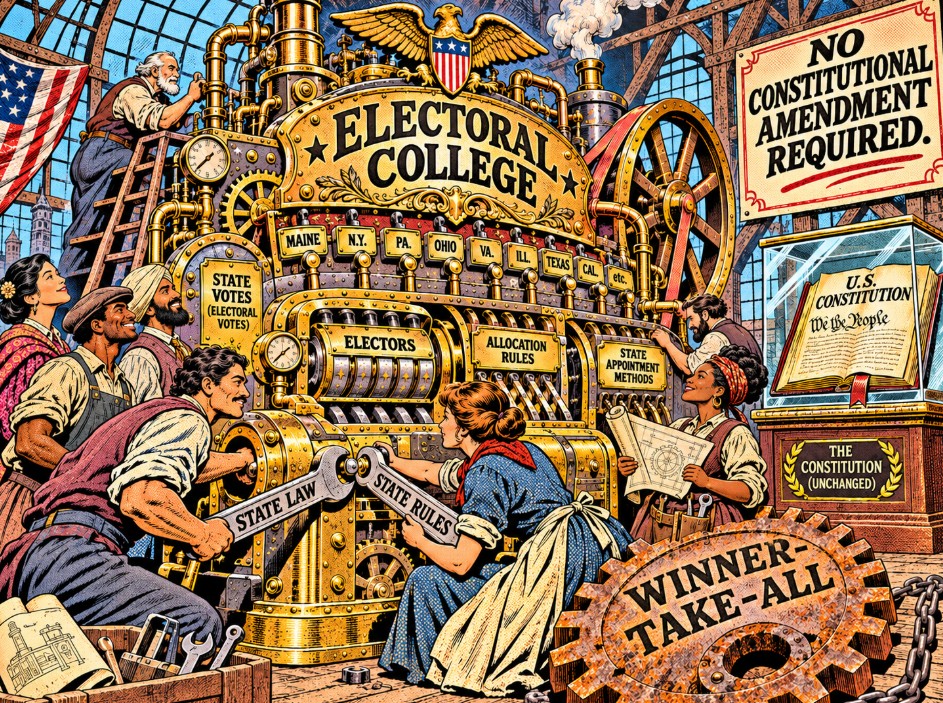
The 435 cap is an ordinary statute, the Permanent Apportionment Act of 1929. An ordinary act of Congress can replace it with a ratio. The Article II formula updates the Electoral College automatically when the House grows, and the 23rd Amendment updates DC’s share the same way. One law reshapes the House, the Electoral College, and DC’s electors together.
The distributed design also fits how presidents are already chosen. Electors meet in their own state capitals, and Washington certifies the results. “The Distributed House” uses that same pattern for legislating: members gather in a hall in each capital, vote together on the grid, and two senior members per state certify the count on a Washington floor that seats 100, the same as the Senate. The presidential vote and the House vote would operate on the same model, with the states as the place where people meet and Washington as the office that confirms the count.
What stays with the states
This reform changes how much weight each state carries. It leaves two other things where the Constitution put them.
States decide how to award their electors. Forty-eight give the whole slate to the statewide winner, and Maine and Nebraska split theirs. With a larger House, a candidate could still win the presidency while losing the national popular vote. Studies of past elections find a large enough House would have changed the outcome in 2000 but not in 2016. Correcting the weights and choosing how each state counts its votes are separate decisions, and the second remains in the hands of each state’s own voters and legislature.
If no candidate reaches a majority, the 12th Amendment sends the choice to the House, with each state delegation casting a single vote. Pennsylvania’s 430 members would vote as one, equal to Wyoming’s 19. The states-as-states principle holds there as well.
The balance
The Senate keeps speaking for the states. The House goes back to speaking for the people at a scale where a citizen can find their representative on a free Tuesday afternoon. The Electoral College gets the mix the framers designed: a fixed splash for the states and a full tank for the people.
Congress stopped pouring in 1929. Starting again takes one bill.
Sources
- Nathaniel Leery, “Letter on the Size of the House,” Blue Ribbon Team, Oct. 24, 2026 — https://blueribbonteam.com/blog/2026/10/24/letter-on-the-size-of-the-house/
- Bright Meadow Group, “The Distributed House,” Blue Ribbon Team, Oct. 30, 2026 — https://blueribbonteam.com/blog/2026/10/30/the-distributed-house/
- American Academy of Arts & Sciences, Our Common Purpose and “The Case for Enlarging the House of Representatives”
- Barthélémy, Martin & Piggins, “The 2016 Election: Like 1888 but not 1876 or 2000,” PS: Political Science & Politics
- Permanent Apportionment Act of 1929
- U.S. Constitution, Article I, Article II, and the 12th, 17th, and 23rd Amendments