I grew up waiting for the bomb.
I mean the real one, the kind that turns Indianapolis into a glass parking lot some Tuesday afternoon because a colonel in Omaha or Moscow misread a radar screen. We drilled for it at school. Duck and cover. Some genius in the bowels of the federal government decided a pressboard desk and a social studies book would stand between a fourth grader and a thermonuclear warhead, and we crawled under there like good little citizens, because kids assume the grown-ups know what the hell they’re doing.
By my teens the Cold War was wallpaper. Sting put out “Russians” in 1985, a song built around the hope that the people on the other side loved their kids as much as we loved ours, and you can believe we hoped it. We hoped there were mothers over there losing sleep same as ours. We hoped somebody behind those missiles wanted to come home for supper.
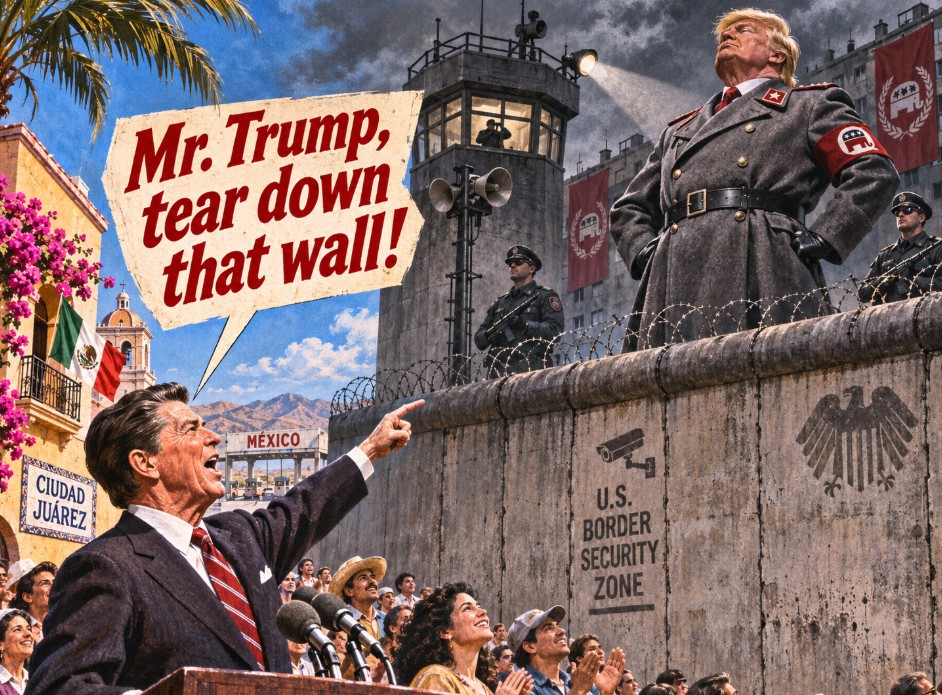
For all the evils of Ronald Reagan, and the jelly-bean-gobbling star of Bedtime for Bonzo racked up a ledger, from busting the air traffic controllers to selling us the fairy tale that money trickles downhill, I was a kid then. I remember him at the Brandenburg Gate in 1987 telling Mr. Gorbachev to tear down this wall. I remember Glasnost when it happened.
I’ll give the old actor that one. He didn’t knock the Wall down himself. Gorbachev’s reforms, a Soviet economy running on fumes, and East Germans with the guts to march in the streets did that. But Reagan named what was on the other side of the concrete, and he called it freedom.
The Wall Was About the Stasi
The American version of the story goes like this: East Germans rioted for Levi’s and Coca-Cola. Sure, they were poor. They stood in bread lines and wanted what they saw on West German television. But socialism wasn’t what separated them from us. Look at the neighbors. West Germany ran national health insurance, strong unions, and a social-market economy. Plenty of NATO countries leaned socialist to one degree or another, especially while they rebuilt from the war.
What East Germany had that West Germany didn’t was the Ministry for State Security. The Stasi. By 1989 it ran around 189,000 unofficial informants, roughly one for every ninety citizens. Your coworker. Your brother-in-law. The guy at church who borrowed your ladder. You watched what your kids said at school, because your kids could get you a file. People couldn’t be who they were out loud, in their own kitchens.
The concrete in Berlin was the part you could photograph. The real wall ran through living rooms. When it came down in November 1989, the people pouring through the checkpoints were walking out of a prison with a national anthem.
I Met the Russians
A few years later I was a radioman aboard USS Niagara Falls, a Navy supply ship. The Soviet Union was gone, and the world was doing something the drills hadn’t covered.
We taught Russian sailors underway replenishment, two ships running side by side at sea with lines and hoses strung across open water while both helmsmen hold the gap. We did one of the first ship-to-ship tour exchanges of the post-Cold War Navy. I’d spent my childhood under a desk because of these people, and here they were on our deck, sailors learning sailor work. They put their pants on one leg at a time.
Then I started hearing about a man named Putin. A hardliner, people said, still furious about how the West had kicked Russia around while the USSR came apart. That grievance should have scared us more than it did. Tell a people their greatness got stolen, hand them somebody to blame, offer a strongman to take it back, and you’ve built an engine that runs on spite. Putin learned to drive it.
So did Donald Trump.
The Bonzo Republicans
Which brings me to the fan club. The people who bronzed Reagan and hung him over the mantel turned into MAGA, and they got so wrapped up in their homogenous fantasy that they’ve rebuilt East Germany right here in the United States, in the name of a dementia-addled B actor.
Last winter Homeland Security flooded the Twin Cities with immigration agents. According to court filings NPR reported on in August, undercover DHS agents sat in on community meetings in churches, libraries, and schools, recording who showed up, writing down license plates, and building dossiers with names, addresses, families, and jobs. They subpoenaed years of bank records from labor unions and nonprofits that weren’t accused of a crime. An interim Lutheran pastor in Roseville stood at his altar and told a congregation of older folks the government had been in their pews. He told NPR, “It feels like I’m living in 1950s Eastern Europe.”
That’s a Lutheran pastor in Minnesota reaching for the same comparison I am.
Then on October 23, the full Fifth Circuit Court of Appeals ruled 10 to 7 that immigrants held without lawful admission have no constitutional right to a bond hearing. Lock them up, no hearing, wait it out. Texas and Louisiana hold the biggest share of immigration detainees in the country, and both sit in that circuit.
Agents in masks. Informants in church. Dossiers on grandmothers. Detention without a hearing. I’ve read this book. The Germans wrote it in the fifties, and we spent forty years and a few trillion dollars telling them how evil it was.
America isn’t East Germany. We still hold elections. Judges still rule against the government; four other appeals courts have gone the other way on those bond hearings. Reporters still dig up the filings. Those differences are real. But a police state doesn’t arrive in a crate stamped MADE IN THE GDR. It gets assembled out of habits: watching the neighbors, loyalty over law, rights for the right kind of people.
The Stasi needed 189,000 snitches and a building full of clerks steaming open letters. We carry the tracking device in our pockets and post our politics on it for free.
Freedom to Do What?
These are the folks who spent forty years telling me government was the enemy of liberty. Now they cheer when the government goes through a church’s sign-in sheet, as long as it’s the wrong church. Turns out tyranny was fine by them. They just wanted their own hands on the controls.
Freedom to worship, if it’s the approved god. Freedom to speak, if you don’t sass the guys with badges. Freedom to be yourself, if yourself looks like them. That’s conformity in a cowboy hat, sold by the truckload with a flag on top.
Freedom is supposed to cover the guy whose bumper sticker raises your blood pressure. It covers the immigrant, the atheist, the protester, the neighbor you’d sooner cross the street than share a beer with. If you only want freedom for people who agree with you, what you want is obedience, and obedience comes cheap. Any two-bit dictator with a radio station can manufacture it by the ton.
Mr. Trump, Tear Down That Wall
When I was a kid, we could see the Wall. Guard towers, dogs, people shot dead in the strip trying to get across. You didn’t need an economics degree to know which side you’d rather live on.
This one goes up a brick at a time. A brick when we shrug at masked agents. A brick when we let the government sit in church taking names. A brick when we decide rights belong to the properly patriotic. A brick when we cheer somebody’s humiliation because the TV told us to hate them.
I was there when American and Russian sailors stopped training to kill each other and started passing fuel lines across the water. I remember the fear before the Wall fell and the hope after it. I refuse to believe the lesson of the Cold War was that we should grow up and turn into the people we were afraid of.
So here’s the old actor’s line, back where it belongs.
Mr. Trump, tear down that wall.
The one between neighbors. The one between the government and the Constitution. The one between the America we promised the world from the decks of our warships and the one we’re turning into.
Tear down that goddamned wall, before another generation of kids grows up thinking freedom was a movie line from a B actor who knew, at least once, what the hell he was talking about.
Sources
- National Archives, Reagan’s Brandenburg Gate address, June 12, 1987
- German Federal Archives (Stasi Records Archive), unofficial collaborator figures
- NPR, “Churches, libraries and breweries: Inside DHS’ covert surveillance operation,” August 25, 2026
- Honolulu Star-Advertiser / AP, Fifth Circuit bond hearing ruling, October 23, 2026
- AP via La Nación, Ninth Circuit bond hearing ruling and circuit split, July 2026