Observe – Design – Intervene
Observe
Somewhere around 3200 to 2500 BC, people in what is now northeast Scotland sat down with hard stone and spent days, maybe weeks, pecking and grinding a lump of granite or sandstone into a ball about the size of a baseball. Then they kept going. They raised knobs on the surface: six on the common ones, a dozen or more on others, and over a hundred on a few. Some knobs line up in arrangements that match the Platonic solids, a good two thousand years before Plato. A handful of the balls carry fine spiral carving, the showpiece being the Towie ball, now in the National Museum of Scotland.
Over 400 of these carved stone balls are known. More than half come from Aberdeenshire. A smaller group comes from Orkney, and a few outliers turn up in northern England and Ireland. They run remarkably consistent in size, close to 7 cm across, and a comfortable weight for one hand.
Here is the part that has kept them a mystery. The great majority were stray finds. Farmers turned them up with plows, pried them out of field walls, or found them lying in open ground, and handed them in during the 1800s and early 1900s. No burial, no hoard, no layer to date them by, no companions. Only a few come from excavated sites, chiefly the Orkney settlements at Skara Brae and the gathering complex at the Ness of Brodgar. And the bulk of them are in good condition, with little chipping or breakage.
The standing theories line up like suspects in a parlor mystery: weapons, bolas weights, rollers for moving megaliths, tokens held by whoever had the floor at a meeting, symbols of rank. Each explains a piece. None explains the whole set of facts at once: the standardized size, the variety of knob patterns, the good condition, and above all the lonely way they keep turning up in fields.
Design
BMG’s working rule for objects like this: ask what people then needed that we have stopped thinking about, and test the answer against how the object is found, not only how it looks.
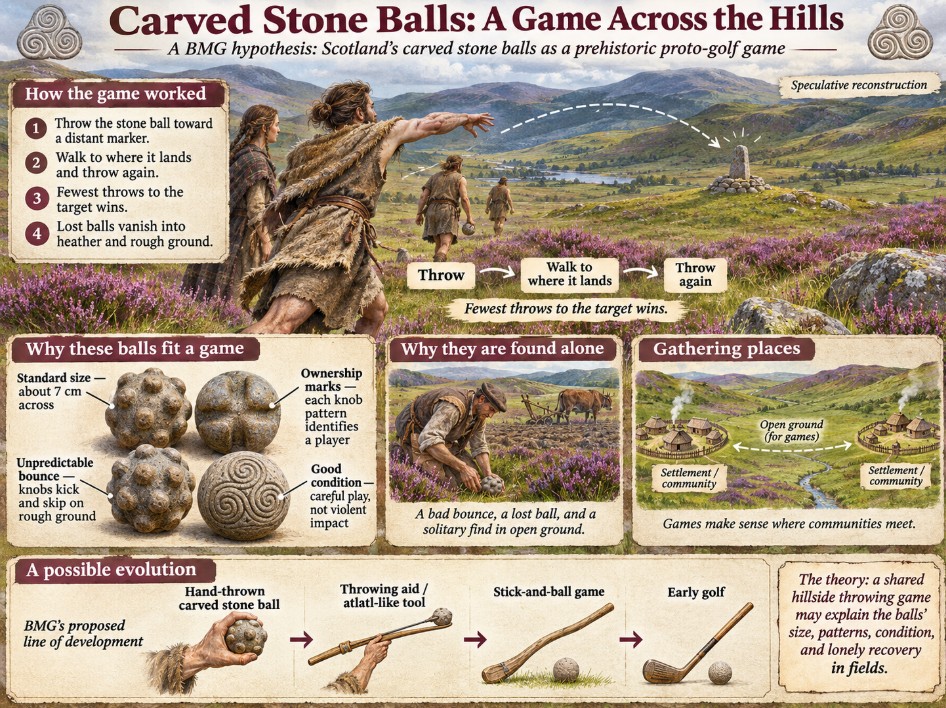
So picture the land. Open rolling hills, turf and heather, long sightlines, small communities with gathering places between them. Now picture a game played across it, something like golf or disc golf. You throw your ball toward a mark, walk to where it landed, and throw again. Fewest throws wins.
Run the facts through that picture and they start falling into place.
The find pattern. A grave good comes with a grave. A ritual deposit comes with a ritual site. A ball that took a bad bounce into the rough and was never found comes with no context whatsoever, alone in open ground, waiting a few thousand years for a plow. That is exactly how the bulk of these balls were recovered. Every golfer who has walked off a course one ball short has added to the same kind of archaeological record.
The knob patterns. On a shared field, you need to know which ball is yours from twenty paces. Five knobs, seven knobs, fourteen knobs, a carved spiral: each reads like a signature, the way bomber crews painted their planes or hunters marked their arrows so a kill could be claimed. The elaborate carved balls fit the picture as the custom set, the prized ball that likely stayed home or came out only for the big match, which would explain why a decorated piece like Towie survives in fine shape.
The size and weight. At around 7 cm and roughly a pound of stone, the balls sit right in the range for a strong one-handed throw over distance. The consistency in size points to a shared standard, the same reason golf balls have rules today.
The knobs themselves. A smooth stone rolls true. A knobbed one kicks and skips on rough ground, adding chance to skill, the way a golf ball catches a root or a bad lie. A game wants that.
The condition. A war stone thrown at people or animals chips on bone and rock. A ball tossed onto turf and carried home in a pouch stays whole. The good condition of the collection argues against weapons and for something handled with care.
The gathering places. The excavated finds come from Skara Brae and the Ness of Brodgar, places where people came together. Games happen where people gather.
And then there is the destination. Scotland gave the world golf. The country has a long, stubborn love of throwing and rolling stones: curling, the stone put, the old lifting stones at farms and churches that young men used to prove themselves. The earliest written mention of golf comes from 1457, when the Scottish Parliament under James II banned it because men were skipping archery practice to play. A game does not get outlawed by a king unless it already has deep roots in the people. BMG’s proposal: those roots run back to the carved stone balls, and the knobbed ball on the Aberdeenshire hills is the primitive origin of golf.
The gap in the line is time. Writing arrives in Scotland with the Romans, close to 3,000 years after the balls, so no contemporary account exists. What survives instead are the traditions themselves. Early Irish tales put ball games at the heart of heroic life, with the boy Cú Chulainn driving a ball across open country in hurling. Shinty in Scotland is old enough that its start is lost. Rural games last a long time, passed down by playing them.
Intervene
This proposal can be tested, and the tests are within reach of a graduate student, a local historical society, or a curious club.
- Map the lost balls. Take the finds with a known farm or parish and plot them against the landscape. If they cluster along ridgelines, valley floors, or the open ground between settlements and gathering sites, that looks like a course. If they scatter at random, the idea weakens.
- Read the ministers. The Statistical Accounts of Scotland, compiled parish by parish in the 1790s and again in the 1830s and 1840s, have local ministers describing customs, games, and odd stones in their own words. Cross-check the parishes where balls were found against any mention of a traditional throwing or rolling game. A match there is a thread nobody may have pulled yet.
- Sort by wear. Sort the 400-plus balls by wear pattern instead of by knob count. Scuffing on the knob tips, polish from handling, and turf abrasion would tell a different story from pristine display pieces. If the plain balls show play wear and the carved ones do not, the custom set idea holds.
- Play the game. Make replicas in the right stone and weight, take them out on rough pasture, and play. Record how they roll, how the knob count changes the bounce, how far a strong arm can throw one, and how often one disappears in the heather. Experimental archaeology has answered harder questions with less.
Golf’s origin story usually starts with Dutch and Scottish stick-and-ball games in the Middle Ages. BMG invites the archaeologists, the historians, and the golfers to walk the course back a few thousand years further, to a hillside in Aberdeenshire, where someone threw a carved stone ball, watched it bounce into the heather, and went home one ball short.
Sources:
- National Museum of Scotland, carved stone balls collection and the Towie ball
- Marshall, D. N. “Carved Stone Balls.” Proceedings of the Society of Antiquaries of Scotland 108 (1977)
- Edmonds, M. “Their Use Is Wholly Unknown.” In Vessels for the Ancestors (1992)
- Excavation reports, Skara Brae and the Ness of Brodgar, Orkney
- Records of the Parliaments of Scotland, Act of 1457 (James II) banning golf and football
- The Statistical Accounts of Scotland (1791–99 and 1834–45)
- The Táin Bó Cúailnge, boyhood deeds of Cú Chulainn