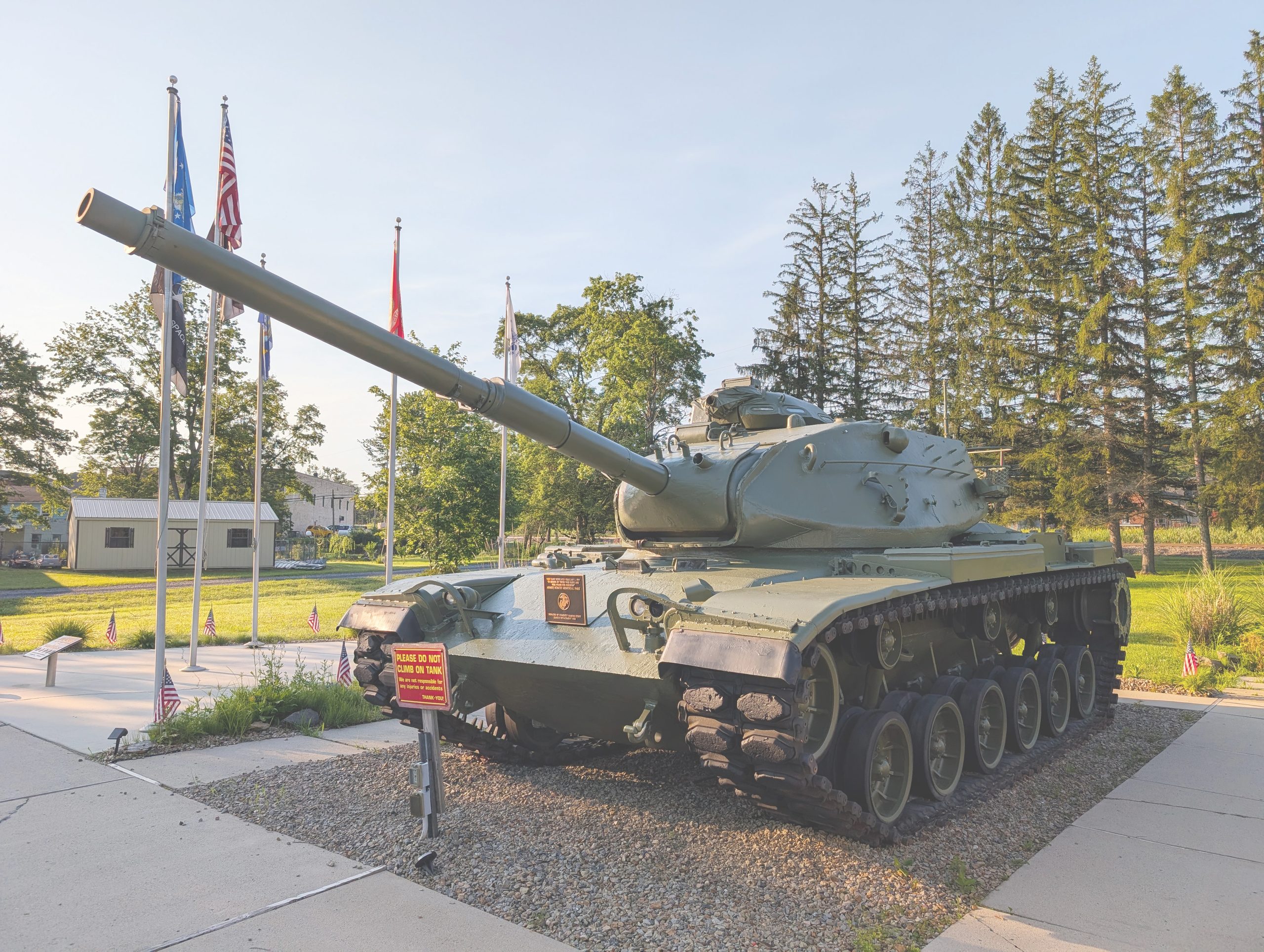
Central City sits along Route 160 in northern Somerset County, a borough compact enough that the ball field, the pavilion and the war memorial share one stretch of Chestnut Street. Past the outfield fence, on a bed of gravel, a steel animal of roughly fifty tons holds its gun up toward a line of Norway spruce. A red sign at its front fender reads “Please Do Not Climb On Tank,” which to the town’s kids must read like a dare.
The tank is an M60A3 TTS, the last and sharpest version of the American tank that held the line in West Germany through the back half of the Cold War. Somerset Marine Corps League Detachment #660 set it here in 1997 with the dedication “In honor of those who have and will stand for freedom.” Flagpoles for the five armed services went up beside it the next year, and a Space Force flag now flies among them. Central City VFW Post 7457 added its own memorial in 2025.
A 1950s Body With a 1980s Brain
The M60 grew out of the M48 Patton. Through the 1950s the M48 ran on a gasoline engine that burned through fuel fast and burned hard when hit. At the same time, new Soviet tanks were showing up with bigger guns. The Army’s answer kept the M48’s general layout, swapped in a diesel for range and safety, and mounted the British L7 105mm gun, built in the United States under license as the M68. The Army adopted the design in 1959 and accepted the first tanks in December 1960, built at the Detroit Arsenal Tank Plant under Chrysler.
The M60A1 arrived in 1962 with the long, pointed “needle nose” turret you see on the Central City tank. For the next two decades the Army kept that hull and turret and kept changing what went inside them. Development of the A3 began in 1972, and the first A3s reached units in 1978. The Tank Thermal Sight version followed into Army units in West Germany in 1979. New production of TTS tanks ran from fiscal 1980 through 1984 and turned out 1,052 of them, while depots in Anniston, Alabama and Mainz, Germany brought older tanks up to the same standard.
The reason for pouring that much work into an aging design came down to arithmetic. NATO planners expected Warsaw Pact armor to cross the border in larger numbers than they could match tank for tank. An outnumbered defender has to win at long range, at night, and through smoke, before the other side closes the gap. A new tank would take years to field. Better eyes and a faster firing solution could be bolted onto the tanks already sitting in German motor pools.
Reading the Tank From the Sidewalk
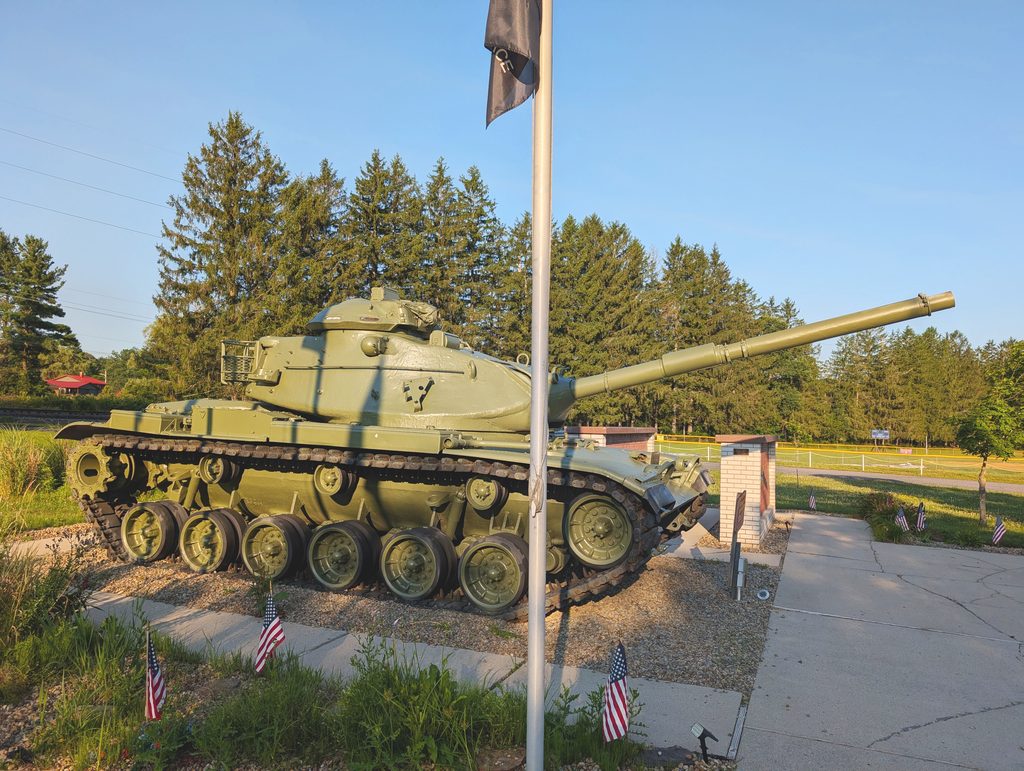
Start at the gun. The barrel wears a series of jacketed sections held on by metal bands. That jacket is the thermal shroud. Sunlight warms the top of a barrel while the underside stays cooler, and steel grows as it heats, so the tube bows a hair toward the cool side. At the muzzle the bend might measure a fraction of a millimeter. Two kilometers downrange it turns into a clean miss. Rain on one side does the same job in reverse. The shroud evens out the temperature around the tube so it stays straight.
Partway down the barrel sits a fat cylinder called the bore evacuator. As a round passes, high-pressure gas pours into the cylinder through angled holes. Once the round leaves the muzzle and pressure in the barrel drops, the stored gas jets back out toward the muzzle and drags the leftover smoke along with it. Without it, the loader would open the breech into a turret full of propellant fumes. On the American M68 the evacuator sits slightly off-center so the barrel clears the engine deck when the turret swings to the rear.
The rounded blisters on the cheeks of the turret once held the optical rangefinder of earlier M60s, where the gunner lined up two half-images until they matched and read the range off a scale. On the A3, the right blister carries a laser rangefinder. The gunner fires a pulse of light at the target, times its return, and gets the distance within a few meters. A solid-state ballistic computer takes that range, adds the crosswind reading from a sensor mast on the turret roof, factors in the ammunition type and the tilt of the tank, and moves the aiming point in the sight. The gunner puts the crosshairs on the target and fires.
The armored box on the turret roof, just ahead of the commander’s position, is the gunner’s sight housing, which tankers call the doghouse. On a TTS tank, the thermal sight lives inside it.
The Eye in the Dark
Anything warmer than absolute zero gives off infrared light, and the warmer it is, the brighter it glows at those wavelengths. A diesel exhaust, a running engine, a road wheel that has been rolling for an hour, a soldier’s face. Earlier night sights either amplified starlight or relied on a searchlight. The M60A1 carried a large xenon lamp over its gun, which lit up the target and also announced the tank’s position to anyone looking its way.
The AN/VSG-2 Tank Thermal Sight needs no light at all. Its detector, made of mercury cadmium telluride, has to be chilled to cryogenic temperatures so the sight’s own warmth doesn’t drown out the faint heat arriving from downrange, the way a humming listener struggles to hear a whisper. What the gunner sees is a picture of heat: warm shapes standing out against a cooler background, through darkness and through the smoke screens both sides planned to use. TTS tanks dropped the searchlight. Crews who served on both the A3 and the early M1 Abrams have long said the TTS gave a clearer picture than the first Abrams thermal system did.
The Body Underneath
The hull and turret are steel castings. Casting lets the designers put thick steel where hits were expected and thinner steel where they weren’t, and it lets them curve and slope the surfaces. The upper front plate is about 4.3 inches thick, but it lies back at 65 degrees, so a round traveling level has to cross roughly ten inches of steel to get through. Think of walking through a doorway on a hard diagonal and how much more doorframe you pass.
Below, six road wheels ride on each side. Each wheel hangs from an arm attached to a steel torsion bar that runs across the floor of the hull to the far side. When a wheel hits a bump, the arm swings up and twists the bar, and the steel springs back like a wrung-out towel unwinding. Small return rollers along the top carry the slack of the track. The toothed sprocket at the rear drives the track, and the large wheel at the front is the idler that steers it back around. The track shoes on the Central City tank still carry their rubber pads, which spared paved roads from the chewing that bare steel would give them.
The engine is a Continental AVDS-1790-2C. The letters stand for air-cooled, V-type, diesel, supercharged, and the number is its displacement in cubic inches, about 29 liters. It makes 750 horsepower at 2,400 rpm and pushes the tank to about 30 miles per hour, with a range near 300 miles. Air cooling meant no radiator to puncture and no coolant to freeze in a German January. Large fans pull air across finned cylinders, the same principle as a motorcycle engine scaled up to the size of a small car.
Four men rode inside. The driver sat low in the center of the hull. The gunner sat at the right front of the turret with the commander behind and above him, under a cupola mounting a .50 caliber machine gun. The loader worked the left side, feeding the main gun from a stowed load of 63 rounds.
After the Line
The M1 Abrams began arriving in 1980 and took over front-line units through the decade. The M60A3s passed to the National Guard and Reserve and left Army service during the 1990s, and a steady stream of demilitarized hulls went to towns, VFW posts and Legion posts. The Laurel Highlands caught several of them. Windber’s Veterans Park dedicated a Cold War tank in 1996 under the same words that appear in Central City a year later, and the American Legion park in Carrolltown displays an M60A3 of its own. Overseas, upgraded M60s still serve in more than a dozen countries, including Turkey, Greece and Taiwan.
The sight that once picked tanks out of a German night now faces a Little League scoreboard and a row of spruce. On a summer evening the hull soaks up sun until well after dark, and anyone looking through that old sight would find the tank glowing there like a banked stove.
Sources
- Historical Marker Database: “In honor of those who have and will stand for freedom,” Armed Forces Memorial Park, Central City — hmdb.org/m.asp?m=300339
- Historical Marker Database: Armed Forces Memorial, Central City — hmdb.org/m.asp?m=300772
- Historical Marker Database: Veterans Memorial, Central City — hmdb.org/m.asp?m=300808
- Historical Marker Database: Windber Veteran’s Park — hmdb.org/m.asp?m=21584
- American Legion memorial listing: Carrolltown American Legion Park — legion.org/memorials/249497/carrolltown-american-legion-park
- GlobalSecurity.org: M60A3 Patton Tank Thermal Sight (TTS) — globalsecurity.org/military/systems/ground/m60a3.htm
- AFV Database: 105mm Gun Tank M60 series — afvdatabase.com/usa/m60.html
- Wikipedia: M60 tank — en.wikipedia.org/wiki/M60_tank
- Army Recognition: M60A3 specifications and Taiwan upgrade — armyrecognition.com
- 19FortyFive: M60A3 history and current operators — 19fortyfive.com