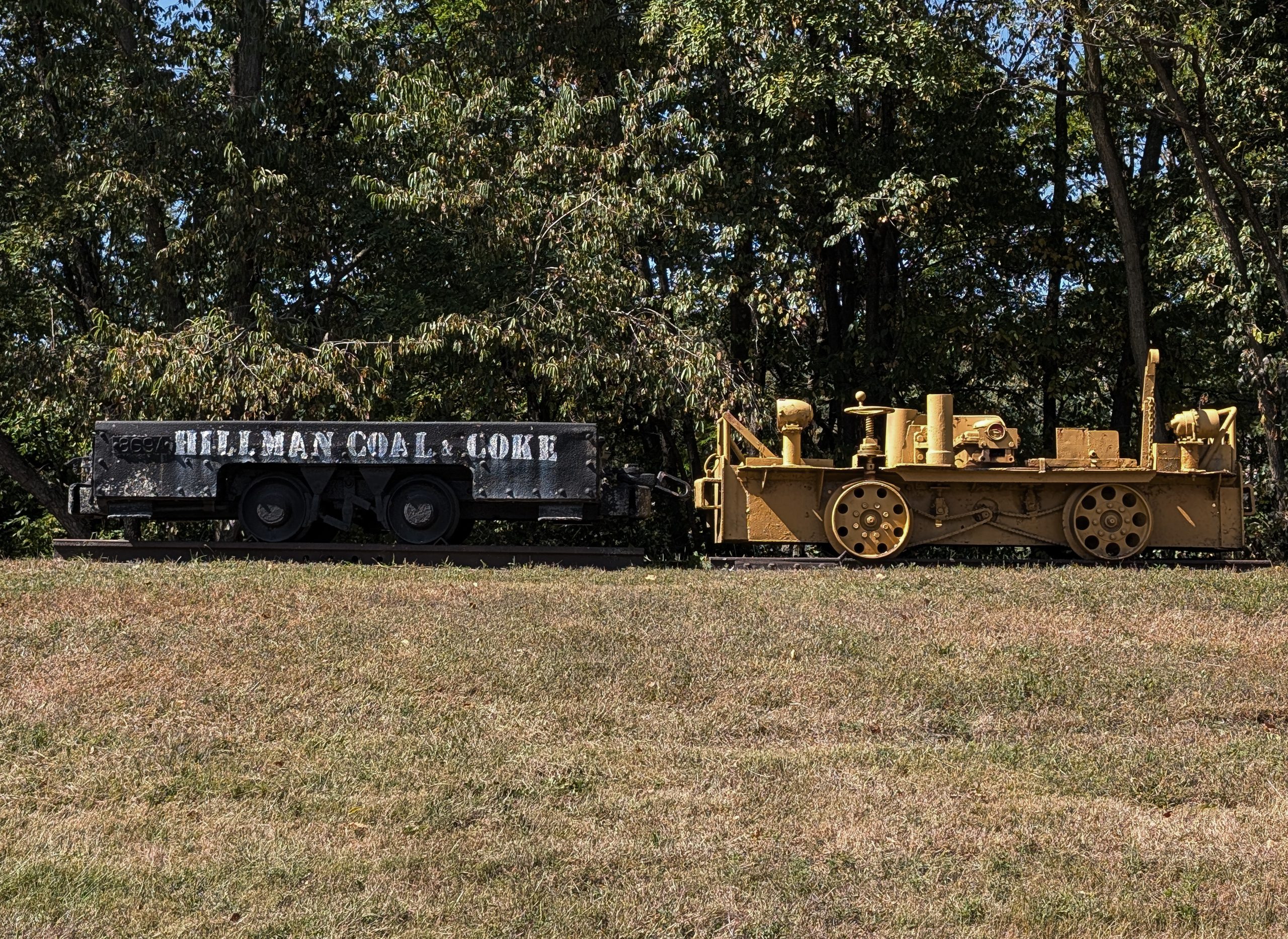
Two pieces of underground railroad sit on a short run of rail at the edge of a mowed field, with a wall of trees behind them. The black one is a coal car, stenciled HILLMAN COAL & COKE in white block letters, with the number 8697 cast or stamped into the end plate. The yellow one coupled to it is the engine that would have pulled it. Miners didn’t call that machine a locomotive. They called it a motor, and the man who ran it was the motorman.
From across the field they look like a toy train somebody’s grandfather built in the garage. Up close they make sense once you picture the ceiling.
The Car
A western Pennsylvania coal seam runs a few feet thick in a lot of places. The men worked in rooms they couldn’t stand up in, and the haulage had to fit the same space. So the mine car got built low and long instead of tall. Its body sits down between the wheels like a shoebox lowered onto two axles, which keeps the loading edge close to where a miner’s shovel lands.
The construction reads like a bridge girder. Steel plate, riveted at the seams, rows of rivet heads marching along the sides and corners. Riveting held up to abuse that a weld of the period might have cracked under: cars got rammed, derailed, overloaded, and dragged back to the shop to be straightened. A mine ran hundreds or thousands of these, and the number on the end was how the company tracked them. Car 8697 tells you something about the size of the fleet it came from.
Between the car and the motor there’s a short link and hook. Coupling by hand in a dark, low entry, between two heavy steel bodies, cost a lot of miners their fingers.
The Motor
Before motors, mules pulled the cars. Many mines kept stables underground and the animals went years without seeing daylight. Electric haulage started replacing them in the late 1800s, and by the early twentieth century the motor was standard equipment in the bigger operations.
This one looks to me like a trolley motor, the kind that drew current from a bare wire strung along the roof of the haulageway. The upright bracket at the right end is where I’d expect a trolley pole to mount, and the cylinders along the deck look like the lamp housings, sand box, and controller you find on these machines. The handwheel on the spring column in the middle is a brake. If the pole and wire are right, picture the setup: a live uninsulated conductor running a foot or two over the motorman’s head, through a tunnel where water dripped from the roof. Builders like Jeffrey and Goodman spent decades patenting ways to fold the pole down low enough to clear tight roof sections and swing it around to reverse direction in entries too narrow to turn.
The wheels are solid steel discs drilled with lightening holes, and the frame is a heavy steel box. Weight was a feature. A motor pulls by traction, and a light one would spin its wheels under a loaded trip of cars.
Painted bright yellow now, it looks cheerful. Underground, under a carbide or electric headlamp, it would have been a dark shape with a headlight coming at you down a tunnel barely wider than itself.
The Company
Hillman Coal and Coke was a Pittsburgh outfit founded by J. Hartwell Hillman Sr., a Tennessee-born businessman who died in 1911. His three sons ran the family business after him as J. H. Hillman & Sons, and the coal and coke company later became Pittsburgh Coke & Chemical, which turned coal into coke, pig iron, and byproducts like activated carbon. That line of the business survives today as Calgon Carbon. A grandson, Henry Hillman, eventually sold off the industrial side and made the family firm into an investment company. The Hillman Library at Pitt carries the name forward.
The company’s reach came close to home. Merchants Coal, a Hillman subsidiary, laid out the town of Boswell in Somerset County, part of the Johnstown metro, buying up mineral rights under the farmland and platting company housing for its miners. The neighboring patch town of Jerome was Hillman-built too. That corner of northern Somerset County saw a long, hard fight over unionization in the early twentieth century, the kind of history that sits behind a stenciled company name.
On the Grass
These two have been retired to the light. Somebody cleaned them up, painted them, laid down a section of track, and parked them where people can walk up and look. The rails they sit on run maybe fifteen feet each. Underground, track like this branched out for miles.
A motor and a single car is the smallest train a mine would have run. A working trip stretched dozens of cars long, rattling out of the portal full and going back in empty, shift after shift, for as long as the seam held out.
Sources
- Wikipedia, “Hillman Coal and Coke Company”
- Wikipedia, “J. Hartwell Hillman Sr.” and “J. Hartwell Hillman Jr.”
- Wikipedia, “Henry Hillman”
- Wikipedia, “Boswell, Pennsylvania”
- US Patents 885,063 (trolley stand) and 1,035,249 (mine locomotive trolley mechanism)
- Sanford Belden, “Recent Developments in the Design of Jeffrey Electric Locomotives and Coal-Cutting Machines,” AIME, 1914