A Bright Meadow Group thought experiment on putting the mail back on the train, with a sorting car on each high-speed shuttle in the Continental Network
Once upon a time, the mail was sorted on trains between cities. A letter dropped in a box in Chicago rode east in a car full of clerks who sorted it on the move. When the train pulled into Pittsburgh, the Pittsburgh mail came off ready to go. The country took that system apart one route at a time. The Continental Network gives it a reason to come back.
OBSERVE
The railroads and the mail grew up together. In 1838 Congress declared the nation’s railroads post roads. In 1864, in the middle of the Civil War, the Post Office Department created the Railway Mail Service. By 1869, trains were snatching mail sacks off trackside cranes without stopping. In 1890, 5,800 railway clerks worked 154,800 miles of track, and by 1907 there were more than 14,000. At the service’s height, the clerks in the Railway Post Office cars handled 93 percent of the country’s non-local mail. The last car rolled into Washington’s Union Station from New York on June 30, 1977.
Today the mail moves between cities by truck and by plane, under contract, and the Postal Service pays the fuel bill whatever it comes to. Fuel prices are set by world markets and swing with wars, storms and refinery fires. No postmaster general can manage that line from the inside, the same way a ship’s cook can’t plan the menu around the weather. The agency closed fiscal 2025 with $80.5 billion in revenue, nearly $89.8 billion in expenses and a $9 billion net loss. It cut $422 million from transportation that year by reorganizing its network, and it has asked for a temporary price increase to cover rising transportation costs. Transportation sits on the ledger as one of the big lines USPS can’t steer, and it falls hardest on the national and international letter mail.
The Constitution gives Congress the power “to establish Post Offices and post Roads.” Federal postal law adds the promise to serve every address. Letter mail sits at the core of that mission, and it’s the part of the business that carries the transportation cost without the package-market prices to pay for it.
The Continental Network runs shuttles between cities on fixed schedules, many times a day, on electric power. The trains will run whether the mail rides them or not.
DESIGN
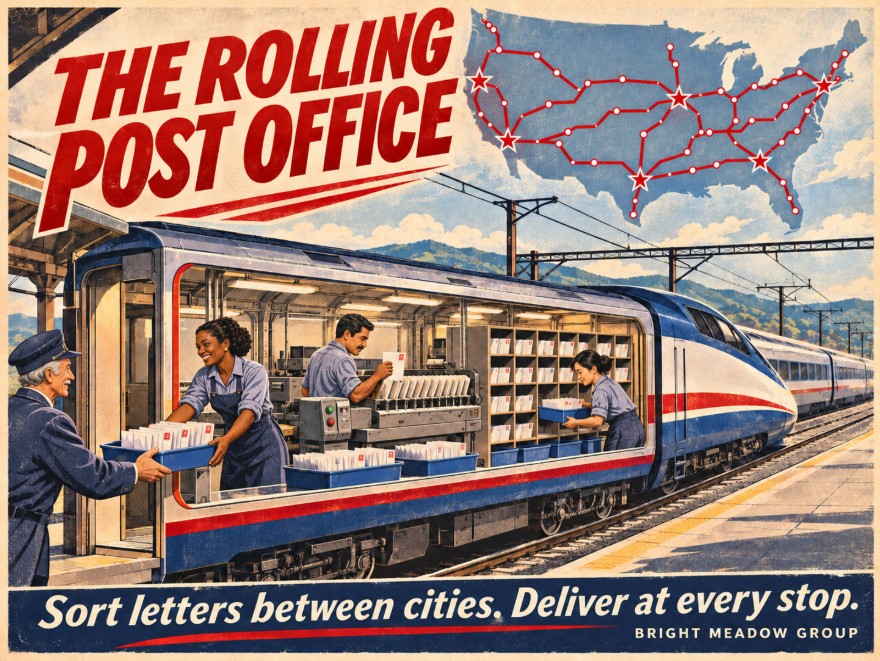
The mail car. Each shuttle on the network carries one postal car, a letter sorter on rails. The mail boards at the origin station and is sorted by stop while the train moves: one bin for each station down the line and one for each transfer to another corridor. When the train pulls in, that city’s mail comes off in one batch and goes to its processing center, which sorts it to carrier routes and sends it out the way it does today. The train handles the miles between cities, and the city plants handle delivery.
The pulse. Picture the network as a heart. Each departure pumps a beat of mail out along the lines, and each station takes its share. Mail for Kansas City drops at Kansas City, mail for Wichita stays aboard for Wichita, and mail for Winnipeg rides to the border. The letters travel through the country on the same network that carries its people.
The machine. A stationary letter sorter weighs tons and sits on a still floor. It sorts down to individual carrier routes, which takes thousands of bins. The rail sorter has a smaller job. It sorts to the stops on its line and the transfer points, so a run from San Antonio to Kansas City needs a bin for each station along the Spine and a few for the connecting corridors. With that few outputs, the machine can be built light and tough enough to ride out the vibration, lean and braking of a train running near 200 mph. On shorter legs, the same car can work a second way. Mail is sorted by stop at the origin station, sealed into containers for each stop and carried. Each corridor uses whichever mode moves the mail at the lowest cost per piece.
The savings. Three sources add up:
- Shared transportation: USPS buys space on a train that’s already running instead of paying for its own trucks, drivers, fuel and equipment on that run.
- Sorting time becomes travel time: the mail gets processed while it moves, which cuts handling steps and the hours letters sit on a plant floor waiting for the next truck.
- The network compounds: each new line on the rail map adds new postal links for free. Once Chicago, Indianapolis, St. Louis, Dallas-Fort Worth and Atlanta are tied together, sorted mail transfers between corridors the way passengers do.
The electric bill. The trains run on electricity bought under long-term contracts. USPS trades a fuel bill that swings with the world oil market for a power bill it can see years in advance. Energy still costs money, but it becomes a number the budget office can plan around.
The station dock. Each passenger station gets a postal transfer dock beside the platform. In a big city, the dock feeds the existing processing center. In a smaller city on the line, the station and its dock work as a regional distribution point, so the town gets fast mail without a new standalone plant.
The clerks. The car needs a crew: clerks to load and pull mail and technicians to keep the sorter running. The Railway Post Office clerk was the elite job in the old service. The craft comes back with new tools.
The second customer. The mail gives the rail network a steady institutional customer from the first day of service. The rail network gives the Postal Service an intercity fleet it doesn’t have to own. Each one carries part of the other’s load.
INTERVENE
Declare the network a post road. Write the postal function into the National High-Speed Rail Act, the way Congress made the railroads post roads in 1838.
Build the car into the standard. Put a postal car and a station dock in the national trainset and station specs, so the mail rides from the first train instead of being retrofitted later.
Sign the carriage contract. Set a long-term agreement between USPS and the rail authority, with the price of electricity locked in for the length of the contract.
Design the rail sorter. Have Postal Service engineering and the trainset builders develop a sorter that sorts by stop and is built for a moving floor.
Run the test on the first island. Pilot the mail car on the Texas triangle when it opens. Compare onboard sorting against station sorting on cost per piece, throughput and handling time, and let the numbers pick the mode for each corridor.
Bring back the railway clerk. Create the craft, train the crews and put them aboard with the first cars.
The last Railway Post Office car rolled into Union Station in 1977. The first one on the Continental Network can roll out of San Antonio.
Sources
Blue Ribbon Team, High Speed Rail series — https://blueribbonteam.com/high-speed-rail/
Blue Ribbon Team, The Continental Network — https://blueribbonteam.com/blog/2026/11/23/the-continental-network/
Blue Ribbon Team, The Three-Nation Line — https://blueribbonteam.com/blog/2026/11/14/the-three-nation-line/
Blue Ribbon Team, The Great Connection — https://blueribbonteam.com/blog/2026/11/11/the-great-connection/
Blue Ribbon Team, The Second Wave — https://blueribbonteam.com/blog/2026/11/23/the-second-wave/
Blue Ribbon Team, The Keystone Network — https://blueribbonteam.com/blog/2026/01/14/the-keystone-network/
Blue Ribbon Team, The Lone Star Junction — https://blueribbonteam.com/blog/2026/10/20/the-lone-star-junction/
Blue Ribbon Team, The Continental Spine — https://blueribbonteam.com/blog/2026/10/21/the-continental-spine/
Blue Ribbon Team, Two Lanes to Anchorage — https://blueribbonteam.com/blog/2026/11/05/two-lanes-to-anchorage/
Blue Ribbon Team, Second Shift — https://blueribbonteam.com/blog/2026/11/07/second-shift/
Blue Ribbon Team, The Head Start — https://blueribbonteam.com/blog/2026/11/09/the-head-start/
Blue Ribbon Team, The Chicago Hub — https://blueribbonteam.com/blog/2026/11/16/the-chicago-hub/
Blue Ribbon Team, The Plains Spine — https://blueribbonteam.com/blog/2026/11/19/the-plains-spine/
Blue Ribbon Team, The Central Transcontinental — https://blueribbonteam.com/blog/2026/11/20/the-central-transcontinental/
Blue Ribbon Team, Sin City Spider — https://blueribbonteam.com/blog/2026/11/24/sin-city-spider/
Smithsonian National Postal Museum, Railway Mail Service, History of the Service: https://postalmuseum.si.edu/research-article/the-railway-mail-service/history-of-the-service
Smithsonian National Postal Museum, Railway Mail Service topics: https://postalmuseum.si.edu/topics/railway-mail-service
Smithsonian National Postal Museum, Moving the Mail: Mail by Rail: https://postalmuseum.si.edu/moving-the-mail-mail-by-rail
Wikipedia, Railway Mail Service: https://en.wikipedia.org/wiki/Railway_Mail_Service
Mystic Stamp Company, This Day in History, July 7, 1838: https://info.mysticstamp.com/wp-content/uploads/07-07-1838-Railway-Mail.pdf
Mystic Stamp Company, Start of Railway Mail Service: https://info.mysticstamp.com/start-of-railway-mail-service/
U.S. Postal Service, U.S. Postal Service Reports Fiscal Year 2025 Results: https://about.usps.com/newsroom/national-releases/2025/1114-usps-reports-fiscal-year-2025-results.pdf
Logistics Management, USPS reports $9.0B loss for fiscal year 2025: https://www.logisticsmgmt.com/article/usps_reports_9.0b_loss_for_fiscal_year_2025/Express_Delivery
U.S. Constitution, Article I, Section 8