Indianapolis built the world’s first union station in 1848. Today the old headhouse hosts weddings and conventions for the hotel next door, and the one passenger train left stops three days a week. In 2019 the state dropped the Hoosier State from its budget, and the last daily train to Chicago made its final run on June 30. The city that invented the train hub now rents one out like a banquet hall.
Indiana calls itself the Crossroads of America, and when it comes to rail, the slogan sells the place short. Draw a line from Chicago to the Ohio Valley, from the Great Lakes to the South, or from the Midwest to the East Coast, and it crosses Indiana. High speed rail will reach the Midwest sooner or later. Indiana gets to choose whether it builds the hub or watches the trains pass through.
Why the statehouse drags its feet
Indianapolis used to be a serious auto town, and car money still carries weight in the legislature. Plants still run in Lafayette, Princeton, Fort Wayne, Kokomo, Greensburg, and Columbus, and the industry treats each train ticket as a car that didn’t get sold. That reasoning overlooks the industry that would gain the most from passenger rail. Each driver who parks the car and takes the train opens up space on I-65 for a truck. Indianapolis has become one of the country’s big distribution centers, and its freight and logistics businesses want clear interstates more than any car buyer does.
Why Indianapolis
Chicago has been the Midwest’s rail hub since before the Civil War, and it will stay important. But Chicago is boxed in by the lake on one side and its own density on the other, and it’s the country’s main freight chokepoint, where passenger trains sit and wait for freight to clear. A second hub at Indianapolis could handle the Ohio Valley and the South while Chicago keeps the Great Lakes and the West. When other mid-sized Midwest cities ask why Indianapolis gets the hub, the answer is that they get a station on its network.
The land helps. Indiana is about as flat as a pool table, with no mountain passes to tunnel through, and the Wabash and White rivers are easy bridges compared with the Mississippi or the Ohio. The interstates already fan out from Indianapolis like spokes on a wheel: I-65, I-69, I-70, and I-74. The state owns those corridors already, so laying track beside them means fewer property fights and faster permits. A state that bends over backward for corporations can bend the same way for its own railroad.
The universities
The university connection by itself justifies the project. Indiana has IU in Bloomington, Purdue in West Lafayette, Notre Dame in South Bend, Ball State in Muncie, Indiana State and Rose-Hulman in Terre Haute, and IU Indianapolis downtown. Today those campuses are an hour or more apart by car. On a fast train they become one research corridor. A Purdue engineer and an IU medical researcher could meet for lunch and be back at their desks the same afternoon. Students without cars could get home, get to internships in Indianapolis, and get to job interviews in Chicago. On a game weekend in Bloomington or West Lafayette, the train fills itself.
Build inside the state first
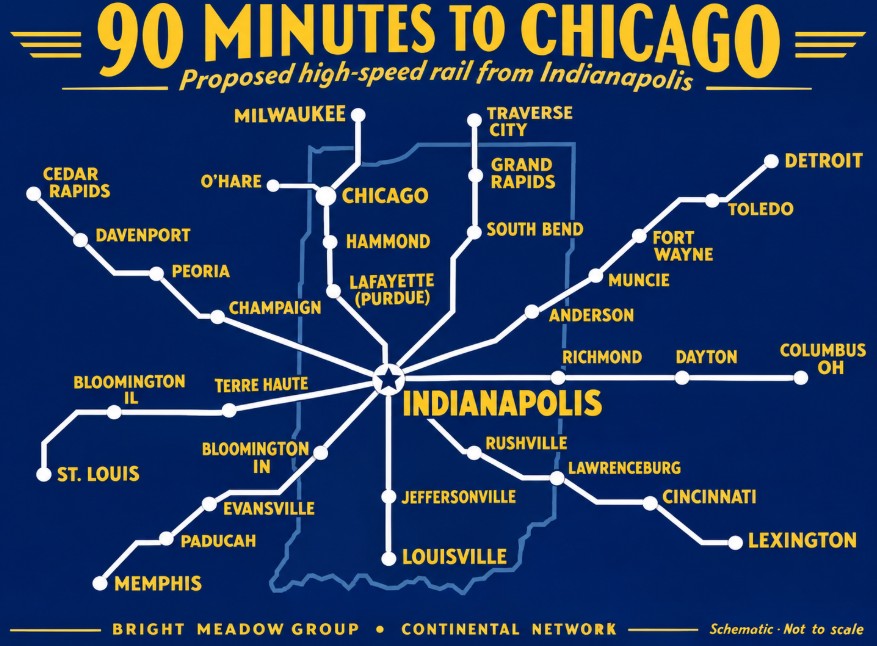
The flagship route is Chicago to Indianapolis. At about 200 miles, high speed trains would turn a three and a half hour drive into roughly ninety minutes, with a stop at O’Hare that gives Indianapolis a back door to international flights. A University of Illinois study in 2013 found that a 220 mph line from Chicago to Indianapolis was feasible and could likely cover its operating costs without subsidies. Fares on a busy corridor can pay to run the trains. Building the line gets paid for the same way I-65 was, because nobody expects a highway to pay for itself out of the gas tax.
The Chicago line crosses a state line, and two-state projects can stall for years. So Indiana shouldn’t wait for its neighbors. It should start with legs that stay inside the state and connect the universities:
- Indianapolis to Lafayette and Purdue, which is also the first 65 miles of the Chicago line
- Indianapolis to Bloomington and IU
- Indianapolis to Terre Haute, Indiana State, and Rose-Hulman, which is also the start of the St. Louis line
- Indianapolis to Fort Wayne by way of Anderson and Muncie
- Indianapolis to South Bend and Notre Dame
- Indianapolis to Rushville, on the way to Cincinnati
Those lines connect the capital to the state’s second-largest city and to five university towns. They’d have riders from the first day, and the state wouldn’t have to negotiate with anyone to build them.
Build to the border and wait
Once the internal ring is running, extend each line to the state line and stop there. Indiana’s side of several borders already belongs to the next state’s metro area. Jeffersonville sits across the river from downtown Louisville. Lawrenceburg is about twenty minutes from Cincinnati. Richmond is about forty miles from Dayton. Evansville already draws from western Kentucky. Hammond is a Chicago suburb in practice, if not on the map.
A station at Jeffersonville gives Louisville rail service whether Kentucky pays or not. Louisville riders cross the bridge, and Indiana collects the fares and the growth around the station. Once Kentucky, Ohio, and Michigan see their own residents driving to Indiana to catch trains, they’ll have their own reasons to finish the connections. First come, first served.
The full map
When the neighbors join, the spokes run out from Indianapolis like this:
- Lafayette, Chicago, and Milwaukee
- Champaign, Peoria, Davenport, and Cedar Rapids
- Terre Haute, Bloomington IL, and St. Louis
- Bloomington IN, Evansville, Paducah, and Memphis
- Louisville direct
- Rushville, Cincinnati, and Lexington
- Dayton and Columbus
- Fort Wayne, Toledo, and Detroit
- South Bend, Grand Rapids, and Traverse City
Indiana has done this before
The state has already spent big on rail when the case was made as economic development. Indiana put $340 million into double-tracking the South Shore Line, and the West Lake extension, a project of roughly $945 million, finished under budget. Officials projected that the two projects together would draw $2.7 billion in private investment and 6,000 jobs to Northwest Indiana by 2048. The legislature was willing to pay for trains that brought Chicago paychecks home to Lake and Porter counties. A network that makes Indianapolis the capital of the Ohio Valley is the same pitch on a larger scale.
Indiana can make its capital one of the key cities in the Midwest, and possibly in the country, and nothing in its geography stands in the way. Anyone who wants to see Indiana do well should push this idea as hard as they can.
Sources
Series index — https://blueribbonteam.com/high-speed-rail/
- The Keystone Network — https://blueribbonteam.com/blog/2026/01/14/the-keystone-network/
- The Lone Star Junction — https://blueribbonteam.com/blog/2026/10/20/the-lone-star-junction/
- The Continental Spine — https://blueribbonteam.com/blog/2026/10/21/the-continental-spine/
- Two Lanes to Anchorage — https://blueribbonteam.com/blog/2026/11/05/two-lanes-to-anchorage/
- Second Shift — https://blueribbonteam.com/blog/2026/11/07/second-shift/
- The Head Start — https://blueribbonteam.com/blog/2026/11/09/the-head-start/
- The Great Connection — https://blueribbonteam.com/blog/2026/11/11/the-great-connection/
- The Three-Nation Line — https://blueribbonteam.com/blog/2026/11/14/the-three-nation-line/
- The Chicago Hub — https://blueribbonteam.com/blog/2026/11/16/the-chicago-hub/
- The Plains Spine — https://blueribbonteam.com/blog/2026/11/19/the-plains-spine/
- The Central Transcontinental — https://blueribbonteam.com/blog/2026/11/20/the-central-transcontinental/
- The Continental Network — https://blueribbonteam.com/blog/2026/11/23/the-continental-network/
- The Second Wave — https://blueribbonteam.com/blog/2026/11/23/the-second-wave/
- Sin City Spider — https://blueribbonteam.com/blog/2026/11/24/sin-city-spider/
- Hotlanta Hub — https://blueribbonteam.com/blog/2026/11/25/hotlanta-hub/
- The Rolling Post Office — https://blueribbonteam.com/blog/2026/11/25/the-rolling-post-office/
- KCKMo Hub — https://blueribbonteam.com/blog/2026/11/25/kckmo-hub/
- Railway Age, “Remembering the Hoosier State (1980–2019)”
- Wikipedia, “Indianapolis Union Station” and “Hoosier State (train)”
- High Speed Rail Alliance, “Indiana: Made for High-Speed Rail”
- Streetsblog USA, “Chicago to St. Louis Is the High-Speed Rail Test America Can’t Afford to Fail” (March 2026)
- Progressive Railroading, “University of Illinois study: 220-mph high-speed line from Chicago to Champaign-Urbana and beyond is feasible” (Oct 2013)
- Rep. Frank Mrvan, “South Shore’s Double Track Finally Arrives”
- Mass Transit, “Indiana completes West Lake Corridor Project on South Shore Line under budget”
- U.S. DOT, West Lake Corridor $354.6 million grant agreement announcement (Oct 2020)