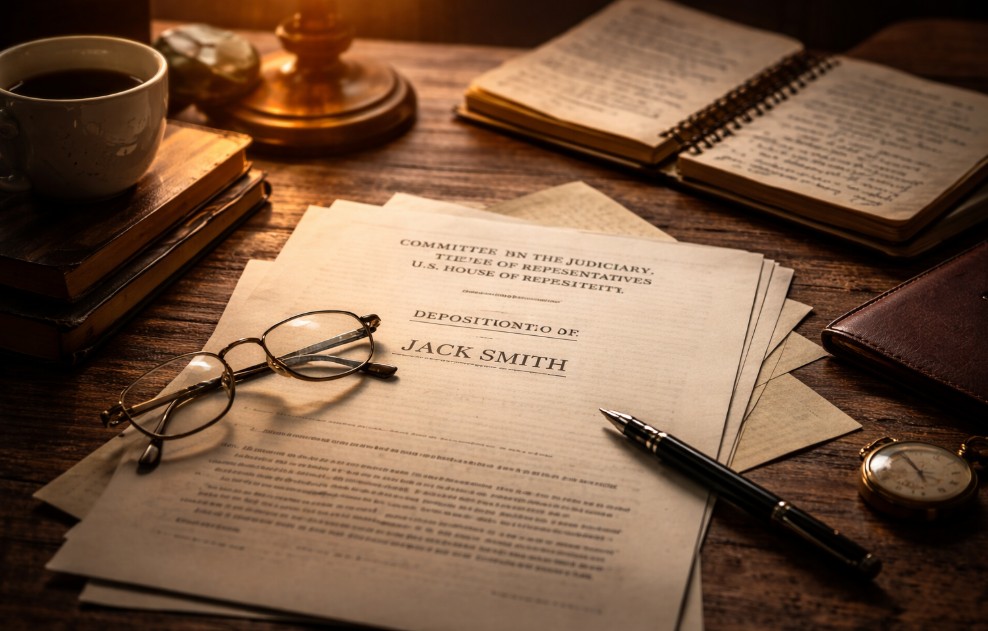
I woke up to a windstorm with a typical bout of insomnia to find the hearing had been released.
That is not a metaphor. It is simply where I was when the record stopped being rumor and became something sturdier. Grammina used to say that most civic disasters begin when people confuse noise for weather. “Storms announce themselves,” she’d mutter, tightening a jar lid. “Wind just wants attention.”
For a long while now, we have lived in wind.
Speculation. Performative certainty. Outrage marketed as foresight. Everyone seemed to know what Jack Smith represented, what he meant, what his work implied — often without ever encountering the work itself. I confess I avoided the clamor. Not out of apathy, but out of discipline. A republic does not survive on instantaneous judgment; it survives on restraint until the facts arrive.
This week, the facts arrived — under oath, before Congress, with counsel present, clocks running, exhibits numbered, and penalties attached for misstatement. That matters more than people seem to realize.
Congressional testimony is not theater when conducted properly. It is one of the few remaining civic rituals where reality is forced to sit still long enough to be examined. In this deposition, a former special counsel did not argue on cable news or issue a press release; he answered questions, acknowledged limits, cited law, and placed responsibility where prosecutors are trained to place it: on evidence and statute, not sentiment.
What struck me most was not the conclusions — reasonable people can disagree there — but the architecture of the exchange. The witness repeatedly emphasized constraint: grand jury secrecy, judicial orders, evidentiary rules, and constitutional boundaries. This was not the language of a zealot. It was the language of someone operating inside a system designed to slow power down, not speed it up.
That distinction matters.
A republic is not built to satisfy our appetite for immediate moral clarity. It is built to prevent certainty from outrunning proof. Madison understood this; so did Adams; so did a quiet Midwestern grandmother who taught me that “truth don’t hurry, Nate — lies do.”
The testimony also exposed something uncomfortable for all factions: process is boring by design. Depositions are procedural, repetitive, and meticulous because liberty depends on friction. When we demand that justice feel dramatic, we invite it to become arbitrary. When we demand that prosecutors speak like politicians, we undermine the very restraint we later insist upon.
I noticed another detail that deserves more attention than it is receiving. The witness acknowledged — plainly — the danger inherent in prosecutorial power. He cited Robert Jackson’s warning that a prosecutor who chooses people rather than crimes becomes a threat to liberty itself. And then, crucially, he affirmed that warning rather than dismissing it. That is not the posture of a man intoxicated by authority; it is the posture of someone aware of standing near a cliff.
Now, let me be clear before someone writes an angry letter: recognizing procedural seriousness is not the same as endorsing every outcome. A republic allows — indeed requires — disagreement. But disagreement must rest on shared reality. Until testimony occurs, we are arguing about shadows. Once it does, we are obligated — morally obligated — to argue with what is actually said, under oath, with consequences attached.
This is where my concern shifts away from personalities and toward culture.
We have grown accustomed to forming judgments before facts are allowed to assemble. We demand verdicts faster than institutions can ethically produce them. Then we accuse those institutions of delay when they refuse to sprint past their own safeguards. This is not republican impatience; it is democratic appetite without discipline.
Grammina used to misquote Cicero by saying, “A loud crowd ain’t a jury, it’s just a feeling.” She was wrong in Latin and right in spirit.
There is also a lesson here that extends beyond this case and into the age now dawning around us. Digital systems — whether prosecutorial databases or artificial intelligences — magnify power through speed. When speed outruns transparency, accountability collapses. The testimony made clear how many legal constraints already exist to prevent misuse of authority. The danger is not that there are too many rules; it is that we are growing culturally hostile to any process that slows us down.
A republic cannot survive that hostility.
The Founders did not fear disagreement; they feared unexamined certainty. That is why they built institutions that force people to explain themselves slowly, in public, under rules they did not write alone. Congressional testimony is one of the last surviving embodiments of that fear — and that wisdom.
I do not ask readers to cheer this testimony. I ask them to respect what it represents: the moment when opinion yields to record, when speculation gives way to sworn answer, and when the republic briefly insists that truth speak at a human pace.
Liberty does not require that we like what we hear.
It requires that we wait until it is said.
Grammina would have put it simpler:
“Before you argue with a man, Nate, make sure he’s actually spoken.”
UPDATE
Every system has a bottom.
Engineers know this. Pilots know this. Farmers know this. There is a point at which stress is no longer theoretical and safety is no longer a promise — only a test. The only question that matters at that moment is not how did we get here, but what happens now.
Fail-safes exist precisely because no system is perfect. They are not optimizations; they are confessions. They acknowledge that defects will emerge and that survival depends on whether the system can identify, isolate, and purge those defects before total failure.
The Jack Smith deposition is not political theater. It is a fail-safe test.
I say this deliberately, and with restraint. I waited for the testimony. I took notes. I ignored the noise. What matters is not tone or allegiance but the fact that, for the first time, the allegations were placed before Congress under oath, with evidentiary definitions substituted for slogans.
That is the moment a republic is designed for.
Roughly half an hour into the testimony, something historically unremarkable — and constitutionally explosive — occurred: a federal prosecutor stated, plainly and without embellishment, that the evidence demonstrated fraud by a sitting President. Not as a tweet. Not as a press release. As sworn testimony.
This is not about manners. It is about architecture.
A republic does not require that prosecutors be polite. It requires that they be precise. And what followed was not a rant but a methodical laying out of legal causation: benefit, foreseeability, proximate cause, obstruction, exploitation of violence, intimidation of witnesses. The language was prosecutorial because it had to be. That is how facts are moved from accusation to record.
When asked whether the President was responsible for the violence of January 6th, the response was devastating precisely because it was narrow: caused, exploited, foreseeable. No theatrics. Just elements.
When pressed on whether there was evidence of a direct command to “crash the Capitol,” the answer was not evasive. It was instructional. Systems fail not only through orders, but through incentives, amplification, and refusal to intervene once a process has destabilized. Any engineer understands this. Any mob boss does too.
What followed was not speculation but pattern recognition: the creation of anger, the deliberate feeding of it, the refusal to stop it, and the subsequent pressure campaign to delay lawful proceedings. This is how prosecutors talk when they believe the record is already strong.
Then came the threats. Not hypothetical. Not imagined. Listed calmly, almost wearily. And still, the witness did not posture. He did not dramatize. He did what professionals do when the work is solid: he moved on.
At this point — less than an hour in — the issue ceased to be Donald Trump and became something larger and more uncomfortable.
Because here is the structural problem: Congress now possesses sworn testimony alleging an ongoing criminal conspiracy by a sitting President. The testimony is not anonymous. It is not leaked. It is not speculative. It exists in the Congressional record.
A fail-safe has been triggered.
Every system must respond when this happens. Either the defect is isolated and addressed, or the system reveals that it has no meaningful bottom — only collapse.
What followed in the hearing only sharpened this reality. Judges had already reviewed the subpoenas. Judges had already agreed that obstruction risks existed. Judges had already signed orders. The argument was no longer whether the process was reckless, but whether Congress was comfortable being observed while participating in it.
The debate over toll records revealed this anxiety clearly. Yes, there are legitimate civil-liberty concerns. But the justification for obtaining them — obstruction, witness intimidation, destruction of evidence — had already been reviewed and upheld. The system had already checked itself. Multiple times.
An hour in, questions turned to DOJ oversight. The answer was obvious to anyone who has worked in high-risk environments: when the stakes are existential, you double-check everything. Public Integrity exists for a reason. Consultation is not collusion; it is insulation.
At one point, a committee member attempted to corner the witness on risk assessment — implying that uncertainty justified inaction. The response was instantaneous and revealing: the responsibility was his. He owned it. And then he moved forward.
That is what integrity looks like under pressure.
As the hearing continued, something else became unmistakable: this was not an attempt to destroy Jack Smith. It was an attempt to transition away from Trump without detonating the institution. The questions, the framing, the insistence on privacy — all of it suggested a system attempting to shed a failing component while preserving its own legitimacy.
And this is where the fail-safe question becomes unavoidable.
If Congress does not act on sworn testimony of this magnitude — not rhetorically, not symbolically, but procedurally — then the conclusion is not that the accusations were false. The conclusion is that the system lacks a functioning bottom.
At that point, failure is not a risk; it is a schedule.
Systems that cannot purge defects do not evolve. They overheat. They fracture. They burn credibility until nothing is left but motion without authority. A constitution that cannot respond to evidence ceases to be law and becomes literature.
I do not say this lightly, and I do not say it gleefully. This is not alarmism. This is engineering.
The fail-safe has been engaged. The record exists. The load is now on Congress.
What happens next will tell us whether the American system corrects — or resets.
Grammina would have said it simpler:
“When the floor gives way, Nate, you find out if the house was built with a cellar — or just a lie.”