The Porch That Saw Everything
There is a particular kind of grief that comes from watching something magnificent survive its own desecration. The Queen Anne porch knows this grief intimately. It wears it the way this one wears its taupe — dutifully, without complaint, underneath which you can still see the bones of something that once announced itself to the whole street in five colors like a brass band at a funeral, which is to say: inappropriately glorious, and completely correct.
The Queen Anne porch was not built to be subtle. It was built to be inhabited. Not decorated. Not photographed for a real estate listing. Inhabited — in the old sense, the way a tree inhabits a hillside, putting down weight and intention and saying I am here and I have opinions about it.
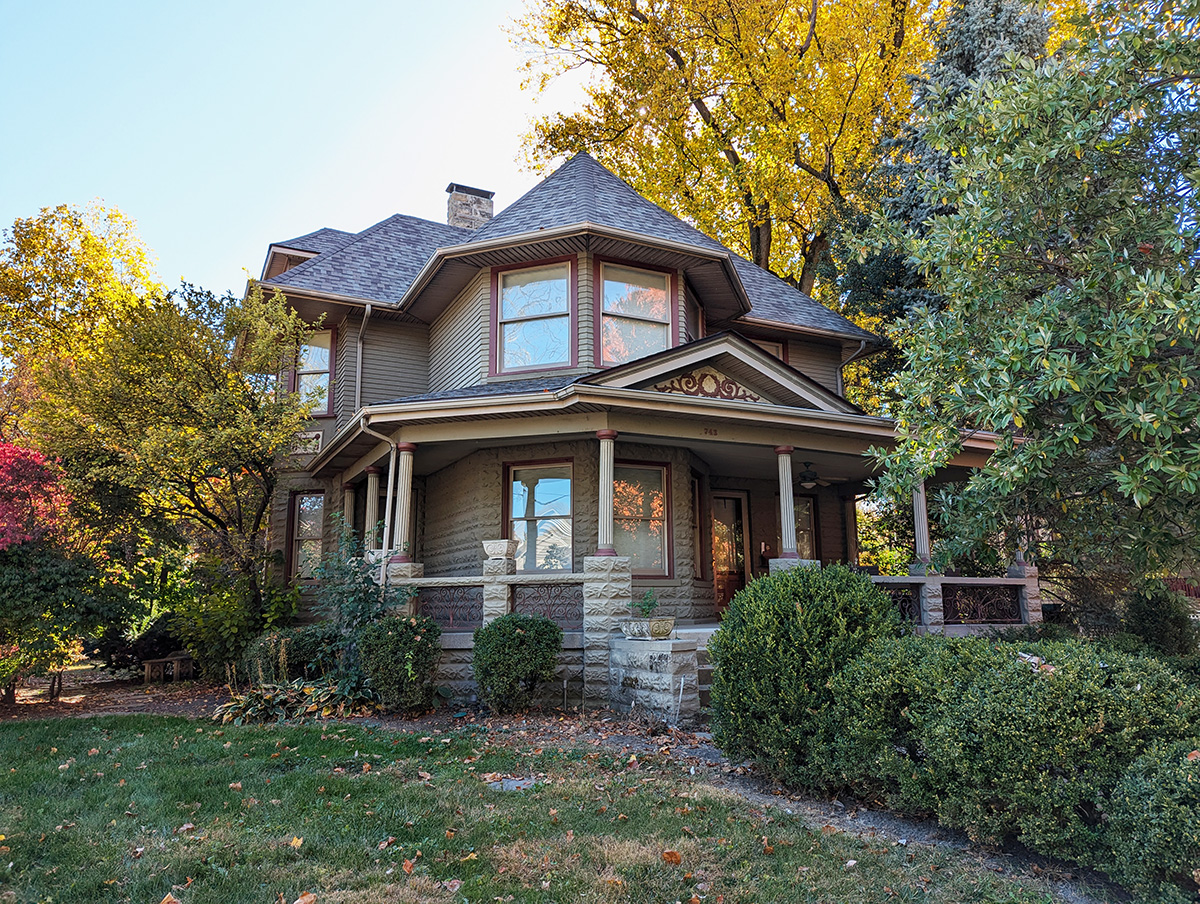
Look at what the porch actually does, structurally. The wraparound does not merely extend the house outward; it rotates the house’s relationship to the world. A flat-front porch says: here is the entrance, approach it directly. The wraparound says: come from wherever you are coming from. It catches the street at an angle, catches the neighbor’s yard, catches the afternoon light from the west and the morning coffee hour from the east, and it does all of this simultaneously. It is architecturally omnidirectional. It is, in the truest sense, a room that that is unlimited by walls.
The columns matter. These fluted Ionic shafts rising from their rusticated stone piers are not decorative in the diminished modern sense — they are load-bearing theater. They hold the porch roof up, yes, but they also hold the social contract up. They say: this threshold has been given weight. Entering here is not nothing. You are being received.
The wraparound porch was the original social media. Every transaction of neighborhood life passed through it — the doctor’s visit announced by a rocking chair pulled to the rail, the courtship conducted in the amber light of a porch lamp, the political argument that lasted three summers, the summer the widow next door came every evening and nobody asked why and nobody had to. The porch absorbed all of it because it was designed to. It was designed with the understanding that human beings require a semipublic zone — not the street, not the parlor, but the membrane between them where you could be both alone and available, both domestic and civic, both yourself and a neighbor.
This one — buried under its decade of contractor beige, its window trim reduced from burgundy-and-cream-and-ochre-and-slate to a single apologetic brown — still has all of it. You can see it in the scroll ornament over the entry gable, still curling with something like defiance. You can see it in the way the porch wraps left and right, offering more square footage of lived-in exterior than most modern houses offer in their living rooms. You can see it in the rusticated stone panels between the piers, those little carved rosettes sitting there like a forgotten vocabulary waiting for someone to start speaking it again.
The original five-color Queen Anne was not vanity. It was legibility. The polychrome scheme was the house reading itself aloud — this is a column capital, this is a shadow line, this is a carved panel, pay attention, each of these things was made by a person’s hands and deserves to be seen as a distinct thing. The Eddie Bauer moment flattened all of that. It said: we have achieved a color called “greige” and we are done. It turned a conversation into a monologue. It took a brass band and gave it one instrument, tuned slightly flat.
Now look harder at the turret, because the turret is the whole argument in one gesture. Most people look at a Queen Anne turret and think: decorative excess. Wrong. The turret is a load-distribution solution that also happens to be beautiful, which is the best kind of solution. The octagonal bay pulls the corner of the house off the standard rectangular grid and in doing so creates interior room shapes that have no modern equivalent — wedge-shaped sitting alcoves, curved window seats, morning rooms that feel like being inside a lantern. Builders of the 1890s understood that the shape of a room changes how a person feels in it, and they charged extra for the good feelings, and people paid. The market, for once, was right.
The roof above it is a hipped witch’s hat form — steeply pitched, cedar-shingled originally, now in a thirty-year architectural composite that is honest about what it is even if it isn’t beautiful. The pitch matters. A low-pitched roof on a Queen Anne is an architectural lie, a body with the wrong head. The steep pitch creates the vertical drama that the wraparound porch answers horizontally. The whole composition is a conversation between height and spread, between the house reaching up and the house reaching out, and the porch is where those two impulses meet and decide to get along.
The porch frieze — that band running between the column capitals and the porch ceiling — is where a lot of Queen Annes got their most elaborate ornamental work, spindle work and turned balusters assembled into what the trade called a spindled frieze, essentially lace made out of lathe-turned pine. This one’s frieze is intact, which is not nothing. Restoration people will tell you the frieze is usually the first thing to go, replaced with flat fascia board by someone in 1967 who decided the spindles were a painting problem rather than an architectural asset. That this one survived says something about the house, or about its owners, or about dumb luck, and probably all three.
The entry surround — the gable above the porch door with its scroll and medallion ornament — is lifted almost directly from the pattern books. Palliser, Palliser and Company. Shoppell’s Modern Houses. Every Queen Anne of this vintage was built from a catalog, which sounds like a diminishment until you realize that the catalog was running three hundred pages and the options included things like degree of bracket elaboration and preferred style of vergeboards. This was mass customization in 1895, and it produced an architectural vocabulary so varied that no two Queen Annes on the same block look exactly alike even when they came out of the same book. Compare that to a subdivision built in 2004.
The porch persists. It is patient. It has outlasted the people who built it, outlasted the fashions that buried it, and it will almost certainly outlast the greige. It knows what it is. It was built by people who understood that a house is not a shelter. A shelter is what you build when you are afraid. A house — a house, with a wraparound porch and five colors and columns that stand at attention in the October light — a house is what you build when you are ready to be a neighbor.
This one is ready. It has always been ready.
It is simply waiting for someone to bring back the paint.