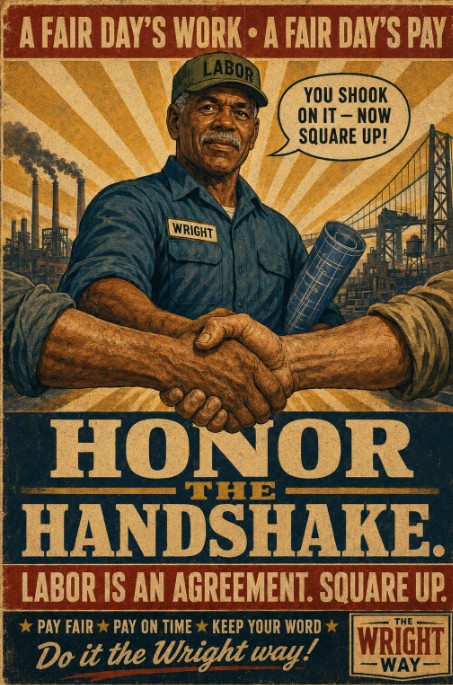
Name’s Wright. Mister Wright if you’re on the clock.
There’s an old commandment about not taking a name in vain. I keep one right beside it, and it’s served me just as long: don’t take another person’s labor in vain. A working man honors honest work — with his hands, with his mouth, and with his checkbook.
That rule is older than any shop I’ve ever walked into. Somebody gives you their time, lends you their skill, shows up when you call — you square up. Fair. On time. No stories attached. Labor is an agreement. You shook on it the minute you let a man pick up a tool on your behalf, and a handshake you can walk away from was never worth much to begin with.
Money’s where most folks get cute, so I’ll start there. I don’t care if it’s a helper, a contractor, a sub, or a friend doing you a solid on a Saturday. If you benefited from the effort, you pay for the effort. Same as you’d want if the boots were on the other feet. There are no discounts for ego. There’s no excuse that gets prettier when you dress it up in the words “cash flow.” A man who stiffs his help has told you exactly what his word weighs, and he’s done it in front of witnesses.
My old man carried bags on the railroad — Pullman porter, thirty-some years — and he put it plain. “Son, if you can’t afford to pay a man, you can’t afford the job.” Simple math. Honest math. He named me after A. Philip Randolph, who organized the porters back when organizing could cost you the only work you had. Randolph organized for dignity — the plain dignity of having your labor counted as your own, owed to you before the first nickel ever changes hands.
Money’s only the front door, though. There are slower ways to take a person’s labor in vain, and they leave a worse mark.
You take it when you waste a man’s time — keep him standing, send him back twice for what you should have said once, spend his afternoon like it’s yours to spend. Measure twice, act once; that reaches well past the lumber. It’s a courtesy you owe anybody waiting on your decision.
You take it when you wreck good work by rushing in behind it. A fellow lays a clean line, sweats the detail, and somebody barrels through to hit a number and undoes a day’s care in ten minutes. The work was honest. What followed it carried his name and none of his craft.
And you take it worst of all when you put your name on what another set of hands carried. Stand up at the meeting, take the nod, let the room believe it came easy and came from you. I’ve watched men build a whole reputation out of other people’s mornings. It holds up about as long as you’d expect.
Here’s the part the slick ones never figure: word gets around. Always has, always will. A shop is a small town with a roof on it. Mess with a person’s pay or their good name, and you’ll find doors easing shut that you didn’t even know were holding you up. You don’t get to pick which bridges matter. You learn that the day you need to cross one. A man who treats labor like it’s optional has gone broke in the one account that never shows up on a balance sheet.
Let me give you the other way, because I’d rather build a thing than warn you off one.
You honor labor by naming it out loud. You say whose hands did the work, in the room where it counts, on the day it costs you a little of your own shine to say it. You pay before you’re chased for it. You guard the next man’s time the way you’d want yours guarded. You leave his good work better than you found it, or you leave it be.
Do that, and something happens no contract can force. People start working for you the way they’d work for themselves. They cover the gap you didn’t see. They tell you the truth before it gets expensive. That’s trust, and trust is the only tool I know that gets sharper the more you use it.
That’s how shops stay solid. That’s how a working man keeps his word clean. That’s how a country full of hands holds itself together when the folks up top forget who built the place.
Respect is the first safety rule. It always was.
Don’t take another person’s labor in vain.
Call it ethics if you want. Down on the floor, we just call it doing business the Wright way.
Now you know, Jack.