A recycled-glass manufacturing concept for Johnstown
Western Pennsylvania throws its glass away. Across the region’s recycling programs, paper moves, metal moves, some plastics move, and glass falls through the floor of the system. It is heavy enough that hauling it for the value it carries rarely pays. Single-stream collection contaminates it past the point where buyers will take it clean. It grinds down the sorting equipment it passes through. So it enters the waste system as a cost and leaves it as landfill fill. The few manufacturers who want clean cullet bring it in from a distance. The material runs in one direction, into the ground, with no path back.
There is an opportunity inside that one-way flow. A waste stream a county pays to bury is, from the other end, a feedstock that arrives already collected and nearly free to anyone positioned to use it where it lands. The same freight arithmetic that sends raw silica to be processed at the mouth of the mine sends recycled glass to be used close to where it is discarded. Distance is the enemy of cheap, heavy material, and Johnstown has the proximity.
Observe
Because the economics are structural, the gap is a standing feature of how the region handles glass, and a stable problem is a foundation to build on. Glass is the hardest material in every regional recovery facility to move, and the numbers push it toward burial every time.
Johnstown holds the rest of what a glass operation needs. The town is dense with mothballed industrial space, much of it already carrying heat and three-phase power, much of it held by owners and a redevelopment apparatus whose purpose is to fill it. The workforce carries manufacturing in its hands — furnace tending, line discipline, the maintenance instinct that keeps hot equipment running through a night shift. These are the exact requirements of a melt operation, and they sit idle.
The residential glass market standardized itself while the craft trade looked elsewhere. The vinyl-replacement-window and tract-housing industries reduced home glazing to a short list of repeated dimensions — door lites, sidelights, transoms, the common double-hung sizes — stamped across millions of houses. The single-craft stained glass world never reached this market, because it produces one-offs priced as art. A catalog product cut to those standard openings is a different category of object, and that category is empty.
Low-grade recycled glass is more than adequate for the product this gap calls for. Decorative architectural glass is judged on color and light. The optical and semiconductor purity that virgin high-grade quartz exists to provide has no bearing here. The seeded, slightly irregular character of remelted post-consumer cullet reads as handmade. The improvement on offer is aesthetic: builder-grade glazing is uniform and widely disliked, and the side-door window is the most identical and most resented pane in the American house — small, cheap to produce, cheap to ship, and ugly enough that one before-and-after photograph makes the case.
Design
The product is a standardized decorative glass overlay, cut to the common residential openings and sold as a no-tool interior cover that holds over the existing pane by magnet or snap surround. The homeowner installs it in a minute, voids no warranty, and calls no glazier. The mounting carries as much weight as the glass; a beautiful panel with no way to hang reaches no wall.
The catalog is the lasting asset. Run on the home-décor model, it is a deliberately limited library of twenty to thirty repeating patterns, marketed in regional rotations so the line stays fresh without constant retooling. A small, strong library and a working sales channel are the durable core, and the manufacturing behind them can be built and expanded as orders justify.
The supply loop is the civic spine. County waste glass, sorted and crushed and recooked into feedstock, turns a disposal cost into a raw input. Sorting by glass type and color is the quality gate — compatible soda-lime stock behaves predictably under heat, and disciplined sorting is the step that turns mixed waste into reliable melt. The sorting that defeats glass recycling at industrial scale becomes ordinary quality control at this scale, because the work is selective by design.
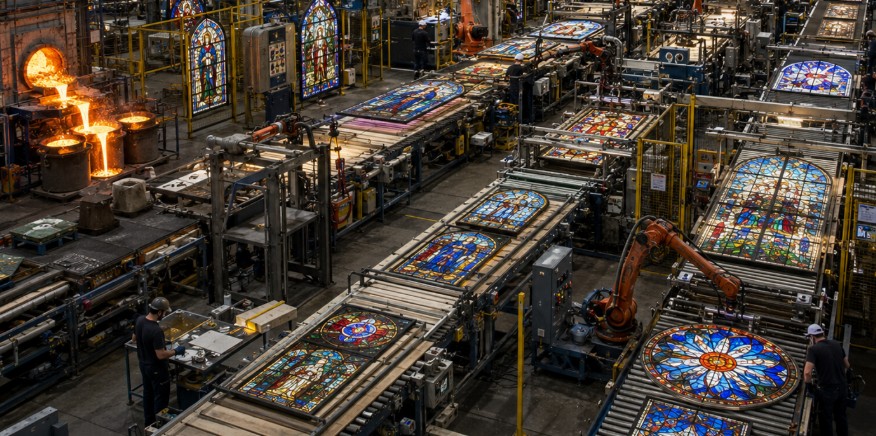
Several methods could carry the product to finished form. Cast or fused frit panels, made in reusable molds, yield real glass melted on site, scaled by replicating the mold so output rises while labor holds steady — the route that carries the sort-crush-recook loop all the way through to the object. Resin-flood panels need no furnace and reach first revenue fastest, a way into the line before the furnace is standing. A hybrid, in which the frame is manufactured to standard and only the glass insert varies, is the version that most wants a building and a crew. Each method trades capital, fidelity, and speed against the others, and a real operation would likely move through more than one as it grows.
All three share a single feature: the look is separated from the cutting. Packing a mold and tending a firing schedule replaces scoring and snapping sheet by hand. That removes the dominant injury of traditional glasswork and lowers labor cost in the same motion, which opens the work to shift labor — the kind a manufacturing town already has in depth.
The path to market is direct. Lead with the single most common opening size at a low anchor price, enough to seed the market and put the product in front of buyers. The full size-and-design price sheet carries the long tail and shows which of the remaining shapes to make next, so demand sets the tooling order.
Intervene
The first phase proves the product small and cheap and turns interest into written orders. A signed order book arrives at the table with demand already in hand, a footing from which to ask for the rest.
The second phase brings that order book and the design library to the people whose work is putting jobs into empty buildings — the Johnstown Redevelopment Authority and the Cambria County economic-development office. The ask is space, incentives, and workforce, presented as a job-creating tenancy. The capital that closes the gap in a distressed post-industrial place comes from the stack built for that purpose: state manufacturing and reshoring programs, Appalachian Regional Commission funding, brownfield money, and local foundations whose mandate is Johnstown employment. A mission-based organization like The Cernunnos Foundation can serve as the vehicle for the civic and philanthropic capital aimed at exactly this kind of work.
The feedstock partnership runs through the county and municipal waste authorities and the regional recovery facilities, which hand over a stream they presently pay to bury. Volume melting is a permitted activity, with air and crystalline-silica controls that come with the territory — the kind of process an economic-development office helps a wanted tenant navigate. A job-creating local project draws that help where an outside stranger would not.
The Return
One intervention returns on three axes at once. It diverts a waste stream the region currently pays to bury, closing a recycling gap at home instead of shipping the problem downstream. It stands a manufacturing line on idle buildings and idle hands, rebuilding local employment and tax base out of capacity the town already owns. And it improves the built environment at scale, replacing the cheapest and most disliked pane in millions of houses with something worth looking at.
A town gets a mill back. A county empties a corner of its landfill. Suburbia grows a little less ugly. All of it from a single line running second-melt glass.