There is a week-old jar of honey on my kitchen table that I have been meaning to give to my neighbor, and this morning, reading the news out of South Carolina, I found myself staring at it instead. A senator died on a Saturday night. By Monday afternoon a governor had named his successor, and by Monday evening the country had worked itself into a froth over the indignity of it — a senator appointed, imagine, by a mere elected governor of a sovereign state, rather than properly anointed by television advertising and small-dollar fundraising emails.
I confess the froth puzzled me more than the appointment did.
For the first hundred and twenty-four years of this republic, no citizen ever cast a direct vote for a United States senator. The Framers built it that way deliberately, and their reasoning was structural rather than snobbish. The House belonged to the people; the Senate belonged to the states. Each state legislature sent two agents to the federal capital, and those agents answered to the governments that sent them. This gave the states a hand on the federal machine from the inside — a seat at the table where the table was built. Madison called the arrangement a compound republic, and he meant the compound part. Two distinct sovereignties, each watching the other, each holding a lever.
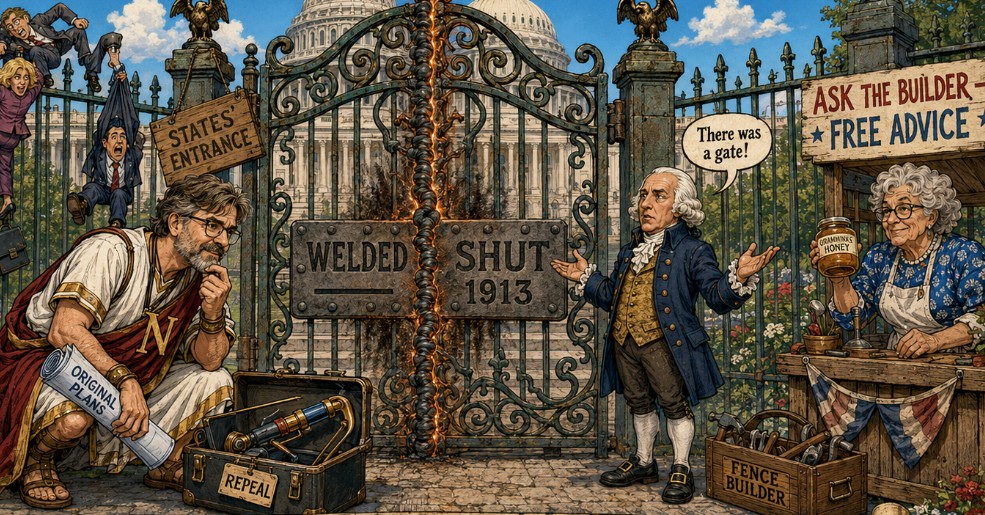
The Seventeenth Amendment removed the states’ lever in 1913, and we have spent a century calling the removal progress. What we actually did was convert the Senate into a second House — a chamber of statewide celebrities, elected by the same passions, funded by the same donors, answerable to the same cable-news weather that governs everything else. The states, as governments, lost their voice in the federal government entirely. They kept their flags and their fairgrounds. They lost their seat at the table.
I will grant the reformers of 1913 their evidence. State legislatures of the Gilded Age sold Senate seats the way railroads sold right-of-way, and some deadlocked so thoroughly that seats sat empty for years. Delaware once went without a senator long enough for the vacancy to register to vote. Those were real failures. But the remedy for a corrupted institution is to clean the institution; we amputated it instead, and then wondered for a hundred years why federalism walks with a limp.
So here is what an old man at a kitchen table would propose, if anyone were fool enough to ask him. Give each state its two senators by two different roads: one appointed by the governor, one chosen by the state legislature. The governor’s senator carries the voice of the state’s executive; the legislature’s senator carries the voice of its assembled representatives. Stagger their terms. Let each state government live with its choices in full view of the voters who elect it — because the accountability never disappears in this design, it simply moves to where the Framers put it, in the statehouse elections every citizen already votes in. A senator who embarrasses Pennsylvania embarrasses the governor and legislature who sent him, and Pennsylvanians know where those people live.
And if we wished to finish the restoration, we might ask whether the presidency, too, has been improved by its transformation into a two-year entertainment product. The combined chambers of Congress electing the executive would give us presidents chosen by people who have watched the candidates work — which is roughly how every functioning board, vestry, and volunteer fire company on earth selects its leadership. But that is a letter for another month.
I know my own weakness here, and I will name it. I like this design partly because I am the sort of man who trusts deliberation over enthusiasm, and there is vanity in that preference; the enthusiasts are sometimes right and the deliberators are sometimes merely slow. A restored Senate would produce its share of hacks, brothers-in-law, and grey men of no distinction. So does the current one. The question was never whether we can eliminate mediocrity — we cannot — but which structure keeps the states inside the federal conversation and which one leaves them shouting through the window. This week a governor appointed a senator, the last small surviving fragment of the original machinery turned over once, and the country called it a scandal. The scandal is that we no longer recognize our own architecture when it works.
Grammina used to say — she claimed it was Jefferson, though I have never found it in him — “Nate, the man who built the fence knew where the gate was. Ask him before you weld it shut.”
We welded a gate shut in 1913. It might be time to ask the builder why he put it there.
Liberty is the harvest of restraint — and so, it turns out, is the Senate.