Prophetstown State Park, Tippecanoe County, Indiana
A few miles from Battle Ground, where a monument and a museum stand over the ground where William Henry Harrison’s army camped in 1811, there is a smaller park along the Wabash. It has a gift shop with short hours, a sample village of a couple of structures, a stretch of riverbank, and a field with a loop trail around it. The trail is a pleasant walk. On an October afternoon you could go the whole way around and come away thinking you had seen a nice bit of restored prairie and not much else.
On the back side of the loop stands a sycamore.
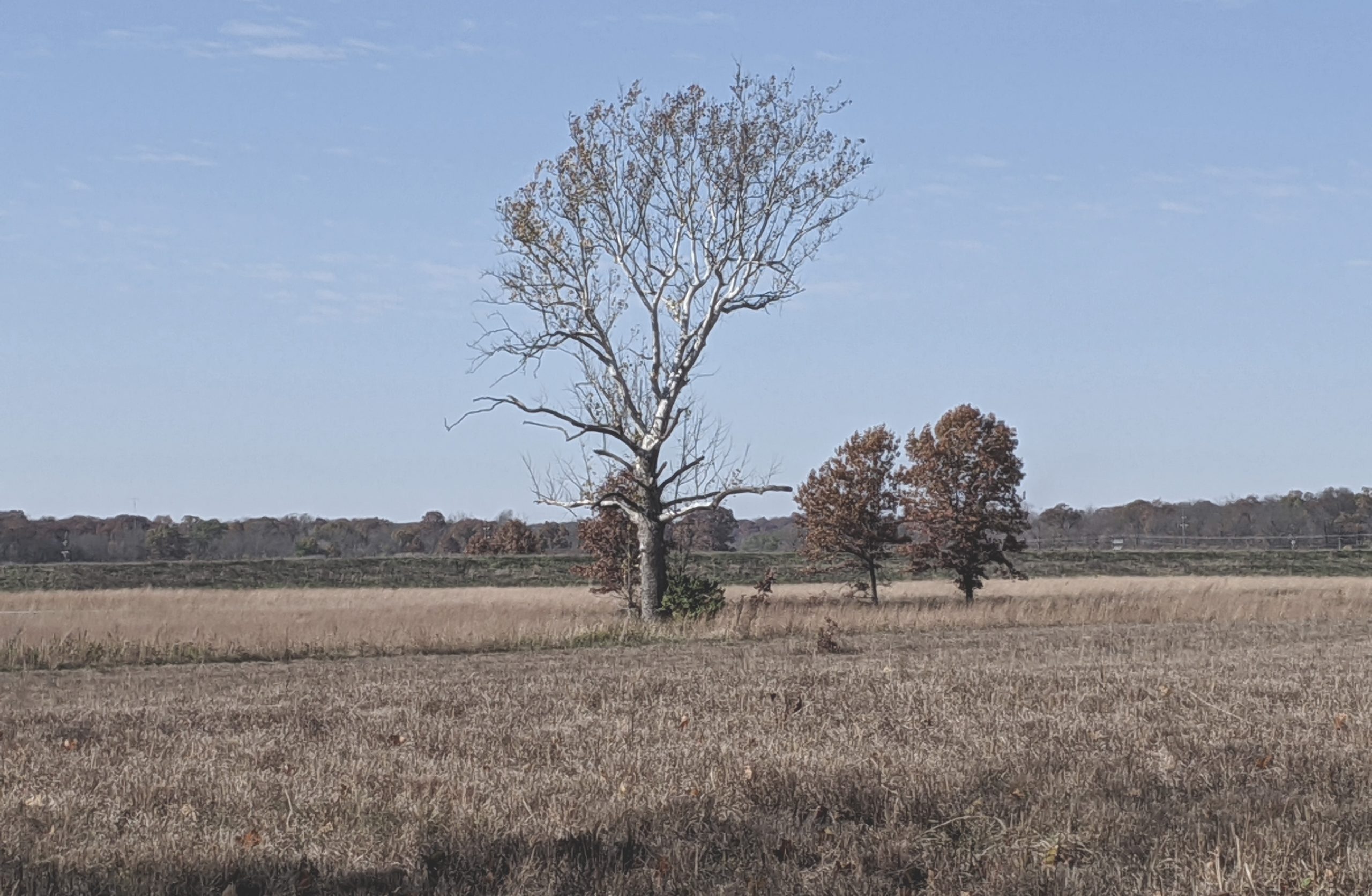
It holds the field by itself, the way a lighthouse holds the end of a breakwater. The upper limbs are bone white against the sky, as if someone dipped the crown in whitewash and left the trunk to weather on its own. Sycamore bark can’t stretch as the tree grows, so it splits and sheds in plates, and the young bark underneath comes up pale as a peeled willow switch. Down low the trunk keeps its older coat of gray and brown. Up high, where the wood is younger, the tree goes white. By mid-October it had dropped a good share of its leaves and held the rest in curled brown clusters, along with the seed balls that will hang on into winter. A young evergreen has tucked itself against the base like a dog lying at its owner’s feet, and a pair of oaks off to the east still held their rust-colored leaves, as oaks tend to do into late fall.
We spent some time with it. Sycamores are bottomland trees, and their kind usually crowd the river edges, shouldering each other for light. This one grew up in the open and spread out accordingly, low-forked and wide, with limbs reaching off in several directions like fingers on a hand held up against the sun. Some of the lower branches are dead and gray. A few of the higher ones have snapped off. It has been through weather.
My guess, and only a guess, is that a tree this size in rich river soil might be a century old, give or take. That would make it too young to have seen what happened here. Its grandparents might have.
The town on the field
In 1805 a Shawnee man named Lalawethika fell into a trance, woke with a vision, and took a new name: Tenskwatawa, the Open Door. He began preaching a return to the old ways. Put down the whiskey. Give up the trade goods and the habits that came with them. Stop selling land. Stand together as one people. His older brother Tecumseh carried the political half of the message, and carried it farther. The land, he argued, belonged to the nations in common, so no single tribe had the right to sign it away.
The brothers first gathered followers at Greenville, Ohio. In 1808 they moved west to the place where the Tippecanoe runs into the Wabash and built a town. The Americans called it Prophetstown. People came from the Shawnee, Delaware, Potawatomi, Kickapoo, Wyandot, Ojibwe, Ottawa, Ho-Chunk, and others, some to stay and some to listen and carry the message home. For a few years the field around this sycamore served as the capital of an idea: that the nations east of the Mississippi could hold the line together where they had been losing it one treaty at a time.
The treaties kept coming. In 1809, at Fort Wayne, Harrison, then governor of Indiana Territory, bought roughly three million acres from a handful of Miami, Delaware, and Potawatomi leaders. Tecumseh rejected the sale and told Harrison so to his face at Vincennes the following summer. The two men met again in 1811. Then Tecumseh went south to recruit the Creek, Choctaw, and Chickasaw, and left his brother in charge with instructions to avoid a fight.
Harrison marched up the Wabash that fall with about a thousand men and made camp within reach of the town. Before dawn on November 7, 1811, warriors from Prophetstown attacked the camp. The fighting went on for a couple of hours in the dark and the early light. Harrison’s line held, and the warriors pulled back. The next day his troops found the town empty. They burned it, along with the corn stored for winter.
Some of the people came back and rebuilt. Kentucky militia burned the town again late in 1812. Tecumseh threw in with the British in the war that followed and was killed at the Battle of the Thames, in Upper Canada, in October 1813. The confederacy came apart with him. Tenskwatawa lived for years in Canada, later moved west with the Shawnee as they were pushed out of Ohio, and died in Kansas in 1836. Harrison rode the name “Tippecanoe” into the White House in 1840.
Battle Ground marks the night the plan failed. Prophetstown is where the plan was drawn up, argued over, and lived in. The battlefield got the obelisk. The town got a field, a loop trail, and a gift shop that closes early. For anyone trying to understand the last organized stand of the Shawnee and their allies east of the Mississippi, the field holds more of the story, and gets a fraction of the attention.
What stays
Sycamore seed balls break apart in late winter and early spring. The seeds ride the wind on tufts of fine hair, and the ones that land on water ride the river. The Wabash has been carrying sycamore seed downstream since long before anyone built a town at the mouth of the Tippecanoe, and it carried it the year after the town burned, and it will carry this tree’s seed come March. Old sycamores go hollow at the heart and keep living around the hollow, sheltering whatever crawls inside. People along these rivers once burned and scraped out sycamore logs to make dugout canoes.
We left the tree where we found it, standing white-topped at the far side of the field, and walked the rest of the loop back toward the gift shop before it closed.
Background reading:
- Indiana DNR, Prophetstown State Park
- Tippecanoe Battlefield Museum, Battle Ground, Indiana
- R. David Edmunds, The Shawnee Prophet (1983)
- R. David Edmunds, Tecumseh and the Quest for Indian Leadership (1984)
- Adam Jortner, The Gods of Prophetstown (2012)